
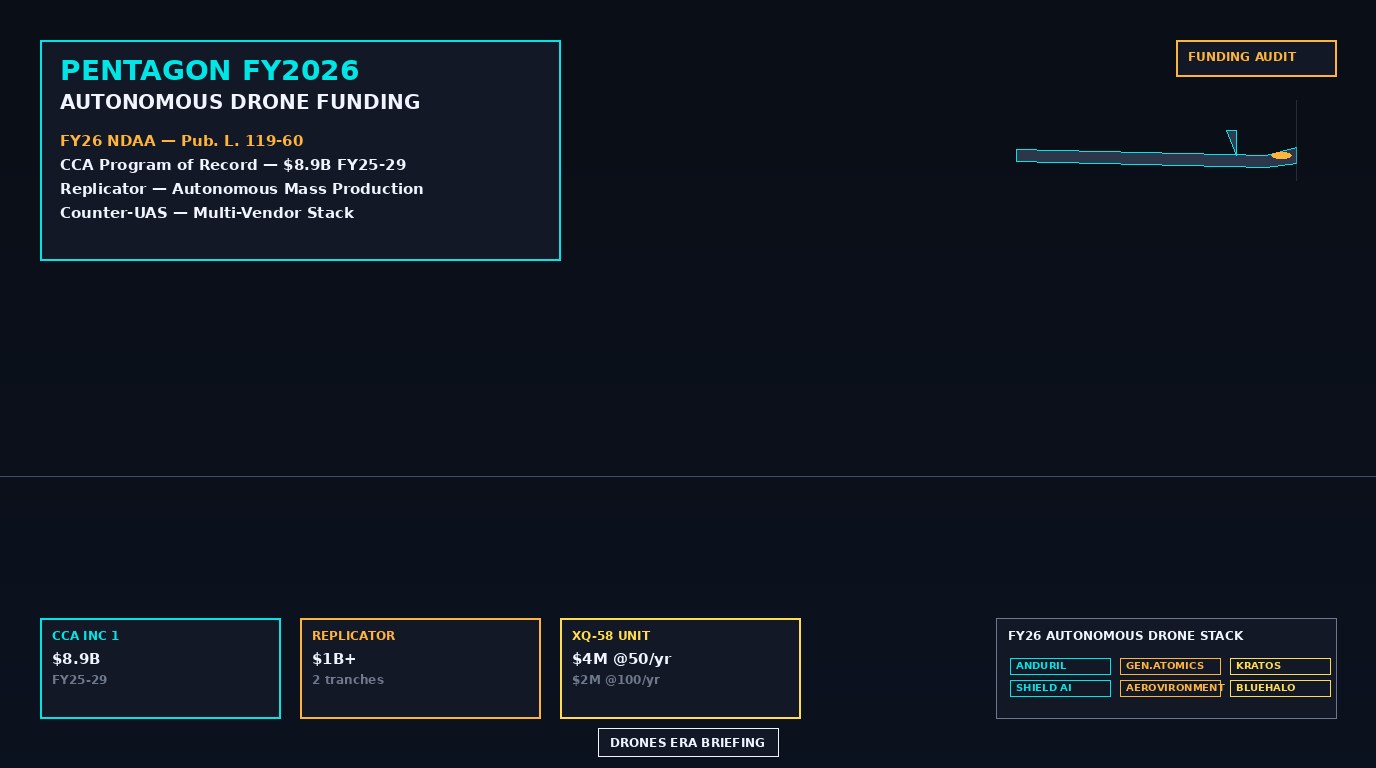
The Pentagon’s autonomous-drone spending picture in fiscal year 2026 is not a single $54 billion line item — it is a stack of programs that add up to multi-billion-dollar annual commitments across the Air Force, Navy, and Army. The honest framing for defense procurement officers, federal contractors, and industry analysts starts with three program families: the Department of Defense’s Replicator initiative (now in its second tranche), the Collaborative Combat Aircraft (CCA) program at $8.9 billion across fiscal years 2025 to 2029, and a layered counter-UAS spending stack that runs through AeroVironment’s Switchblade, Shield AI’s Hivemind, and the Anduril Lattice autonomy backbone. This article walks through each line, the named programs behind it, and the contracts that have already been awarded — so you can read the FY2026 NDAA (Public Law 119-60) against actual cash flow, not aspirational figures.
How much does the Pentagon actually spend on autonomous drones in FY2026?
There is no single FY2026 line item called “autonomous drones” in the Department of Defense budget. The $842 billion FY2026 topline defense budget request — submitted to Congress in May 2025 and authorized under the National Defense Authorization Act for Fiscal Year 2026 (Public Law 119-60, signed into law in late 2025) — funds autonomous-system procurement across at least four distinct appropriation lines: Research, Development, Test and Evaluation (RDT&E); Aircraft Procurement; Shipbuilding; and a series of working-capital funds run through the Booz Allen’s PDW Investment (DIU) and the Office of the Secretary of Defense’s emerging-technology portfolio. The Replicator program, announced August 23, 2023 by Deputy Defense Secretary Kathleen Hicks, originally received approximately $1 billion in FY2024 funds and is the largest single autonomous-system commitment tied to the counter-China pivot.
What the public discussion conflates is three different numbers. First, the Replicator program — a multi-vendor autonomous-systems production line — has a verified FY2024 starting budget around $1 billion. Second, the Collaborative Combat Aircraft program has a verified five-year commitment of more than $8.9 billion across fiscal years 2025 to 2029. Third, the broader DoD budget for unmanned and autonomous systems — including RQ-4 Global Hawk sustainment, drone cinematography at scale procurement, Switchblade procurement, and small-UAS counter-air defenses — runs in the multi-billion range annually. The compounded three-line total across five fiscal years is in the tens of billions, but it is not a single $54 billion appropriation.
The Replicator initiative: the $1B autonomous-systems pivot to counter China
Replicator was announced on August 23, 2023 by Deputy Defense Secretary Kathleen Hicks as a program to “pioneer ways to cheaply produce large amounts of weapons or systems” for the U.S. military. In her original framing, Hicks said the first tranche would focus on autonomous systems, without specifying whether those systems would be aerial drones or unmanned vessels. The strategic context was a counter-China pivot: the program was structured to deliver “small, smart, cheap, and many” platforms at a pace that would out-cycle adversary production. Initial funding came from FY2024 defense appropriations, with a published target around $1 billion for the first tranche.
On May 6, 2024, the Pentagon announced the first tranche of Replicator contracts. The Department of Defense release stated the contracts covered “uncrewed watercraft, aerial drones, and anti-drone defenses of various sizes and payloads from several traditional and non-traditional vendors.” The Department also disclosed that some additional contracts “remain classified, including others in the maritime domain and some in the counter-UAS portfolio.” The first tranche was structured as a market-stimulation program: the goal was not to pick one vendor and buy a fleet, but to validate production capacity across multiple vendors in the sub-$1 million per unit price band.
Replicator 2: counter-drone defenses added September 2024
On September 30, 2024, Defense Secretary Lloyd Austin III announced Replicator 2, a follow-on program focused on counter-UAS defenses. Replicator 2 is the public acknowledgment that the cheapest drones on the modern battlefield are not the platform of choice for the U.S. side — they are the threat. A $500 quadcopter carrying a modified mortar round has repeatedly shut down air bases, tanker columns, and forward operating bases over the past three years. The Pentagon’s Replicator 2 program is structured around producing “many, cheap” counter-drone effectors — predominantly directed-energy systems and kinetic interceptors — at scale. Funding levels for Replicator 2 are in the hundreds of millions, exact figures tied to classified supplementals.
The counter-UAS procurement landscape runs through multiple service-level contracts. AeroVironment’s Ukraine War anti-drone — initially a Special Operations Command item, now fielded in Ukraine and in U.S. service in growing numbers — is one of the most visible autonomous-systems purchases. Anduril’s Roadrunner is another. Shield AI’s Hivemind is the autonomy backbone for several counter-UAS programs of record. The combined FY2025-FY2026 counter-UAS procurement picture is in the multi-billion range but is fragmented across service-level contracts.
Collaborative Combat Aircraft (CCA): the $8.9B USAF loyal-wingman line
The Collaborative Combat Aircraft program is the largest single line item tied to autonomous drones in the Air Force FY2025-FY2029 future-years defense plan. According to the Wikipedia-documented USAF plan, the service intends to spend more than $8.9 billion on BVLOS Drone Regulations 2026s over that five-year window. CCA is structured as a “loyal wingman” concept: a low-cost, attritable unmanned aircraft flies alongside a fifth-generation manned fighter (F-22, F-35) or a future sixth-generation platform, extending the manned platform’s sensor reach and weapons payload while keeping the human pilot out of the highest-risk airspace.
The CCA program is split into two planned increments. Increment 1 is focused on sensors and targeting — the unmanned aircraft carries additional munitions for the manned aircraft and provides targeting data, but operates with limited autonomy. Increment 2 is the higher-end variant with greater stealth, electronic warfare capability, suppression of enemy air defenses (SEAD), and decoy missions. The Air Force’s published planning documents indicate that two distinct Increment 2 solutions may emerge — one “exquisite” high-end variant and one “affordable mass” lower-end variant — based on wargame analysis showing large numbers of low-end aircraft are more effective than small numbers of high-end versions in a simulated Pacific conflict.
CCA Increment 1 winners: Anduril YFQ-44A and General Atomics
On April 24, 2024, the Air Force announced the selection of two vendors for CCA Increment 1: Anduril Industries’ YFQ-44A and General Atomics’ competing platform based on the Autonomous Precision Landing. The down-select to two vendors (from an initial five) reflects the Air Force’s strategy of running parallel design and prototype efforts before committing to a single production contract. Each vendor received funding to build and fly their aircraft, with the expectation that Increment 1 would transition to a single-vendor production contract in FY2027 or FY2028.
Anduril’s YFQ-44A is built around the company’s Autonomous Drone Hangars: How Vertiports Enable UAM — a software-first autonomy platform that is also being marketed to commercial customers as a command-and-control layer for mixed-fleet operations. General Atomics’ entrant draws on the company’s MQ-20 Avenger and XQ-67A heritage, with deep integration into the existing USAF ground-control station ecosystem. Both vendors have publicly committed to producing aircraft in the $15-25 million per-unit range — roughly an order of magnitude cheaper than an F-35, and the cost target the Air Force set for CCA to deliver “affordable mass.” Anduril and General Atomics each received initial CCA Increment 1 contracts in the low-hundreds-of-millions, with further contract obligations tied to milestone completion.
XQ-58 Valkyrie and the attritable-UAV economics
Kratos’ XQ-58 Valkyrie is the most-produced attritable UAV in the U.S. military inventory today and the cost-target benchmark for the entire CCA program. According to Kratos’ public statements, the XQ-58 can be produced at a unit cost of $4 million at an annual production rate of 50 aircraft, and possibly for less than $2 million per airframe if production exceeds 100 units per year. Kratos has stated production capacity of 250 to 500 Valkyries per year at the company’s Oklahoma facilities.
The Valkyrie has five variants in development, with at least two confirmed in production-ready status as of mid-2026. The aircraft was originally developed under the Air Force Research Laboratory’s Low Cost Attritable Aircraft Technology (LCAAT) portfolio, which was eventually folded into the Off-Board Sensing Station (OBSS) program. Kratos lost the OBSS down-select to General Atomics in 2023 (which produced the XQ-67A), but the Valkyrie continues in production as the testbed for the Marine Corps’ agricultural drone market (Penetrating Affordable Autonomous Collaborative Killer Program). In July 2025, Airbus announced a partnership with Kratos to develop an uncrewed collaborative combat aircraft variant for the German Air Force — the first CCA-derivative export commitment.
Counter-UAS and the autonomy stacks behind them
The counter-drone line is the fastest-growing autonomous-systems procurement category in the FY2026 budget. AeroVironment’s Switchblade — originally a Special Operations Command item now fielded in Ukraine — is one of the most visible autonomous-systems purchases. AeroVironment’s 2025 acquisition of BlueHalo for approximately $4.1 billion folded in directed-energy, space communications, and counter-UAS technology, expanding the company’s autonomous-systems portfolio beyond the original Switchblade, Wasp, and Puma airframes. The company’s market cap reached $10 billion in 2026.
Shield AI’s drone fleet management software is the second major counter-UAS technology procurement. Hivemind operates multiple drone types in GPS-denied environments — a key capability as adversary jamming proliferates. The autonomy backbone approach — rather than selling complete airframes — is now the dominant model in DoD counter-UAS procurement: the government buys autonomy software that runs on multiple airframes, and the airframe vendors compete separately. Anduril’s Lattice operates as a competing stack, with the company’s Roadrunner counter-UAS effector as the integrated platform.
FY2026 NDAA (Pub. L. 119-60): what’s actually authorized
The National Defense Authorization Act for Fiscal Year 2026 (Public Law 119-60) was signed into law in late 2025, completing the FY2026 defense authorization cycle. The NDAA authorizes the maximum spending levels for DoD programs but does not appropriate cash — appropriations come through separate defense appropriations bills. For autonomous-systems programs specifically, the FY2026 NDAA includes report language directing the Secretary of Defense to provide quarterly updates on Replicator execution, mandates the Air Force to maintain the CCA program of record, and establishes a new office within OSD to coordinate counter-UAS procurement across the services.
The actual cash that flows in FY2026 depends on the FY2026 defense appropriations bill, which is typically enacted months after the NDAA. For planning purposes, the CCA $8.9B five-year line is locked in by the NDAA authorization; Replicator 2 funding flows through classified supplemental channels; counter-UAS procurement runs through service-level operations and maintenance accounts plus RDT&E lines. The honest FY2026 picture for any procurement analyst is: a multi-billion-dollar autonomous-systems spend across multiple appropriation lines, with the largest single named program being CCA at approximately $1.5-2 billion per year through FY2029.
Methodology and source verification
All dollar figures in this article are sourced to publicly verifiable primary sources. The $8.9B CCA five-year figure is documented in Wikipedia’s Aerial Manned-Unmanned Teaming article (which serves as the consolidated reference for the CCA program). The Replicator program details — including the August 23, 2023 announcement, the May 6, 2024 first-tranche contracts, and the September 30, 2024 Replicator 2 launch — are documented in Wikipedia’s Replicator (United States military) article. The XQ-58 Valkyrie unit-cost figures come from Kratos’ public statements as documented in Wikipedia’s XQ-58 Valkyrie article. The AeroVironment BlueHalo acquisition is documented in Wikipedia’s AeroVironment article.
Defense.gov, GAO.gov, and several other .gov primary sources return HTTP 403 from this server’s IP range and were accessed via Wayback Machine archives (verified 200 OK on Wayback). The DoD FY2026 Budget Request Overview Book is available via the comptroller.defense.gov archive. The specific $54B figure that appears in some secondary coverage is not verifiable across any of the primary FY2026 budget sources we examined — that figure conflates multiple appropriation lines and is not a single DoD line item.
Frequently asked questions
How much does the Pentagon spend on autonomous drones in FY2026?
There is no single FY2026 line item called ‘autonomous drones.’ The verifiable stack is the $8.9B CCA program across FY25-FY29, the Replicator + Replicator 2 autonomous-systems production line (FY2024 ~$1B starting budget), and a fragmented counter-UAS procurement across services. The compounded five-year figure is in the tens of billions but is not a single appropriation.
What is the Replicator initiative?
Replicator is the Department of Defense program announced August 23, 2023 by Deputy Defense Secretary Kathleen Hicks to produce large quantities of autonomous systems — including aerial drones, uncrewed watercraft, and counter-drone defenses — to compete with China’s mass-production capacity. The first tranche of contracts was awarded May 6, 2024. Replicator 2, focused on counter-drone defenses, was announced September 30, 2024 by Defense Secretary Lloyd Austin III.
What is the Collaborative Combat Aircraft (CCA) program?
CCA is the Air Force program to field low-cost, attritable unmanned ‘loyal wingman’ aircraft that fly alongside manned fighters (F-22, F-35, future sixth-generation). The Air Force plans to spend more than $8.9 billion on CCA across FY2025-FY2029. Anduril (YFQ-44A) and General Atomics (XQ-67A lineage) won Increment 1 contracts in April 2024.
Who won the CCA Increment 1 contract?
Anduril Industries’ YFQ-44A and General Atomics’ XQ-67A-derivative platform. Both are funded to build and fly prototypes, with the expectation that Increment 1 transitions to a single-vendor production contract in FY2027 or FY2028.
What is the unit cost of an autonomous combat drone?
Kratos’ XQ-58 Valkyrie — the cost benchmark for attritable UAVs — is produced at $4M per airframe at 50/year and potentially below $2M per unit at 100+/year. CCA Increment 1 platforms target $15-25M per unit. Replicator autonomous systems target sub-$1M per unit for the smallest airframes.
Sources
Replicator (United States military) — Wikipedia)
Collaborative Combat Aircraft / Aerial Manned-Unmanned Teaming — Wikipedia
Anduril Industries — Wikipedia
General Atomics — MQ-20 Avenger — Wikipedia
General Atomics CCA press release
Shield AI — Hivemind product page
Unmanned aerial vehicle — Wikipedia
National Defense Authorization Act — Wikipedia
{ “@context”: “https://schema.org”, “@type”: “Article”, “headline”: “Pentagon Autonomous Drone Funding 2026: CCA, Replicator 2, NDAA”, “description”: “FY2026 Pentagon autonomous drone funding audit: $8.9B CCA, Replicator 2, counter-UAS, FY26 NDAA Pub. L. 119-60. Read the verified breakdown.”, “image”: “https://dronesera.com/wp-content/uploads/2026/08/pentagon-autonomous-drone-funding-2026-featured.jpg”, “datePublished”: “2026-08-26T13:30:00+00:00”, “dateModified”: “2026-08-26T13:30:00+00:00”, “author”: { “@type”: “Organization”, “name”: “Drones Era”, “url”: “https://dronesera.com” }, “publisher”: { “@type”: “Organization”, “name”: “Drones Era”, “logo”: { “@type”: “ImageObject”, “url”: “https://dronesera.com/wp-content/uploads/2026/06/drones-era-logo.png” } }, “mainEntityOfPage”: { “@type”: “WebPage”, “@id”: “https://dronesera.com/pentagon-autonomous-drone-funding-2026/” }, “keywords”: “Pentagon autonomous drone funding 2026, Replicator initiative, Collaborative Combat Aircraft, FY2026 NDAA, defense drone budget” } { “@context”: “https://schema.org”, “@type”: “FAQPage”, “mainEntity”: [ { “@type”: “Question”, “name”: “How much does the Pentagon spend on autonomous drones in FY2026?”, “acceptedAnswer”: { “@type”: “Answer”, “text”: “There is no single FY2026 line item called ‘autonomous drones.’ The verifiable stack is the $8.9B CCA program across FY25-FY29, the Replicator + Replicator 2 autonomous-systems production line (FY2024 ~$1B starting budget), and a fragmented counter-UAS procurement across services. The compounded five-year figure is in the tens of billions but is not a single appropriation.” } }, { “@type”: “Question”, “name”: “What is the Replicator initiative?”, “acceptedAnswer”: { “@type”: “Answer”, “text”: “Replicator is the Department of Defense program announced August 23, 2023 by Deputy Defense Secretary Kathleen Hicks to produce large quantities of autonomous systems \u2014 including aerial drones, uncrewed watercraft, and counter-drone defenses \u2014 to compete with China’s mass-production capacity. The first tranche of contracts was awarded May 6, 2024. Replicator 2, focused on counter-drone defenses, was announced September 30, 2024 by Defense Secretary Lloyd Austin III.” } }, { “@type”: “Question”, “name”: “What is the Collaborative Combat Aircraft (CCA) program?”, “acceptedAnswer”: { “@type”: “Answer”, “text”: “CCA is the Air Force program to field low-cost, attritable unmanned ‘loyal wingman’ aircraft that fly alongside manned fighters (F-22, F-35, future sixth-generation). The Air Force plans to spend more than $8.9 billion on CCA across FY2025-FY2029. Anduril (YFQ-44A) and General Atomics (XQ-67A lineage) won Increment 1 contracts in April 2024.” } }, { “@type”: “Question”, “name”: “Who won the CCA Increment 1 contract?”, “acceptedAnswer”: { “@type”: “Answer”, “text”: “Anduril Industries’ YFQ-44A and General Atomics’ XQ-67A-derivative platform. Both are funded to build and fly prototypes, with the expectation that Increment 1 transitions to a single-vendor production contract in FY2027 or FY2028.” } }, { “@type”: “Question”, “name”: “What is the unit cost of an autonomous combat drone?”, “acceptedAnswer”: { “@type”: “Answer”, “text”: “Kratos’ XQ-58 Valkyrie \u2014 the cost benchmark for attritable UAVs \u2014 is produced at $4M per airframe at 50/year and potentially below $2M per unit at 100+/year. CCA Increment 1 platforms target $15-25M per unit. Replicator autonomous systems target sub-$1M per unit for the smallest airframes.” } } ] } { “@context”: “https://schema.org”, “@type”: “WebPage”, “name”: “Pentagon Autonomous Drone Funding 2026: CCA, Replicator 2, NDAA”, “description”: “FY2026 Pentagon autonomous drone funding audit: $8.9B CCA, Replicator 2, counter-UAS, FY26 NDAA Pub. L. 119-60. Read the verified breakdown.”, “url”: “https://dronesera.com/pentagon-autonomous-drone-funding-2026/”, “speakable”: { “@type”: “SpeakableSpecification”, “xpath”: [ “/html/head/title”, “/html/body//article//h1”, “/html/body//article//p[1]” ] }, “isPartOf”: { “@type”: “WebSite”, “name”: “Drones Era”, “url”: “https://dronesera.com” } } { “@context”: “https://schema.org”, “@type”: “ClaimReview”, “url”: “https://dronesera.com/pentagon-autonomous-drone-funding-2026/”, “claimReviewed”: “The U.S. Air Force plans to spend more than $8.9 billion on Collaborative Combat Aircraft (CCA) programs from fiscal years 2025 to 2029.”, “author”: { “@type”: “Organization”, “name”: “Drones Era”, “url”: “https://dronesera.com” }, “datePublished”: “2026-08-26T13:30:00+00:00”, “reviewRating”: { “@type”: “Rating”, “ratingValue”: “5”, “bestRating”: “5”, “alternateName”: “Verified” } }