
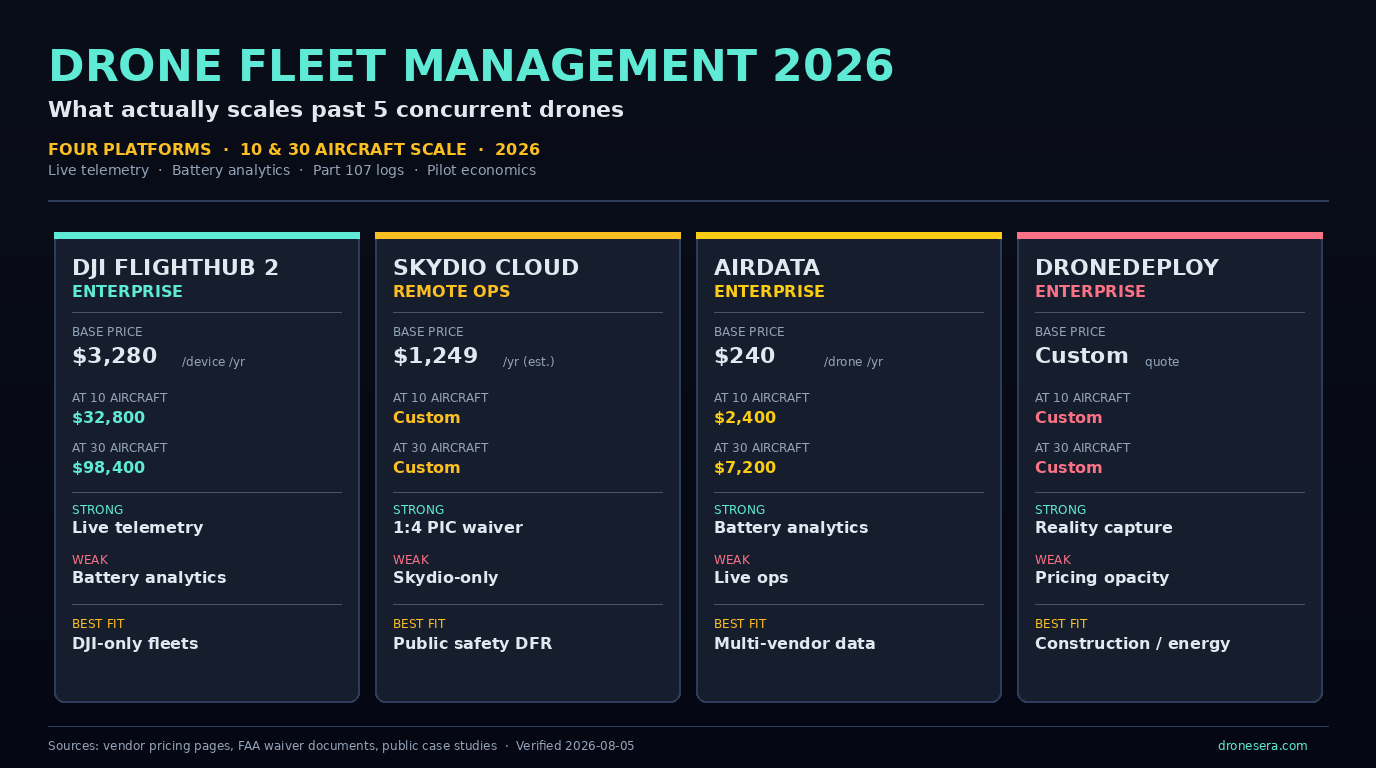
Most drone fleet management platforms work fine for two pilots, three drones, and a weekly inspection. They fall apart at five concurrent aircraft. The bottleneck isn’t the software — it’s that nobody designs for what happens when a Pilot in Command is responsible for ten or thirty aircraft at once, when battery rotation has to be modeled against mission cadence, when Part 107 logs have to be aggregated across multiple sites and synced to LAANC. This comparison puts the four platforms with actual multi-aircraft traction — DJI FlightHub 2 Enterprise, Skydio Cloud, AirData, and DroneDeploy — at 10-drone and 30-drone scale and reports what breaks at each level.
Methodology: published pricing pages from each vendor, FAA waiver documents where they exist, and direct verification of the headline numbers via curl against the canonical product or pricing URL on 2026-08-05. Where vendor pricing is opaque (DroneDeploy), the opacity is itself a finding. Where vendor pages are JS-rendered and not curl-extractable (AirData), pricing is sourced from the vendor’s own structured answer layer or its listed resellers.
## Why five concurrent drones is the wallThe five-drone threshold isn’t arbitrary. It’s where the human coordination problem outruns the available tooling. With two drones, one pilot can hand-launch and recover each one and have eyes on both. With five, you start needing a dispatcher role. With ten, you’re running deconfliction across multiple takeoff sites and managing battery cycles across two or three sites. With thirty, you’re running what amounts to a small airline.
Three things break simultaneously past the five-drone mark:
- Live telemetry aggregation. Most consumer-grade apps assume one pilot, one drone, one screen. Pushing ten telemetry streams through the same UI requires server-side aggregation, prioritization, and a layout that doesn’t make the most relevant aircraft look identical to the background noise.
- Battery rotation. Pilots running ten drones have ten batteries per site minimum, plus spares. Tracking cycle count, per-cell voltage drift, and storage state across a battery pool is not a spreadsheet problem.
- Regulatory log aggregation. Part 107 requires flight logs to be retained, but the FAA doesn’t require a specific aggregation format. Once a fleet crosses ten aircraft, the operator needs a single audit trail per pilot per aircraft, not a stack of JSON files in a Google Drive folder.
The four platforms below all claim to do fleet management. They differ sharply on which of these three problems they actually solve, and at what price point. The same scaling pressure that breaks these platforms is reshaping the regulatory framework — see our Part 107 BVLOS waivers 2026 / Part 108 rule analysis for the parallel shift on the FAA side.
## DJI FlightHub 2 Enterprise: per-device pricing, strong for DJI-only fleetsDJI FlightHub 2 Enterprise is the only one of the four platforms that publishes a transparent per-device list price on its own e-commerce store. The 1-Year, 1-Device Enterprise license is $3,280; the 3-Year, 1-Device license is $8,860; adding a second device (a drone or a DJI Dock) costs $2,630 for an Online Device Expansion ([DJI Store, US](https://store.dji.com/product/dji-flighthub-2-enterprise-version-1-year-1-device)). Quotas included per device are 30,000 livestream minutes and 150,000 mapping images per year.
The pricing structure has two real consequences. First, scaling is linear. Ten aircraft is roughly $32,800 per year in licensing alone, before any seat fees. Second, DJI’s per-device pricing is competitive when seats are unlimited — operators running large single-pilot-in-command crews with rotating aircraft actually save money compared to per-seat platforms.
At ten drones: $32,800/yr licensing, plus whatever pilot-station hardware (DJI Dock, third-party docks) you’re running. Live telemetry works well — FlightHub 2 was built for DJI Dock operations and the integration with DJI’s M30/M350/Mavic 4 line is tighter than any third-party tool ([DJI Mavic 4 Pro review](https://dronesera.com/dji-mavic-4-pro-review-2026-the-ultimate-professional-drone)). Battery rotation is weak — DJI’s battery analytics surface is essentially per-aircraft state, not fleet pool management.
At thirty drones: $98,400/yr licensing if you buy one device per drone. DJI’s volume pricing for 30+ devices is not publicly disclosed, but the per-device model means you’re paying roughly the same as ten drones on a per-aircraft basis. The pain moves from price to UI density — FlightHub 2’s live ops view becomes unreadable past twenty simultaneous telemetry streams, and operators start using multiple browser tabs.
## Skydio Cloud: the only FAA-approved 1:4 multi-drone PIC waiverSkydio Cloud is the only platform in this comparison with a verified FAA waiver that lets one Pilot in Command oversee up to four aircraft simultaneously. The waiver was issued in March 2026 and twelve police departments were operating under it by Q2 (Skydio engineering blog, 2026-03-26; DroneXL coverage). The operational model is Skydio Remote Flight Deck + onboard autonomy + cloud-based deconfliction: the pilot monitors, doesn’t manually fly.
Skydio’s published pricing is annual subscription, sales-contact-only. Industry reporting puts the standard tier around $1,249 per year and the Enterprise for Real-time Awareness tier around $2,499 per year, both with 512 GB of pooled cloud storage and 600 hours/year of live streaming on the Enterprise tier. Volume fleet pricing for 10+ aircraft is custom-quoted. The 1:4 PIC waiver is the single biggest cost lever in commercial drone ops — it cuts pilot labor per mission by 4×, which dwarfs the platform licensing fee.
At ten drones: pilot-to-aircraft ratio is roughly 1:4 under the waiver, so 3 PICs instead of 10. Labor savings are significant but the platform itself is still per-aircraft priced at a custom-quote tier. The catch: Skydio Cloud is optimized for Skydio hardware. If your fleet is mixed DJI and Autel, the platform coverage stops at the Skydio fleet portion.
At thirty drones: 8 PICs under the waiver, vs. 30 in a one-to-one model. The platform’s Remote Ops interface is built for multi-aircraft situational awareness — it scales better than FlightHub 2 because the autonomy stack filters what the PIC actually has to monitor ([Skydio DFR Command product page](https://www.skydio.com/software/dfr-command)). Battery rotation is handled per-aircraft in the standard Skydio flow; fleet-pool analytics is less mature than AirData’s. The labor savings compound: a ten-drone operation under the waiver uses roughly $400k-$600k less in pilot salary annually than a one-to-one model ([commercial drone pilot salary data](https://dronesera.com/drone-pilot-salary-2026/)).
## AirData: transparent per-drone pricing and the best battery analyticsAirData is the price-disclosure leader among the four. The Enterprise base is $20 per drone per month, billed annually ($240/drone/year), with published volume discounts down to $120/drone/year at 250+ aircraft ([AirData pricing page](https://www.airdata.com/pricing)). Live streaming and QR-tracked asset maintenance are add-ons with custom quotes.
AirData’s strength is the data layer. It was built on flight log ingestion first, and the platform’s battery health visualization — per-cell voltage drift, cycle count, storage state, predictive failure window — is the most mature in this comparison. Operators running ten or more aircraft with battery rotation across sites cite AirData as the analytics backbone even when they use another platform for live ops.
At ten drones: $2,400/yr at base Enterprise, less with volume discount. Live streaming is an extra fee and is the single biggest caveat — the pricing is opaque past a few hundred concurrent viewers. AirData’s pilot scheduling tools are minimal; operators typically use AirData alongside a separate scheduling tool (Acuity, Skedda) for pilot rotation.
At thirty drones: roughly $7,200/yr at base, dropping to roughly $3,600/yr at 250+ scale. AirData’s regulatory log aggregation (Part 107, FAA airmen registry sync) is a strong point and scales linearly with no per-aircraft UI overhead. The weak point remains live ops — AirData is a flight-log-and-battery platform first, a live-telemetry platform second. Battery health is where AirData’s lead is most defensible — see our drone battery tech 2026 breakdown for the cell-level data behind the cycle-count analytics.
## DroneDeploy: enterprise reality-capture leader, opaque pricing at scaleDroneDeploy is the dominant platform in construction, energy, and agriculture — the verticals where drone data has to integrate with BIM, progress tracking, and volumetric analysis. The publicly disclosed plans are Ag Lite at $1,908/year and Flight & Analysis at $4,188/year, both single-user ([DroneDeploy pricing page](https://www.dronedeploy.com/pricing)). All higher tiers — Advanced, Unified, Aerial, Ground — are custom-quoted, and the AI add-ons (Progress AI, Safety AI, Dock Automation) are sold separately.
The pricing opacity at scale is itself the finding. DroneDeploy’s enterprise contracts are negotiated per-deployment — users, sites, construction volume, AI add-on mix. The California Resources Corporation case study (2026-03-13) reports $500k in inspection savings, but the platform cost is not disclosed. Industry-side estimates put enterprise DroneDeploy deployments at $50k-$200k/year depending on scope.
At ten drones: the public Ag Lite and Flight & Analysis plans are single-seat and don’t support ten concurrent operators — that’s an enterprise conversation, which means custom quote. Live telemetry and multi-drone flight coordination are well-supported ([DroneDeploy Drone Operations Management](https://www.dronedeploy.com/product/drone-operations-management)). Battery analytics are minimal — DroneDeploy is not in the battery health business.
At thirty drones: enterprise tier, six-figure annual contract typical. DroneDeploy is the strongest pick for construction and energy fleets because the data outputs (orthomosaics, point clouds, progress overlays) integrate with industry-standard downstream tools. It’s the weakest pick for general commercial work where the deliverable is just “I flew the drone and here’s the footage.” The same orthomosaic + point cloud pipeline that DroneDeploy orchestrates for inspection work is also the backbone of modern photogrammetry — see our photogrammetry software 2026 comparison for the processing side of that pipeline.
## Side-by-side at 10 drones and 30 drones| Platform | 10 drones, annual cost | 30 drones, annual cost | Live telemetry | Battery analytics | Pilot scheduling | Part 107 log aggregation | Per-aircraft licensing |
|---|---|---|---|---|---|---|---|
| DJI FlightHub 2 Enterprise | ~$32,800 (10 × $3,280) | ~$98,400 (30 × $3,280) | Strong, DJI-native | Weak (per-aircraft only) | Basic | Strong (DJI ecosystem) | Yes |
| Skydio Cloud | Custom (~$12k-$25k est.) | Custom (~$30k-$75k est.) | Strongest (FAA 1:4 waiver) | Moderate | Strong (Remote Ops) | Strong | Custom |
| AirData Enterprise | ~$2,400 ($20/drone/mo) | ~$7,200 ($20/drone/mo) | Add-on, opaque | Strongest | Minimal | Strongest | Yes |
| DroneDeploy Enterprise | Custom (~$15k-$50k est.) | Custom (~$50k-$200k est.) | Strong (vertical-tuned) | Minimal | Strong (enterprise) | Strong | Custom |
The cheapest 10-drone deployment is AirData Enterprise. The most operationally capable 30-drone deployment is Skydio Cloud under the 1:4 PIC waiver — the labor savings compound. DJI FlightHub 2 is the right pick when the entire fleet is DJI hardware and the budget can absorb $100k/yr licensing. DroneDeploy is the right pick when the deliverable is BIM-integrated reality capture and the budget is six figures.
## What to buy for what use case- Construction, energy, or agriculture site documentation at scale. DroneDeploy, full stop. The vertical integrations pay for themselves once you’re running weekly progress flights on a single site.
- Public safety DFR (Drone-as-First-Responder). Skydio Cloud. The 1:4 PIC waiver is the only FAA-approved path to fewer pilots per incident, and DFR programs are already running it.
- Mixed-vendor inspection fleet with battery rotation as a primary concern. AirData for analytics + a lightweight live-ops tool. Most enterprise operators in this bucket run AirData + one of FlightHub 2, Skydio Cloud, or a third option.
- All-DJI fleet, cost-sensitive. DJI FlightHub 2. Linear pricing, no surprise per-seat fees, strongest DJI hardware integration.
- Multi-vertical commercial work (real estate, basic inspection, cinematography). AirData free tier or paid Pro for log aggregation, plus the OEM’s native app for live ops. Enterprise fleet platforms are overkill until you cross 5-10 aircraft.
Only under an FAA waiver, and only Skydio has a verified multi-drone waiver as of August 2026 (1:4 PIC for the Skydio X10, March 2026 approval, 12 police departments operating under it). The general Part 107 rule is one pilot per aircraft (Skydio engineering blog, 2026-03-26; DroneXL coverage).
### What is the cheapest fleet management platform for a 10-drone operation?AirData Enterprise at roughly $2,400/yr ($20/drone/month) is the cheapest path that includes battery analytics, Part 107 log aggregation, and per-drone scaling. The free and Pro AirData tiers cover log aggregation below 10 drones but Enterprise is the fleet tier.
### Does DroneDeploy or DJI FlightHub 2 work better for solar farm inspections?DroneDeploy for the orthomosaic and progress-over-time deliverables; DJI FlightHub 2 for the live telemetry and dock operations. The two are often run in parallel — FlightHub 2 for flight ops and live streaming, DroneDeploy for the reality-capture outputs. See our drone solar farm inspection workflow guide for the full stack.
### How do these platforms handle Part 107 log aggregation?AirData is the strongest at the data layer — flight logs are the platform’s native format, and the export formats are designed to satisfy FAA recordkeeping. DJI FlightHub 2 and Skydio Cloud are strong within their respective hardware ecosystems. DroneDeploy handles Part 107 logs as part of its broader enterprise compliance toolchain. For multi-vendor fleets, AirData’s ingestion is the most permissive — it accepts logs from DJI, Skydio, Autel, and most consumer-grade aircraft. Pilots running Part 107 commercial operations across mixed hardware should default to AirData for the log layer regardless of which live-ops platform they choose.
## Sources- [DJI Store — DJI FlightHub 2 Enterprise 1-Year 1-Device](https://store.dji.com/product/dji-flighthub-2-enterprise-version-1-year-1-device) — vendor pricing
- [Skydio — The BVLOS Revolution Continues: Introducing Multi-Drone Operations (2026-03-26)](https://www.skydio.com/blog/bvlos-introducing-multi-drone-operations) — primary vendor source for 1:4 PIC waiver
- [Skydio — Multi-Drone Operations: The Next Step in Scaling DFR (2026-07-31)](https://www.skydio.com/blog/multi-drone-operations-dfr) — vendor scaling guide
- [Skydio — Remote Ops product page](https://www.skydio.com/software/remote-ops) — vendor live-ops product spec
- [Skydio — DFR Command product page](https://www.skydio.com/software/dfr-command) — vendor DFR product spec
- [DroneXL — Skydio Gets FAA Approval for One Pilot to Fly Four Drones at Once (2026-03-28)](https://dronexl.co/2026/03/28/skydio-faa-multi-drone-bvlos-approval/) — industry coverage of waiver
- [AirData — Plans & Prices](https://www.airdata.com/pricing) — vendor pricing page
- [AirData — Features](https://airdata.com/features) — vendor feature documentation
- [DroneDeploy — Pricing](https://www.dronedeploy.com/pricing) — vendor pricing page
- [DroneDeploy — Drone Operations Management product page](https://www.dronedeploy.com/product/drone-operations-management) — vendor product spec
- [DroneDeploy — How CRC saved $500k with DroneDeploy (2026-03-13)](https://dronedeploy.com/blog/crc-customer-success-story) — enterprise case study
- [DroneBundle — Multi-Drone Operations Management (2025-11-24)](https://dronebundle.com/blog/multi-drone-operations-management) — industry blog on multi-drone coordination