
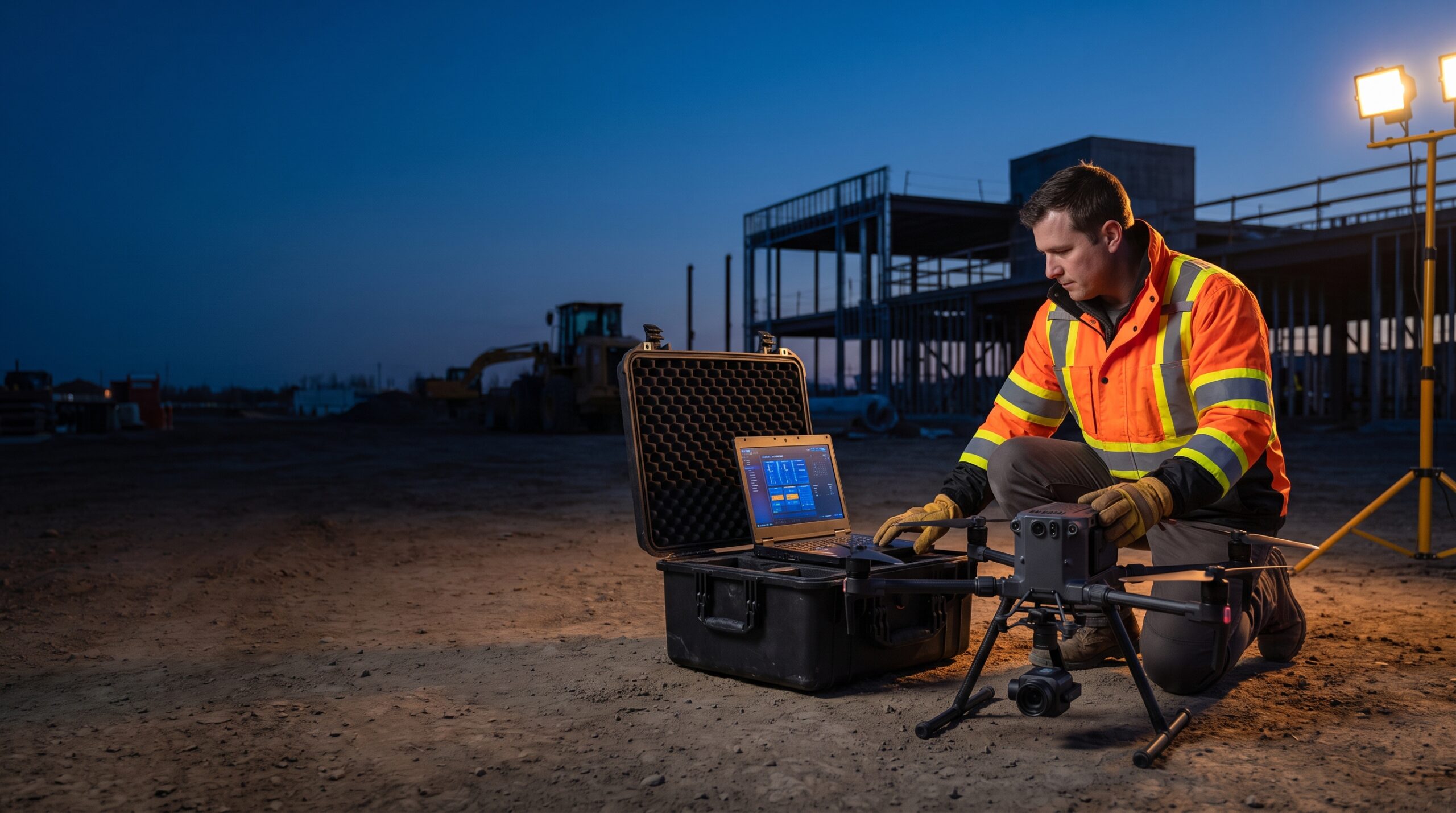
A Part 107 certificate is the cheapest line item in a drone business. The FAA knowledge test is $175, registration is $5 per aircraft, and an EIN is free. The real budget begins after the paperwork: liability insurance, a reliable aircraft and spare batteries, data storage, accounting, travel, maintenance, and the time required to turn raw flight data into a deliverable a client can use. For a one-pilot operation in 2026, a realistic launch budget is roughly $4,000-$12,000 for a photo/inspection business and materially more for mapping or thermal work. Annual overhead can range from about $3,000 for a lean visual-content operator to more than $20,000 when you add high-limit insurance, mapping software, vehicle mileage, and replacement equipment. Operators building a new service line should pair this budget with our real-estate drone business guide. This is the working model.
The short answer: three budgets, not one
Separate launch cash, monthly overhead, and job-variable cost. Mixing them produces a misleading “drone business startup cost” number.
| Budget | Lean visual operator | Mapping/inspection operator |
|---|---|---|
| Launch cash | $4,000-$7,000 | $10,000-$25,000+ |
| Fixed monthly overhead | $250-$650 | $900-$2,000+ |
| Variable cost per job | $25-$150 | $100-$600+ |
| Break-even target | 2-5 jobs/month | 3-8 jobs/month |
These are planning ranges, not quotes. Your aircraft, geography, insurance limits, travel radius, tax structure, and service mix move the result. The SBA’s startup-cost framework is useful here because it forces you to list one-time purchases separately from recurring expenses.
Required compliance and business setup costs
The FAA pathway is straightforward, but it is not the whole legal budget. Start with the FAA commercial-operator requirements and the agency’s pilot testing and certification guidance. Our complete Part 107 guide covers the operating-rule side; this article focuses on the ledger.
- Knowledge test: budget $175 for the initial UAG exam. Training is separate: free FAA material can cover the basics, while paid courses commonly add $100-$300.
- Aircraft registration: Part 107 aircraft registration is $5 per aircraft and is valid for three years. The FAA registration guidance is the source of truth; avoid third-party “registration” markups.
- Business formation: an EIN is free. State entity, local license, registered-agent, and filing fees vary. The SBA structure guide explains the liability and tax trade-offs; it does not replace advice from a CPA or attorney.
- Waivers and authorizations: the FAA does not charge a standard fee for every operational authorization, but the labor to build compliant procedures, maps, and client documentation is real. Treat it as preparation time.
Minimum paperwork cash is therefore about $180 before training, entity formation, local licensing, or insurance. That is why “$415 to become a commercial drone pilot” is a poor business plan: it describes access to the market, not readiness to sell work.
Aircraft, batteries, payloads, and field kit
For visual work, the aircraft is often the largest launch purchase. A capable compact camera drone may put a working operator in the $1,000-$3,000 hardware tier. A second aircraft is not automatically prudent: it doubles registration, batteries, firmware management, and capital tied up in inventory. Buy redundancy when a missed job costs more than the backup.
- Aircraft: $1,000-$3,000 for a competent visual platform; $3,000-$8,000+ for higher-end payloads or enterprise kits.
- Battery set: $250-$900, depending on platform. Include a charging hub, spare propellers, and a fire-resistant transport solution.
- Controller/tablet: $300-$1,200. Do not assume a consumer tablet is a reliable field display in direct sun.
- Data and safety kit: $250-$1,000 for SD cards, cases, landing pad, high-visibility clothing, cones, first-aid equipment, and weather protection.
- Maintenance reserve: set aside 5%-10% of aircraft value annually, plus a larger reserve for crash damage.
The useful number is not the retail price. It is replacement exposure per job. If a $2,000 aircraft produces $150 jobs, one unrecoverable loss consumes the gross revenue from more than 13 jobs before insurance, travel, or taxes.
Insurance: the line item clients notice
Federal Part 107 rules do not create a universal insurance mandate for every commercial flight, but clients, venues, general contractors, and property owners frequently require proof of coverage. The BWI commercial drone insurance overview is a useful example of the distinction between liability and hull coverage. For policy-selection detail, see our drone insurance guide.
| Coverage | Planning range | Why it matters |
|---|---|---|
| Liability-only | $300-$1,200/year for many small operators | Meets client COI requirements and protects against third-party claims. |
| Hull/equipment | Often priced as a percentage of insured value | Protects the aircraft, payload, and sometimes accessories. |
| Higher limits | $1,500-$3,500+/year in complex operations | Construction, industrial, and public-sector work may require $2M-$5M limits. |
Get a quote using the actual operation: aircraft models, payloads, flight environments, night work, controlled-airspace exposure, and annual revenue. A generic “drone insurance cost” search result is not a quote. Also price the administrative cost of certificates of insurance; responding to a client’s risk questionnaire is part of selling commercial work.
Software and back-office subscriptions
Software is where the budget splits by service line. A photographer can begin with a camera workflow, storage, invoicing, and editing. A mapping operator may need cloud processing, measurement tools, reports, and collaboration. Compare that stack against our 2026 drone mapping software comparison.
- Email and storage: Google Workspace’s business plans are priced per user per month. Use the official pricing page rather than a reseller’s bundle.
- Accounting: QuickBooks and comparable tools add a recurring subscription; the official product comparison shows the available tiers.
- Editing: budget for the software that matches your deliverable: photo editing, video editing, color management, and client review.
- Mapping: DroneDeploy’s pricing page and Pix4D’s PIX4Dmapper and PIX4Dcloud pages show why mapping is a different business: annual software can cost thousands before you fly a paid job.
A lean operator can start near $0 in specialized mapping software and add subscriptions only when the service requires them. A mapping operator should not quote a project without including processing time, cloud storage, exports, and revisions. Software is not overhead if it is directly required to produce the contracted output; it is a cost of goods sold.
The monthly operating model
Build a simple monthly P&L before you buy equipment. Here is a conservative one-pilot visual operation:
| Monthly line | Lean plan | Working plan |
|---|---|---|
| Insurance | $50 | $150 |
| Software/email/accounting | $50 | $250 |
| Phone/data/storage | $40 | $100 |
| Maintenance reserve | $75 | $200 |
| Marketing/admin | $50 | $300 |
| Vehicle and travel reserve | $100 | $400 |
| Total before owner pay and tax | $365 | $1,400 |
Vehicle costs deserve their own line. The IRS publishes the annual standard mileage rates; for 2026, the published rate changes during the year. Track business miles even if you use the standard-mileage method. It gives you a defensible measure of the distance your “$150 job” actually consumes. If visual media is the service, our drone photography revenue guide gives useful market context for the income side.
Break-even calculator for a one-pilot operation
Use this equation:
Jobs to break even = (monthly fixed overhead + owner pay target + tax reserve) ÷ contribution margin per job.
Example: your monthly overhead is $700, your owner-pay target is $3,000, and you reserve $900 for taxes. You sell a $650 photo package. After $75 of travel, storage, subcontractor, and payment costs, contribution margin is $575. You need 8 jobs: ($700 + $3,000 + $900) ÷ $575 = 8.0. At six jobs, the business may look busy while missing its cash target.
For mapping, use the same math with a higher ticket and higher variable cost. A $2,500 site model with $450 in processing, travel, and data costs contributes $2,050. If monthly overhead is $2,000 and owner pay/tax reserve total $4,000, you need three jobs, not one, to cover the month.
Where new operators overspend
- Buying enterprise hardware before validating demand: rent or subcontract thermal and LiDAR capability until the work repeats.
- Counting gross revenue as pay: reserve for taxes, travel, revisions, downtime, and maintenance before taking distributions.
- Underpricing insurance and paperwork: if a client needs a certificate, a named additional insured, and specific limits, the requirement affects your price.
- Subscribing too early: do not buy $4,000 mapping software for a service you have not sold. Price the workflow first.
- Ignoring non-flying labor: a 30-minute flight can create three hours of planning, transfer, editing, reporting, and client communication.
The most durable cost advantage is operational discipline: repeatable checklists, standardized deliverables, clean file naming, and a quote template that exposes travel and revision assumptions.
FAQ: Part 107 business costs
How much does it cost to start a Part 107 drone business?
A lean visual-content business can launch around $4,000-$7,000 if you already own a suitable computer and vehicle. Mapping, thermal, and inspection operations commonly need $10,000-$25,000 or more because of hardware, insurance, and processing software.
Is drone insurance required for Part 107 work?
Not universally by the federal rule set, but clients and venues often require liability coverage. Confirm the contract requirements before quoting.
What is the largest recurring cost for a drone business?
It depends on the service. Insurance and vehicle travel dominate many visual operators; mapping operators may find software and processing capacity are larger recurring costs.
Can you start with no mapping software subscription?
Yes, if you do not sell mapping deliverables. Once a contract requires orthomosaics, measurements, or repeatable reports, price the required processing workflow into the job.
How many jobs do you need to break even?
Divide fixed overhead, owner-pay target, and tax reserve by contribution margin. A $575 contribution margin and a $4,600 monthly target require eight jobs.
Conclusion: price the business before buying the drone
Start with a one-page P&L, not a shopping cart. List compliance, aircraft replacement, insurance, software, travel, maintenance, taxes, and non-flying labor. Then choose the smallest service line that can cover the model. If real estate is the target, compare the equipment budget with our real-estate drone buyer’s guide. For a next step, quote three real jobs using the break-even formula above. If the required price is uncomfortable, change the workflow or the target market before adding equipment.
{“@context”:”https://schema.org”,”@type”:”Article”,”headline”:”Part 107 Business Costs: The 2026 Operating Budget”,”description”:”What does a Part 107 drone business really cost? Use this itemized 2026 budget for aircraft, insurance, software, travel, taxes, and break-even jobs.”,”author”:{“@type”:”Person”,”name”:”Dronesera Editorial”},”publisher”:{“@type”:”Organization”,”name”:”Dronesera”,”url”:”https://dronesera.com/”},”datePublished”:”2026-07-23″,”dateModified”:”2026-07-23″,”mainEntityOfPage”:”https://dronesera.com/part-107-business-costs-2026/”} {“@context”:”https://schema.org”,”@type”:”FAQPage”,”mainEntity”:[{“@type”:”Question”,”name”:”How much does it cost to start a Part 107 drone business?”,”acceptedAnswer”:{“@type”:”Answer”,”text”:”A lean visual-content business can launch around $4,000-$7,000; mapping, thermal, and inspection operations commonly need $10,000-$25,000 or more.”}},{“@type”:”Question”,”name”:”Is drone insurance required for Part 107 work?”,”acceptedAnswer”:{“@type”:”Answer”,”text”:”It is not universally required by federal rules, but clients and venues often require liability coverage.”}},{“@type”:”Question”,”name”:”What is the largest recurring cost for a drone business?”,”acceptedAnswer”:{“@type”:”Answer”,”text”:”Insurance and travel often dominate visual operations; mapping operators may have larger software and processing costs.”}},{“@type”:”Question”,”name”:”Can you start with no mapping software subscription?”,”acceptedAnswer”:{“@type”:”Answer”,”text”:”Yes, if you do not sell mapping deliverables. Add the required processing workflow when a contract requires it.”}},{“@type”:”Question”,”name”:”How many jobs do you need to break even?”,”acceptedAnswer”:{“@type”:”Answer”,”text”:”Divide fixed overhead, owner pay, and tax reserve by contribution margin per job.”}}]} {“@context”:”https://schema.org”,”@type”:”SpeakableSpecification”,”cssSelector”:[“.wp-block-post-content > p:first-of-type”]} {“@context”:”https://schema.org”,”@type”:”ClaimReview”,”claimReviewed”:”A Part 107 certificate is the main cost of starting a commercial drone business.”,”reviewRating”:{“@type”:”Rating”,”ratingValue”:”1″,”bestRating”:”5″,”alternateName”:”Misleading”},”author”:{“@type”:”Organization”,”name”:”Dronesera Editorial”},”url”:”https://dronesera.com/part-107-business-costs-2026/”}