
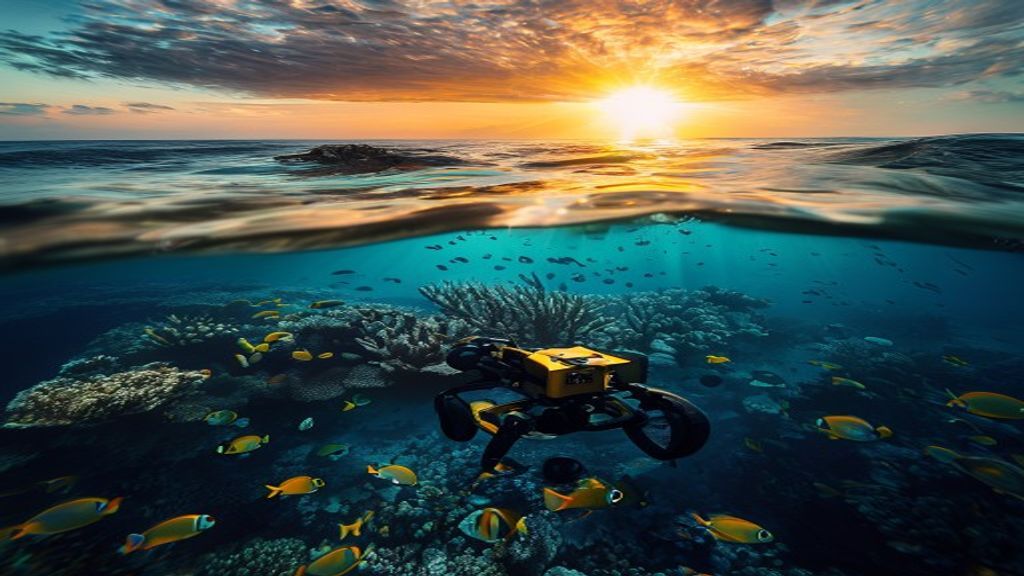
Drone Underwater ROV Guide 2026: Exploring The World Beneath The Surface
While aerial drones dominate the headlines, a parallel revolution is happening underwater. Remote Operated Vehicles (ROVs) and underwater drones are becoming accessible to enthusiasts, researchers, and professionals. Here’s everything you need to know about exploring the world beneath the waves.
Why Underwater ROVs?
Seventy percent of Earth’s surface is covered by water, yet we’ve mapped less of the ocean floor than we have the surface of Mars. Underwater ROVs let anyone contribute to ocean exploration, inspect marine infrastructure, or simply discover a world invisible from above.
Types of Underwater Drones
1. Tethered ROVs (Professional Grade)
Professional underwater ROVs like the BlueROV2 or VideoRay Defender are used for inspections, search and recovery, and scientific research. These require expertise to operate and cost $5,000 to $50,000+. They offer multiple thrusters for stability, high-resolution cameras, and manipulator arms for intervention tasks.
2. Consumer Underwater Drones
More accessible options have emerged in the $500-$3,000 range:
– Chasing M2 Pro Max: 4K camera, 6 thrusters, 200m depth rating, $2,499
– Qiio X: 4K with real-time sharing, 100m depth, $1,299
– FIFISH V-EVO: 4K, 100m depth, unique jaw design for sampling, $1,899
– Youcan Robot Arowana: Budget option at $799, 4K, 50m depth
How They Work
Unlike aerial drones that use GPS, underwater ROVs rely on:
– Tethered connections for power and communication (most consumer models)
– Acoustic positioning systems for depth and location
– Heading sensors (compasses work but drift without external reference)
– Visual odometry for short-range navigation
The tether is both a strength (guaranteed connection, no signal loss) and limitation (requires careful cable management, limits range).
Depth Ratings
Consumer drones typically handle 50-200 meters. Beyond that, pressure housings require professional engineering. The deepest consumer ROVs can reach 300+ meters for specialized applications.
Applications in 2026
– Marine biology research and documentation
– Ship hull inspections (saving thousands in diver costs)
– Aquarium and pool maintenance monitoring
– Search and recovery operations
– Recreational exploration of lakes, rivers, and coastal waters
– Fishing — locating fish and underwater structure
Best Practices
– Always check salt content — saltwater corrodes faster than freshwater
– Rinse thoroughly after every saltwater dive
– Check O-rings and seals before every dive
– Practice in shallow water before going deep
– Be aware of currents — they affect tethered operations significantly
The Future
Autonomous underwater vehicles (AUVs) that navigate without tethers are emerging for scientific applications. Battery technology improvements are extending dive times from 2 hours toward 6+ hours for consumer models.
Related Specialty Drone Guides
Related guides on dronesera.com: drone thermal camera comparison, reading weather for drone pilots, and night drone operations guide.