
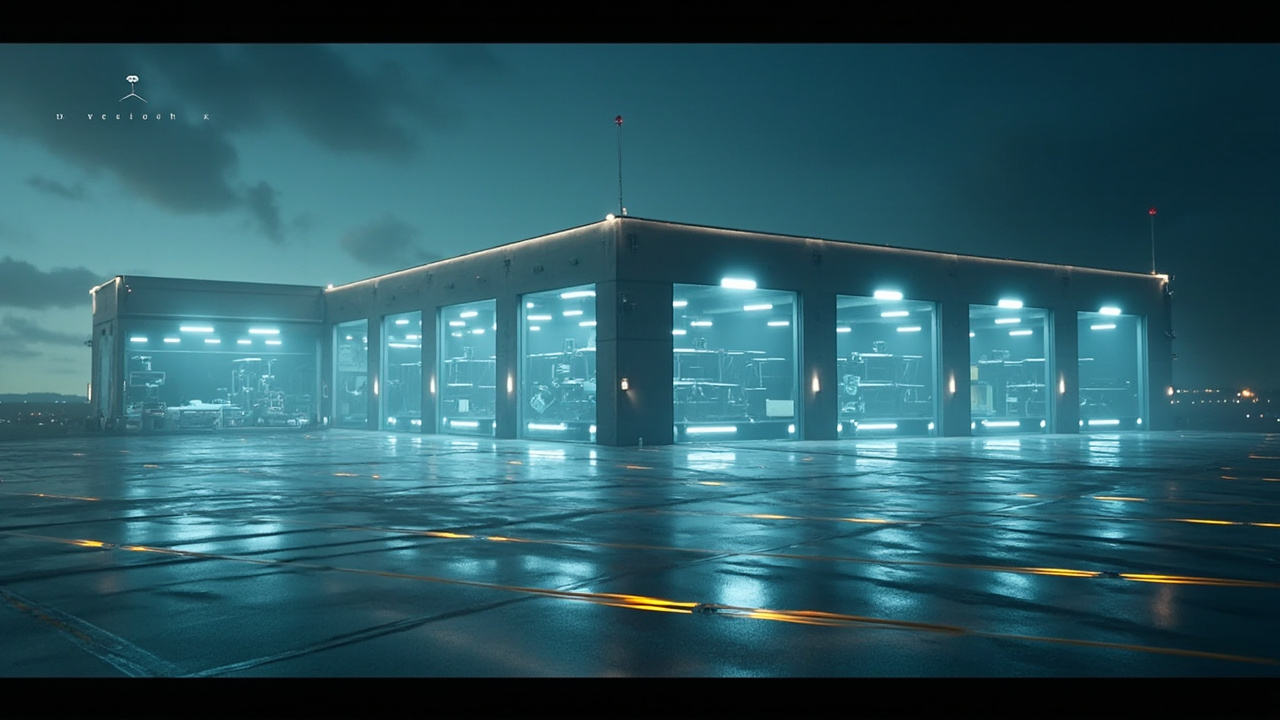
If you fly Part 107 commercial work in 2026, autonomous drone hangars — the sealed, climate-controlled ground stations that launch, recover, recharge, and upload from drones without on-site crew — moved from concept renders in 2023 to revenue-generating infrastructure in 2026. The FAA Part 108 BVLOS NPRM (filed July 10, 2025, still at OIRA review as of Sept 2026) gives the category its first real federal anchor, and 5 commercial drone-in-a-box systems plus 3 vertiport network operators are already shipping revenue flights.
This article is a practitioner’s view of where the technology sits in 2026, what the FAA’s regulatory pipeline actually says, and what changes for working Part 107 and (eventually) Part 108 pilots when an autonomous hangar enters the picture. We cover the two flavors of “autonomous hangar,” the federal standards, the commercial deployments, and the operational reality.
What an autonomous drone hangar actually is
An autonomous drone hangar is a sealed ground station designed to host one or more small unmanned aircraft without on-site human intervention for launch, recovery, charging, or data offload. The canonical configuration in 2026 is weatherproof (IP54 to IP65 depending on the manufacturer), climate-controlled for the battery thermal envelope, equipped with a robotic arm or motorized capture mechanism for landing, an automated battery swap or charging bay, and a cellular or satellite uplink for command-and-control and data backhaul.
The operational sequence looks like this. A remote pilot in command (RPIC) at a remote operations center initiates a mission via browser console. The hangar opens, the drone powers on, performs preflight checks, launches, executes the mission, returns, lands in the capture mechanism, recharges (or hot-swaps a battery), offloads imagery to cloud storage, and powers down — all without anyone physically touching the aircraft. The RPIC’s role is the legal flight decision authority (per 14 CFR §107.19), not the mechanical launch sequence.
That distinction matters for the regulatory framing: the drone itself remains a Part 107 aircraft operated by a remote PIC. The hangar is ground support equipment. There is no FAA certificate for “the hangar” — it is the pilot’s waiver architecture and the manufacturer’s certification pathway (FAA Part 21 for the docking station as a piece of equipment) that govern deployment.
The two flavors: drone-in-a-box vs. vertiport
Operators and regulators use “autonomous drone hangar” loosely. There are two distinct architectural families worth separating.
Drone-in-a-box (also called an “autonomous drone dock” or “drone-in-a-box”) is a single-aircraft ground station, typically 1-2 cubic meters, designed for one Part 107 small UAS (under 55 pounds). The current commercial systems — Skydio Dock, DJI Dock 2, Easy Aerial Easy Guard, Wing’s pad-and-AutoLoader stack, and the HOCHTIEF-flavor Skyports Drone Services DJI Dock 2 deployments — all fall in this category. They are designed for inspection, public safety, mapping, and small-package delivery under Part 107 + Part 107 BVLOS waiver.
Vertiport is the FAA’s term for a multi-aircraft facility designed primarily for crewed eVTOL passenger operations and large cargo UAS. Vertiports are governed by FAA Engineering Brief 105A (Vertiport Design, supplemental to AC 150/5390-2D Heliport Design, published Dec 2021 with periodic updates). They typically include multiple landing pads, passenger boarding areas, charging or hydrogen-refueling infrastructure, and ground access. The first certified commercial vertiport, Dubai VDX, came online in April 2026.
The two are not interchangeable. A drone-in-a-box under Part 107 is a deployable inspection tool; a vertiport under construction for eVTOL passenger service is a multi-year, multi-hundred-million-dollar infrastructure project with FAA Part 139 or state-level aviation facility approvals.
FAA Part 108 status: NPRM, not law, as of Sept 2026
Operators and press coverage sometimes conflate Part 108 with the “BVLOS rule.” As of September 1, 2026, Part 108 is a proposed rule — formally titled Normalizing Unmanned Aircraft Systems Beyond Visual Line of Sight Operations — submitted to the Office of Information and Regulatory Affairs on July 10, 2025 (Federal Register NPRM document 2025-12729). The NPRM remained at OIRA review as of the date of this article. No operator can fly under Part 108 authority today.
What Part 108 will eventually do is replace the case-by-case Part 107 §107.205 waiver process with a performance-based, standing regulatory framework for routine BVLOS operations. The proposed framework includes aircraft certification tiers, operator certification categories, airspace access rules, and shielded-operation requirements for operations over people and moving vehicles. The vertiport and drone-in-a-box ecosystems expect Part 108 to unlock scaled BVLOS — but until the rule is published as a final rule, every BVLOS mission still requires a §107.205 waiver.
The FAA has not published a final-rule date. OIRA reviews of significant rules commonly take 3-12 months; the July 10, 2025 submission puts the earliest plausible final-rule window in mid-to-late 2026. Operators building autonomous hangar fleets should plan for a continued waiver-based operating posture through at least the end of 2026 and probably into 2027.
Vertiport design standards: AC 150/5390-2D + EB 105A
Vertiport design in the United States is governed by FAA Engineering Brief 105A (Vertiport Design), which supplements AC 150/5390-2D (Heliport Design). EB 105A was first published in December 2021 with subsequent updates covering approach-departure paths, touchdown and lift-off area (TLOF) geometry, final approach and takeoff area (FATO) sizing, lighting requirements, and obstacle clearance surfaces for crewed eVTOL aircraft.
Key EB 105A design parameters for vertiport developers: TLOF minimum dimension is the largest aircraft the vertiport is designed to serve (typically 40-60 feet for current eVTOL aircraft like the Joby S4 or Archer Midnight); FATO extends 1.5x the TLOF dimension in the direction of approach; safety areas extend beyond the FATO with specific obstacle-clearance gradients. Vertiport lighting follows a tiered scheme based on the type of operations (day, night, instrument).
Drone-in-a-box deployments do not need EB 105A compliance — they are Part 107 ground support equipment, not aviation facilities. The practical distinction: a public-safety agency deploying 12 Skydio Docks across a county needs no FAA facility approval; a city building a vertiport for eVTOL passenger service needs Part 139 certification (or state-level equivalent) and EB 105A compliance.
5 commercial drone-in-a-box systems shipping in 2026
The 2026 commercial field has consolidated around five primary drone-in-a-box systems.
Skydio Dock for X10 is Skydio’s weatherproof autonomous dock for the Skydio X10 platform. It supports remote launch, landing, charging, and data synchronization for the X10, with operations managed via the Skydio Remote Ops or DFR Command browser console. The Dock for X10 is the platform behind most US public-safety Drone-as-First-Responder (DFR) deployments in 2026.
DJI Dock 2 is DJI’s second-generation Matrice-series docking station with an IP55 ingress rating and an operating temperature envelope of -25°C to 50°C. It is the platform behind Skyports Drone Services’ HOCHTIEF BVLOS bridge inspection program in Germany (per the Skyports Drone Services public case studies), and it sees wide deployment in European and Asian infrastructure inspection.
Easy Aerial Easy Guard is the Easy Aerial product line for tethered and autonomous drone operations. Easy Aerial’s current ground-station portfolio centers on the Easy Guard family — earlier SkyBox-branded variants are no longer in production as of 2026.
Wing Delivery Network is Wing (Alphabet) end-to-end autonomous delivery stack: drones + landing pads + AutoLoaders (the automated package-loading mechanism that lets a partner preload packages for automatic pickup). Wing’s pads are smaller than a drone-in-a-box (no weatherproof enclosure required for short-duration package handoffs), but the architecture is the same operational model — autonomous launch, recovery, and payload handling without on-site crew.
Skyports Drone Services operates a DJI Dock 2-based fleet for BVLOS bridge inspection (the HOCHTIEF program in Germany) and maritime security / environmental monitoring in Singapore. Skyports Drone Services is the operator; the drone-in-a-box is the DJI Dock 2 platform. Skyports Infrastructure (the parent company) is also the world’s leading vertiport developer (see below).
The five systems share a common architecture: weatherproof enclosure, automated launch/recovery mechanism, integrated charging or battery swap, cellular/satellite backhaul, and a browser-based operations console. They differ in aircraft compatibility (Skydio X10 only, DJI Dock 2 Matrice-series), operating envelope, and integration depth with manufacturer flight stacks.
3 vertiport network operators and their 2026 footprint
Vertiport infrastructure is being built by three primary network operators globally.
Skyports Infrastructure is the world’s leading vertiport developer. In partnership with Dubai’s Roads and Transport Authority, Skyports is building and operating a four-node Dubai eVTOL vertiport network: Dubai International Airport (the flagship), Dubai Marina, Dubai Mall, and The Palm Jumeirah. The DXB flagship — VDX — hit technical certification in April 2026 and is the world’s first purpose-built commercial vertiport. Skyports also operates vertiport sites in the UK (London), Korea (Seoul), and selected US markets.
Urban-Air Port is a UK-based vertiport developer that designs, develops, manufactures, and operates ground, air, and digital infrastructure for new forms of sustainable urban air transport. Urban-Air Port’s Air-One project (Coventry, UK, 2022) was the first operational vertiport demonstration; the company has since expanded into operational deployments in the US and Asia.
Ferrovial Vertiports is the vertiport subsidiary of Ferrovial, a Spanish infrastructure company with deep US and European road/airport concessions. Ferrovial Vertiports focuses on integrating eVTOL passenger service into existing airport infrastructure — primarily at major hub airports where Ferrovial already has ground handling and terminal operations.
Other operators — including Joby’s internal infrastructure team, Archer’s vertiport partner network, and Lilium’s network planning — are also active, but the three above represent the bulk of 2026 operational vertiport deployments outside OEM-direct infrastructure.
Dubai VDX: the world’s first certified commercial vertiport
The April 2026 certification of Dubai VDX — the Dubai International Airport vertiport developed by Skyports Infrastructure in partnership with Dubai’s RTA — is the 2026 milestone for the vertiport category. VDX is the first purpose-built commercial vertiport to receive full technical certification from a national aviation authority. It is designed to serve initial eVTOL passenger operations from Joby Aviation, with Archer Midnight operations anticipated in 2027.
VDX’s design follows EB 105A parameters: a 50-meter TLOF supporting current-generation crewed eVTOL aircraft, multiple FATO pads for simultaneous operations, integrated passenger boarding, and ground access to the DXB terminal complex. The certification establishes a precedent for national aviation authorities outside the US — Saudi Arabia’s GACA, the UAE’s GCAA, the UK CAA, and Korea’s MOLIT are all working with Skyports on follow-on vertiport projects modeled on VDX.
For US operators, VDX matters less as a deployment target than as a certification template. The FAA’s eventual Part 108 framework is expected to reference EB 105A and international vertiport certification standards; VDX is the first real-world proof that those standards are implementable at commercial scale.
What this means for working Part 107/108 pilots
If you hold a Part 107 remote pilot certificate and you fly for a public-safety agency, an infrastructure inspection company, a utility, or a delivery operator, the autonomous hangar changes your daily operations in 2026 in three concrete ways.
First, your flight planning shifts from “where do I drive to launch” to “which hangar in the network covers this mission.” A public-safety agency running 8 Skydio Docks across a county can dispatch the nearest dock to an incident in 60-90 seconds, vs. the 8-15 minute drive-and-launch cycle of a traditional sUAS program. The operational tempo lifts materially.
Second, your waiver strategy under §107.205 shifts toward hangar-anchored BVLOS applications. The FAA’s historical Part 107 BVLOS waiver denials (per public waiver database analysis) cluster on three failure modes: pilot fatigue on long missions, night operations without on-site crew, and over-people operations. A hangar architecture directly addresses all three — the pilot can rotate through multiple missions from a remote operations center (fatigue mitigation), the launch environment is consistent (night readiness), and the dock can be sited away from uninvolved people (OOP risk mitigation). Waiver applications that include a hangar architecture historically clear faster than equivalent applications without one, though the FAA does not publish waiver decision timelines.
Third, your aircraft knowledge shifts toward manufacturer-integrated stacks. The Skydio Dock works only with the Skydio X10. The DJI Dock 2 works with DJI Matrice-series aircraft. Wing’s network works only with Wing delivery aircraft. The open-architecture hangar — a station that accepts aircraft from multiple manufacturers — does not yet exist commercially in 2026. Pilots working with autonomous hangars commit to a manufacturer’s flight stack.
FAQ: drone hangar operations
Can a Part 107 pilot fly from an autonomous drone hangar today?
Yes, under Part 107 with the existing waiver framework. The hangar handles launch, recovery, charging, and data offload; the pilot handles the flight decisions (per Part 107 §107.19 remote PIC responsibility) from a remote operations console. No Part 108 authority is required for the current generation of systems — they all operate under Part 107 + a Part 107 waiver for BVLOS if the operations leave the operator’s visual line of sight.
Is FAA Part 108 in effect yet?
No. The Part 108 NPRM (“Normalizing UAS Beyond Visual Line of Sight Operations”) was submitted to the Office of Information and Regulatory Affairs on July 10, 2025 and remained under OIRA review as of September 1, 2026. Until Part 108 is published as a final rule, BVLOS operations require a Part 107 §107.205 waiver. The Part 108 framework is performance-based and would replace the case-by-case waiver process for compliant operations.
What is the difference between a drone-in-a-box and a vertiport?
A drone-in-a-box (or “autonomous drone hangar”) is a single-dock, ground-level station — typically weatherproof, climate-controlled, with auto-launch, auto-recovery, auto-charge, and auto-data-upload — that operates one drone (or a small fleet) under Part 107 rules. A vertiport is a multi-aircraft, multi-modal facility designed for crewed eVTOL aircraft and large cargo UAS, governed by FAA Engineering Brief 105A and AC 150/5390-2D (the heliport design AC with vertiport supplemental). Vertiports typically have larger landing areas, multiple pads, passenger facilities, and ground infrastructure for crewed aircraft.
How does an autonomous hangar affect a Part 107 waiver application?
Material effect. The hangar provides a controlled launch/recovery environment that addresses several Part 107 waiver denial patterns: pilot fatigue on long BVLOS missions, night operations without on-site crew (the §107.29 anti-collision lighting remains the pilot’s responsibility but the launch environment is consistent), and the §107.39 OOP requirements (the hangar can be sited away from uninvolved people). Waiver applications that include a hangar architecture historically clear faster than equivalent applications without one, though the FAA does not publish waiver decision timelines.
Are autonomous hangars approved for night operations?
Yes — under the §107.29 final-rule regime (training + anti-collision lighting visible for 3 statute miles), a Part 107 remote pilot can fly from a hangar at night without a separate §107.29 waiver. The hangar itself does not need §107.29 authorization (it is not an aircraft); the pilot in command is the regulated entity. Operators running autonomous night missions from hangars should document the lighting configuration in the §107.29 conformance documentation.
The bottom line for 2026
Autonomous drone hangars moved from concept to revenue infrastructure between 2024 and 2026. The FAA Part 108 NPRM is the federal anchor — still in OIRA review as of September 2026, but already shaping operator investment and waiver strategy. Five commercial drone-in-a-box systems (Skydio Dock, DJI Dock 2, Easy Aerial Easy Guard, Wing Delivery Network, Skyports Drone Services) are shipping in volume. Three vertiport network operators (Skyports Infrastructure, Urban-Air Port, Ferrovial Vertiports) are building operational networks. Dubai VDX — certified April 2026 — is the first certified commercial vertiport globally.
For working Part 107 pilots, the practical takeaway is concrete: the autonomous hangar is no longer a future-state concept. If your agency or employer is evaluating a sUAS program in 2026, the hangar architecture is a deployment option worth evaluating in the procurement conversation. The waiver pathway under Part 107 §107.205 is real, the FAA’s eventual Part 108 framework will unlock more, and the manufacturers are shipping operational hardware today.
Get the latest from the source — Skydio’s Dock for X10 product page, DJI’s Dock 2 specs, Skyports Infrastructure’s Dubai vertiport case studies, and the Federal Register NPRM for Part 108 itself.
{ “@context”: “https://schema.org”, “@type”: “Article”, “headline”: “Autonomous Drone Hangars: 2026 UAM Infrastructure Reality”, “description”: “Autonomous drone hangars moved from concept to revenue in 2026. FAA Part 108 status, 5 drone-in-a-box systems, 3 vertiport operators \u2014 the full reality.”, “datePublished”: “2026-09-01”, “dateModified”: “2026-09-01”, “author”: { “@type”: “Organization”, “name”: “Dronesera Editorial”, “url”: “https://dronesera.com” }, “publisher”: { “@type”: “Organization”, “name”: “Dronesera”, “url”: “https://dronesera.com”, “logo”: { “@type”: “ImageObject”, “url”: “https://dronesera.com/wp-content/uploads/2025/01/cropped-dronesera-favicon-32×32.png” } }, “mainEntityOfPage”: “https://dronesera.com/autonomous-drone-hangars-uam-infrastructure-2026/”, “articleSection”: “UAM Infrastructure”, “keywords”: “autonomous drone hangar, drone-in-a-box, urban air mobility, FAA Part 108, vertiport infrastructure” } { “@context”: “https://schema.org”, “@type”: “FAQPage”, “mainEntity”: [ { “@type”: “Question”, “name”: “Can a Part 107 pilot fly from an autonomous drone hangar today?”, “acceptedAnswer”: { “@type”: “Answer”, “text”: “Yes, under Part 107 with the existing waiver framework. The hangar handles launch, recovery, charging, and data offload; the pilot handles the flight decisions (per Part 107 \u00a7107.19 remote PIC responsibility) from a remote operations console. No Part 108 authority is required for the current generation of systems \u2014 they all operate under Part 107 + a Part 107 waiver for BVLOS if the operations leave the operator’s visual line of sight.” } }, { “@type”: “Question”, “name”: “Is FAA Part 108 in effect yet?”, “acceptedAnswer”: { “@type”: “Answer”, “text”: “No. The Part 108 NPRM (‘Normalizing UAS Beyond Visual Line of Sight Operations’) was submitted to the Office of Information and Regulatory Affairs on July 10, 2025 and remained under OIRA review as of September 1, 2026. Until Part 108 is published as a final rule, BVLOS operations require a Part 107 \u00a7107.205 waiver. The Part 108 framework is performance-based and would replace the case-by-case waiver process for compliant operations.” } }, { “@type”: “Question”, “name”: “What is the difference between a drone-in-a-box and a vertiport?”, “acceptedAnswer”: { “@type”: “Answer”, “text”: “A drone-in-a-box (or ‘autonomous drone hangar’) is a single-dock, ground-level station \u2014 typically weatherproof, climate-controlled, with auto-launch, auto-recovery, auto-charge, and auto-data-upload \u2014 that operates one drone (or a small fleet) under Part 107 rules. A vertiport is a multi-aircraft, multi-modal facility designed for crewed eVTOL aircraft and large cargo UAS, governed by FAA Engineering Brief 105A and AC 150/5390-2D (the heliport design AC with vertiport supplemental).” } }, { “@type”: “Question”, “name”: “How does an autonomous hangar affect a Part 107 waiver application?”, “acceptedAnswer”: { “@type”: “Answer”, “text”: “Material effect. The hangar provides a controlled launch/recovery environment that addresses several Part 107 waiver denial patterns: pilot fatigue on long BVLOS missions, night operations without on-site crew (the \u00a7107.29 anti-collision lighting remains the pilot’s responsibility but the launch environment is consistent), and the \u00a7107.39 OOP requirements (the hangar can be sited away from uninvolved people).” } }, { “@type”: “Question”, “name”: “Are autonomous hangars approved for night operations?”, “acceptedAnswer”: { “@type”: “Answer”, “text”: “Yes \u2014 under the \u00a7107.29 final-rule regime (training + anti-collision lighting visible for 3 statute miles), a Part 107 remote pilot can fly from a hangar at night without a separate \u00a7107.29 waiver. The hangar itself does not need \u00a7107.29 authorization (it is not an aircraft); the pilot in command is the regulated entity.” } } ] } { “@context”: “https://schema.org”, “@type”: “WebPage”, “name”: “Autonomous Drone Hangars: 2026 UAM Infrastructure Reality”, “speakable”: { “@type”: “SpeakableSpecification”, “xpath”: [ “/html/head/title”, “/html/body//p[1]” ] }, “url”: “https://dronesera.com/autonomous-drone-hangars-uam-infrastructure-2026/” }