
There is no single global drone pilot license in 2026
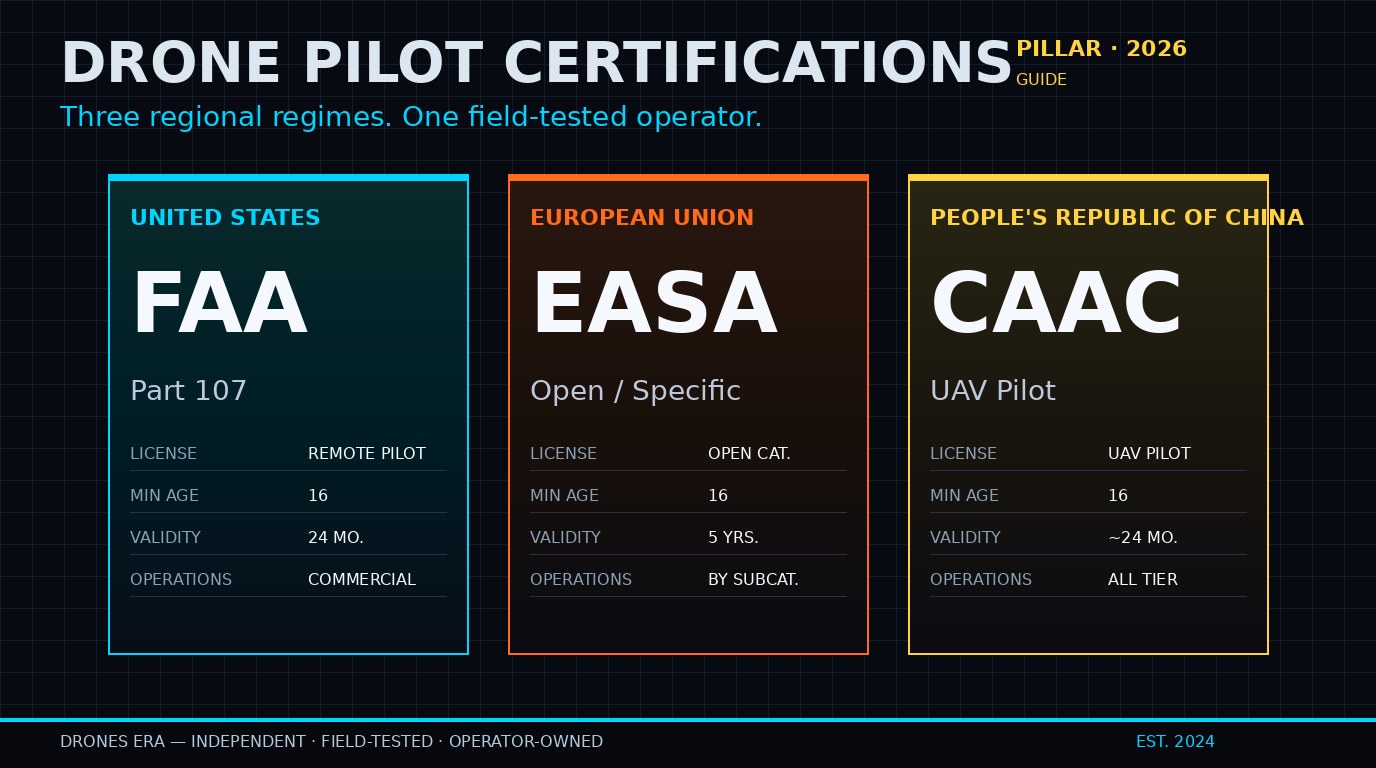
There is no single global drone pilot license you can hold in 2026. What exists instead are three regional pilot certification regimes — FAA Part 107 in the United States, CAAC’s UAV pilot license in China, and the EASA Open and Specific categories across the European Union — plus a smaller patchwork of national authorities everywhere else. They share the same philosophy: pass a knowledge exam, demonstrate operational competency, register the aircraft, and stay within risk-based boundaries. But the age thresholds, exam cost, recurrency rules, and how far any one of them gets you when you cross a border vary enough that treating the question as “just one international license” gets operators in trouble. We have written this comparison to be the resource we wish someone had handed us when we were first sorting it out.
FAA Part 107 (United States) — what the certificate actually requires
FAA Part 107 is the United States’ commercial drone pilot certificate, called the Remote Pilot Certificate. To earn one you must be at least 16, proficient in English, and in a physical and mental condition to operate a small unmanned aircraft safely. Most first-time applicants pass the Unmanned Aircraft General – Small (UAG) knowledge test at an FAA-approved testing center; people who already hold a current Part 61 pilot certificate and a recent flight review can complete a shorter online training course instead. After passing, you complete FAA Form 8710-13 in the IACRA system to receive your certificate.
What Part 107 gets you: commercial operations under 55 pounds, daylight by default (with night operations under 107.29), and access to a waiver process for higher-risk work like beyond visual line of sight, operations over people, and operations over moving vehicles. What it does not get you: flying outside the US. Internationally, the FAA has bilateral recognition with very few regulators, and even where recognition exists, operators caution that local procedures and registration still apply on top of the US certificate.
Recurrency is straightforward but unforgiving. The current cycle — per FAA guidance — requires a free recurrent online training every 24 months for all Part 107 holders, regardless of how much you fly. Recreational pilots in the US, separately, need the FAA TRUST certificate, which is a different and lighter credential.
For the full mechanics of the US test itself — topics covered, pass rates, study strategy — our Part 107 study guide and our deeper first-time applicant walkthrough cover the playbook in detail.
CAAC UAV pilot license (China) — who needs one, and what changed
China’s Civil Aviation Administration of China (CAAC) administers three practical weight tiers of civil unmanned aircraft, and the license threshold depends on which tier you operate. Operators of micro and light civil drones do not need a pilot license, but they must be proficient in operation, risk awareness, and management rules. Operators of small, medium, and large drones do need a formal UAS pilot license issued through the CAAC’s training and exam process — the body’s flagship certificate is commonly referred to as the UAV pilot license, with weight-class endorsements on top.
The license structure matters because China’s commercial drone market has scaled faster than most regulators outside it expected. Starting May 1, 2026, drones operating in Chinese airspace must additionally comply with mandatory national standards for real-name registration and network-based operation identification. Industry sources suggest the practical effect is to push hobbyist pilots and small commercial operators toward the same registration pipeline that previously applied only to commercial work, with light-drone operators now needing network identification even when no pilot license is required.
CAAC licenses are widely accepted within mainland China for both recreational and commercial operations, and the exam pathway is administered through CAAC-approved training organizations. Foreign operators treating CAAC as the entry point should plan for the language barrier — exam materials and most instructor resources are in Mandarin, and very few CAAC-approved training bodies offer English-language pipelines. Acceptability outside China is limited; the license is not generally accepted in FAA or EASA jurisdictions without completing the local certification path.
EASA Open and Specific (European Union) — what changed and what’s coming
The European Union Aviation Safety Agency (EASA) divides civil drone operations into three regulatory buckets: Open, Specific, and (less commonly used for commercial scale) Certified. Open is the entry tier and the one most individual operators and small businesses operate under; it is structured around three subcategories that govern what you can fly, where, and how close you can be to uninvolved people.
Subcategories A1, A2, and A3 are the headline mechanics of Open. A1 covers lighter drones operating over people (but not over open-air assemblies). A2 lets you operate closer to uninvolved people using a medium-risk drone — you must hold an A1/A3 certificate first, complete practical self-training, and pass an additional theoretical exam. A3 is the lowest-risk open class: fly far from people, in sparsely populated areas. Under all subcategories, flights must remain within visual line of sight, below 120 meters in altitude, and cannot carry dangerous goods or drop materials.
Remote pilot certificates issued under EASA Open rules are valid for five years, and the minimum age is generally 16 (though Member States may lower it to 12). Training and exams can be completed in any EASA Member State, which is genuinely useful for operators who travel across the bloc. Specific category sits above Open and is required for higher-risk operations like long-range, beyond visual line of sight, or operations over assemblies; it uses the scenario-based STS 01 (VLOS over controlled ground area in urban) and STS 02 (BVLOS in sparsely populated environment) standard scenarios, with a documented operations manual submitted to the relevant national authority.
Mandatory geozone awareness, online registration, and an updated operator exam are now table stakes across the EU. Operators caution that the practical exam load depends heavily on which Member State you register in — national authorities vary in how they administer the practical training requirement and what they accept as evidence of competency.
Side-by-side: how the three regimes compare
Here is the at-a-glance comparison across the dimensions that actually matter for an operator choosing where to certify:
- Country / bloc — Part 107: USA. CAAC: China. EASA: EU 27 + Iceland, Liechtenstein, Norway, Switzerland (via bilateral).
- Certificate name — Part 107: Remote Pilot Certificate. CAAC: UAV pilot license (weight-class endorsements). EASA: Open category proof of completion (A1/A3 and A2 subcategories); operator certificate for Specific.
- Minimum age — Part 107: 16 (or hold Part 61 + flight review). CAAC: 16+ for the standard license, varies by endorsement. EASA: 16 general, Member States may lower to 12.
- Exam — Part 107: UAG knowledge test at an FAA testing center. CAAC: written plus practical at CAAC-approved training body. EASA: online training + online test for A1/A3, additional theoretical exam for A2; Specific requires operational documentation.
- Validity — Part 107: indefinite, recurrent online training every 24 months. CAAC: industry sources suggest 2-year renewal. EASA Open: 5 years; renewal requires updated training.
- Cross-border acceptance — Part 107: limited (no broad bilateral recognition). CAAC: limited (primarily Mainland China). EASA: portable across all Member States for Open; Specific STS scenarios are mutually recognized across Member States.
- Recreational tier — US has TRUST separately. China has light-tier non-licensed operation + real-name rules. EU uses the Open category A1/A3 entry as the recreational baseline.
If you only operate in one country
Certify locally, full stop. Part 107 is non-negotiable for any US commercial operation; the EASA Open certificate does not let you fly commercially in the United States, and the CAAC license does not transfer. If your business is domestic, the cheapest path to compliant commercial operations is almost always the regulator in your own jurisdiction. The decision tree in our training programs roundup shows the school-quality matrix by region.
If you operate across borders
Cross-border work is genuinely the harder problem. The most common pattern is EASA pilots flying temporarily into Switzerland or Norway (covered by bilateral arrangements), and US Part 107 pilots operating in BVLOS-approved jurisdictions under waivers — but neither certificate grants unilateral commercial access to the other’s market. The pragmatic path for a US or EU operator flying into a third country is to hire a local pilot holding that country’s certificate and operate under their authority.
What the world does not yet have — and what ICAO is laying the groundwork for — is a harmonized international remote pilot license that would let one certificate unlock multiple jurisdictions. ICAO Annex 1, the international standard for personnel licensing, established international standards for remote pilot licences applicable since November 2022, but those standards are implemented by individual Member States rather than serving as a single internationally-recognized pilot credential.
What changed in 2026 — and what to watch
The headline 2026 shifts worth flagging: China expanded its mandatory real-name registration and network-identification rules effective May 1, 2026 — a significant reach into light-tier operations previously outside that pipeline. The FAA’s Part 107 framework keeps evolving with incremental rule changes (BVLOS rule publication, continued Remote ID enforcement) that expand what authorized operators can do. EASA’s regulatory framework for civil drones, anchored in EU Regulation 2019/947, continues to roll forward with amended Easy Access Rules that operators must track through the official EASA portal.
If you are planning to certify in 2026: pick the certificate that matches where you actually operate, complete the knowledge component first (it is the gating step in every regime), and assume any cross-border work will require additional local credentialing on top of your home country certificate.
Frequently asked questions
Can I fly commercially in the EU with my FAA Part 107 certificate?
No. Part 107 is a US credential; to fly commercially in any EASA Member State you must hold either an Open category proof of completion (lower-risk operations) or a Specific category operational authorization (higher-risk work). Some recreational allowances exist under A1/A3 for very low-risk flights, but commercial operations require the EASA path.
Do I need a license to fly a sub-250g drone recreationally in the US?
No. Sub-250g recreational flights do not require a Part 107 certificate, but the FAA TRUST certificate is mandatory for all recreational pilots, plus you must follow community-based organization guidelines.
How long is the FAA Part 107 exam?
The UAG knowledge test is computer-based at FAA-approved testing centers, and covers airspace, weather, sectional charts, drone loading and performance, and emergency procedures. Industry sources suggest it takes most applicants 60–90 minutes to complete, with three attempts allowed within a single application cycle.
Does the EASA Open certificate let me operate BVLOS?
No. Open category requires visual line of sight at all times. BVLOS work in the EU falls under the Specific category and requires an STS 02 declaration or a full operational authorization.
Will there ever be one global drone pilot license?
ICAO’s Annex 1 sets international standards for remote pilot licences, but each country still issues its own certificate against those standards. A genuinely portable international license is plausible in the decade ahead but does not exist today.
Sources
- FAA — Become a Drone Pilot (Part 107 commercial operator overview)
- FAA — Unmanned Aircraft Systems (UAS) main portal
- EASA — Civil Drones Regulatory Framework
- EASA — Easy Access Rules (current regulations with amendments)
- CAAC — Civil Aviation Administration of China — English Portal
- ICAO — Annex 1 — Personnel Licensing (incl. Remote Pilot Licence standards)
