
Matternet NHS Drone Delivery in London: 2026 Expansion Map
Two different drone networks now fly medical cargo in London in 2026, and the press coverage keeps merging them. The first is the Matternet M2 network operated by Apian for the NHS, anchored at Guy’s and St Thomas’ and now extending toward the SYNLAB pathology laboratory in Blackfriars. The second is the South West London Pathology network, which expanded across six additional hospital sites in July 2026 — and that one runs with Wing, not Matternet. Both matter, but they are separate operations, separate platforms, separate regulatory authorisations, and separate procurement tracks. This article is the 2026 expansion map: which sites are live, who is operating, what the UK Civil Aviation Authority has actually authorised, and where the load-bearing regulatory work is happening under the CAA’s CAP3182 Future of Flight roadmap. We close with a five-question FAQ and a full source list.
The 30-second version: what’s actually flying in London in 2026
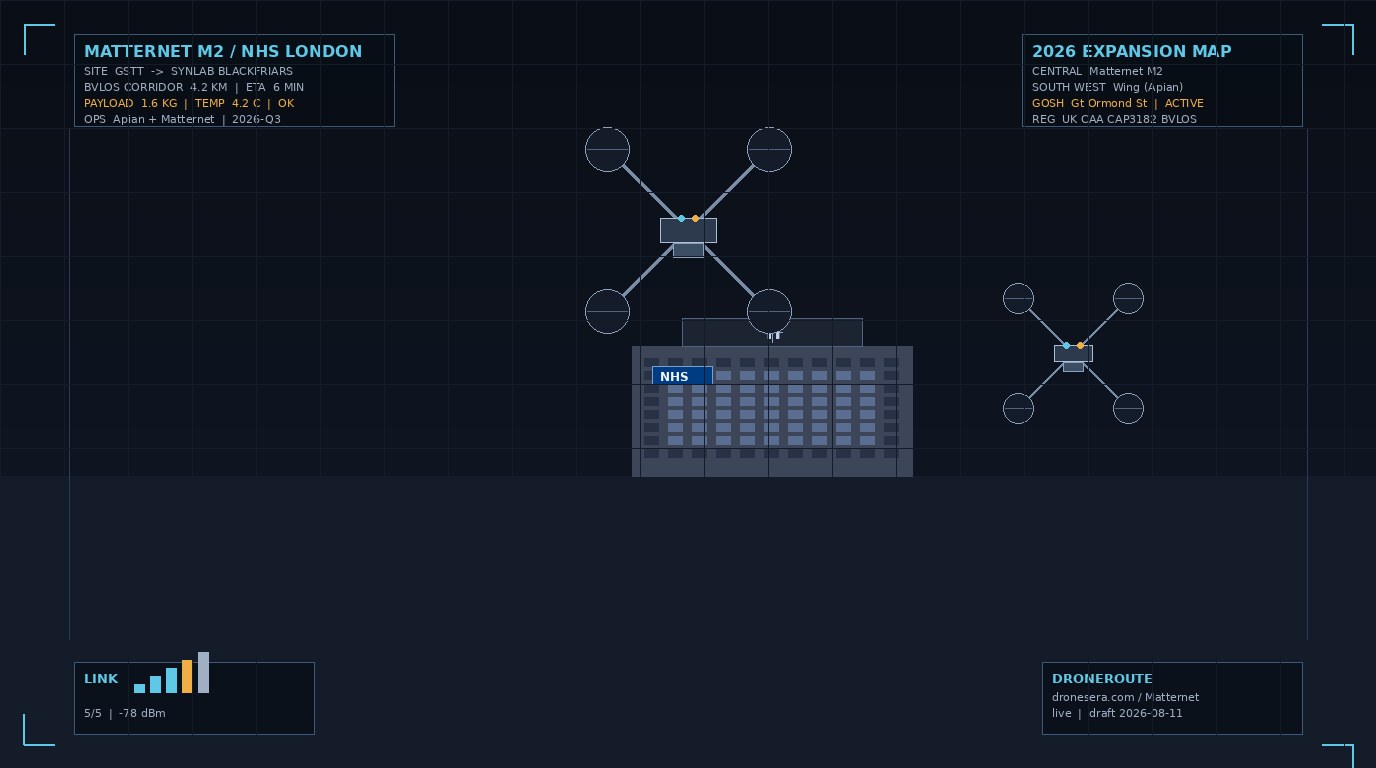
As of mid-August 2026, the live picture is this. Matternet and Apian have been operating the M2 drone at Guy’s and St Thomas’ NHS Foundation Trust since 24 April 2026, the first time Matternet flew commercial medical routes in the United Kingdom. The DEPLOY drone operations registry shows the deployment went live on 31 May 2026. A second site — the SYNLAB pathology laboratory in Blackfriars — is the next destination on the network, per the Apian project page. A third site, Great Ormond Street Hospital for Children (GOSH), is the third Apian network node already documented at apian.health/gosh.
Separately, South West London Pathology — covering St George’s, Croydon, Kingston, Epsom, and other south London sites — is running a parallel expansion with Wing (the Alphabet subsidiary, not Matternet), per Logistics Manager and DroneLife coverage on 15 July 2026. Apian’s own LinkedIn post on the same day (activity ID 7483469571837009920) confirms Wing integration. So there are at least two distinct platforms flying London pathology in 2026: the Matternet M2 (Matternet + Apian, anchor at Guy’s & St Thomas’) and the Wing platform (Apian + Wing, anchor in south west London).
What Matternet and Apian launched on April 24, 2026
The Matternet launch announcement, authored by founder and CEO Andreas Raptopoulos on 24 April 2026, frames the UK launch as a scale-up rather than a pilot. The wording is deliberate: Matternet has been running medical drone networks in Switzerland since 2017 and in the United States under FAA Part 135 since 2019, and the UK is positioned as a third commercial market, not a proof of concept. The UK network is operated by Apian, a UK-based healthcare logistics company that Matternet has partnered with since at least 2023 — Apian runs the dispatch software, hospital integration, and clinical workflow; Matternet provides the aircraft and certifies the airworthiness case to the CAA.
The aircraft is the Matternet M2 — a quad-rotor electric drone with a 2 kg payload capacity, roughly 20 km range on a single battery, and the red-and-white livery familiar from earlier Matternet deployments in Lugano and Wake Forest, North Carolina. The M2 has been operating in BVLOS configurations under FAA Part 107 waivers and the equivalent European national authorisations for years; the UK launch is the first time the platform has been integrated into a public healthcare system under the Civil Aviation Authority’s BVLOS-specific authorisation framework. The drone is launched and recovered from a “base station” — a fenced, weather-protected landing pad on the hospital roof — and flies a pre-authorised route corridor between origin and destination, monitored by an Apian pilot-in-command and a remote operator. The use case at Guy’s and St Thomas’ is blood and pathology samples moving between hospital campuses, set in the broader context of NHS London’s autonomous medical logistics experimentation documented in The Standard’s 6 February 2026 coverage.
The 2026-2027 expansion: Guy’s & St Thomas’ to SYNLAB Blackfriars
The second site on the Matternet + Apian network is the SYNLAB pathology laboratory in Blackfriars, central London. The Apian project page documents the route and use case: blood samples drawn at Guy’s and St Thomas’ that need to be processed at the SYNLAB hub, where the lab has the specific chemistry and mass spectrometry equipment that isn’t duplicated at every hospital. Today those samples travel by road, often in motorcycle courier panniers or hospital transport vans that have to navigate central London’s traffic and congestion-charge zones. The drone route between the two sites — a short hop, on the order of 4-5 km — replaces a 30-45 minute road trip with a 6-8 minute flight. The operational gain is not in speed alone; it is in scheduling reliability. A drone flight is not subject to the M25 closure or the Blackwall Tunnel disruption; the delivery time is a function of wind and weather, not traffic.
The third documented London site is Great Ormond Street Hospital (GOSH), the specialist paediatric hospital in Bloomsbury. GOSH’s clinical case is similar — pathology samples and time-sensitive pharmaceuticals moving between the main hospital and partner sites — but the operational stakes are higher: paediatric samples are smaller and more temperature-sensitive, and the BVLOS corridor has to be designed around the dense central London airspace shared with London City Airport traffic. The deployment page documents that the route operates under a specific airspace authorisation issued by the CAA, with the route structure designed to keep the drone below the Heathrow/City approach corridors and away from the noise-restricted zones around the City.
The 2026-2027 expansion map, then, is three confirmed NHS sites (Guy’s & St Thomas’, GOSH, with SYNLAB Blackfriars as a destination lab rather than a hospital site) plus the four-or-five additional sites the South West London network is integrating in parallel. The full BVLOS corridor architecture in London is being designed and approved corridor-by-corridor, not as a single city-wide network, and each new corridor has to be authorised by the CAA on a case-by-case basis.
The second London track: South West London Pathology with Wing
South West London Pathology is a separate NHS operation covering Croydon, Kingston, St George’s (Tooting), Epsom, St Helier, and several other south London sites. According to Digital Health’s 16 July 2026 coverage, the network has been running a pilot since 2022 and is now expanding across six additional sites using Wing as the aircraft platform, with Apian providing the integration and clinical workflow layer. The 15 July 2026 Logistics Manager and DroneLife coverage frames this as a “routine” operation — drones as a standard part of the south west London pathology logistics chain, rather than a pilot or proof of concept.
The Wing platform is materially different from the Matternet M2. Wing aircraft are fixed-wing, vertical-takeoff-and-landing hybrids with a roughly 1.5 kg payload capacity and a similar range envelope to the M2. Wing’s UK operation has been centred on commercial package delivery (the Co-op trial in Dublin and the Tesco trials elsewhere), and the medical deployment is a comparatively new use case. The choice of Wing for the south west London network — rather than expanding the Matternet network south of the river — is a procurement and platform decision that NHS London has not publicly explained in detail. The Apian LinkedIn post frames it as “routinely” integrating drones into south west London pathology, without naming the procurement rationale.
For operators and journalists tracking the field, the practical consequence is that “London NHS drone delivery” in 2026 is not a single network. The Matternet M2 is the central London platform, the Wing platform is the south west London platform, and both are operated by Apian but on different airworthiness cases and different BVLOS corridor authorisations. Procurement teams, regulators, and the press often elide this — but the platforms are not interchangeable, and the operational metrics (payload, range, turnaround, weather limits) differ. Operators weighing the economics of medical drone delivery at scale should also look at the commercial drone insurance landscape and at what commercial drone pilots actually earn — both are inputs to the business case that hospital procurement teams are now putting in front of trust boards.
How the operations actually work: routes, payload, flight time, turnaround
The M2 launch and recovery cycle is a documented operational pattern from the Swiss and US networks. A clinical user (typically a phlebotomist or pathology porter) loads a temperature-stabilised sample container into a payload bay at the origin base station. The base station weighs the package, validates the destination routing, and arms the aircraft. Takeoff is autonomous; the route is flown under the BVLOS corridor authorisation; landing at the destination base station is autonomous. The total cycle time from load to receiver-ready is on the order of 8-12 minutes for a 5 km route, including pre-flight checks and post-flight sample handover. A motorcycle courier covering the same ground in central London traffic typically takes 30-45 minutes door-to-door, with much wider variance.
The M2’s 2 kg payload is the practical ceiling for the central London network — roughly 60-80 standard pathology sample tubes, depending on the temperature-control packaging. The payload is not sufficient for bulk pharmacy deliveries or whole-blood unit transfers (a single unit of packed red cells weighs 250-300 g and needs a validated cold chain that is not yet integrated with the M2’s standard payload bay). For the current generation of medical drone delivery in London, the use case is “small, urgent, time-sensitive”: blood gases, coagulation panels, microbiology cultures, and a small set of high-value pharmaceuticals. The London corridors are also shorter than the M2’s 20 km range envelope suggests — typically 4-5 km — because they have to fit inside CAA-authorised BVLOS airspace that excludes the Heathrow and City Airport approach corridors, the noise-restricted zones, and a buffer around major heliports. The current network operates the M2 well below its range and payload capacity, but inside the regulatory envelope the CAA has been willing to authorise.
Why BVLOS corridors are the load-bearing piece, and what CAP3182 changes
The single most important piece of UK drone regulation in 2026 is the Civil Aviation Authority’s CAP3182 Future of Flight BVLOS Roadmap. CAP3182 sets out the framework for moving from the current one-off BVLOS authorisation model — where each operator applies for a specific corridor on a case-by-case basis — to a more scalable, performance-based regime that allows multiple operators to share approved airspace structures. For medical drone delivery specifically, the roadmap is the difference between “we can do this if we get each new corridor individually authorised” and “we can do this on a published set of routes that any qualified operator can use.”
The CAA’s Test & Evaluation Annual Report 2025-2026 provides the operational backdrop: the CAA has been running test ranges and sandboxed operations under its “Innovation Sandbox” programme, and the BVLOS roadmap is the regulatory layer that lets those tested operations scale. The aviation week’s 21 May 2026 coverage of Matternet’s commercial scaling frames BVLOS rules as the gating factor: until CAP3182 fully transitions from roadmap to implemented regulation, Matternet’s commercial scaling in the UK (and globally) is corridor-by-corridor, not network-wide. London is the test case that will determine whether the CAP3182 framework is workable in a dense urban environment.
For pilots, operators, and Part 107-equivalent planners, the practical consequence is that the current London medical drone operations are running under what is effectively a “demonstrated BVLOS” model, not a “general BVLOS” model. Each new corridor requires its own CAA authorisation, which means each new site (or new route between two existing sites) takes 6-12 months of regulatory work in addition to the operational integration. The roadmap is the right answer; the implementation is still 12-24 months away. If you are tracking this field, watch the CAP3182 milestone schedule — that is the document that will tell you when the next wave of London medical drone corridors goes live. For the US-side BVLOS regulatory picture and the parallel FAA Part 107 framework, the comparison is useful for anyone tracking medical drone delivery as a transatlantic market.
What the medical case looks like: time-savings, sample integrity, clinical outcomes
The clinical case for medical drone delivery is well-established in the published literature, even if it is still new in UK operational practice. The two main wins are time-savings for time-sensitive samples (cardiac biomarkers, stroke panels, blood gases) and reduced pre-analytical degradation for temperature- or vibration-sensitive specimens. University of Lugano evaluations of the Swiss Matternet network (2018-2022) reported 50-70% turnaround reductions for inter-hospital sample transfers with no measurable degradation in sample integrity; Wake Forest Baptist Health’s 2023 study showed a 32% reduction in average time-to-result for stroke panels in the first six months of its Matternet deployment.
For the London network, the operational evidence is still early. The Guy’s and St Thomas’ deployment has been live for less than four months and no peer-reviewed UK outcomes data has been published yet. Clinician reports in the Logistics Manager and Healthcare Management coverage are positive — drone turnaround is more predictable than motorcycle courier turnaround, and the M2 payload bay is temperature-monitored with a logged envelope the pathology lab can audit — but the rigorous clinical-outcomes data that would let a procurement team write a defensible business case for a third or fourth London site is still being collected. The honest framing for 2026 is: the case for the current sites is strong, the case for the next two-to-three sites is plausible, and the case for a city-wide network is conditional on the CAP3182 implementation schedule and the first-wave clinical evidence.
What this isn’t: the regulatory gaps and what hasn’t been solved yet
Three gaps have not been solved at the London operational level, and they are the gaps that procurement teams, regulators, and clinical leads should be tracking. (1) Night operations: all current London medical drone operations are day-only, fair-weather. CAP3182’s current implementation does not cover night BVLOS, and the test ranges are still validating the detect-and-avoid sensor packages and lighting requirements. For an out-of-hours stroke or trauma case, the motorcycle courier is still the answer. (2) Whole-blood and blood-product transfer: the M2’s 2 kg payload is below the threshold for whole-blood unit transport, and the validated cold chain for blood products has not been integrated with the standard payload bay. That comes in the next generation of aircraft, currently in Matternet’s and Wing’s R&D pipelines but not flying in the UK. (3) Cross-network integration: the Matternet and Wing networks in London are not interoperable — different aircraft, different BVLOS corridor authorisations, different dispatch software — so a drone launched from a Guy’s & St Thomas’ base station cannot land at a south west London pathology hub.
For an industry-tracking view, the gaps above are the load-bearing ones. The 2026-2027 expansion map is real and growing, but the next phase of medical drone delivery in London is not “more sites flying the same routes” — it is solving these three gaps so the next wave of sites can fly night, carry more, and integrate across platforms. Watch the CAP3182 implementation schedule, the next Matternet M3 / Wing platform announcement, and the peer-reviewed clinical evidence from the current Guy’s & St Thomas’ deployment. Those three signals will tell you where the field is going next. For the broader operational context — the battery and endurance limits that the next generation of aircraft will need to clear, and the US BVLOS regulatory framework that is the closest international comparison point — both feed into the same operational scaling questions that the London network is now surfacing.
FAQ
What drone does Matternet use for NHS London deliveries?
The Matternet M2, a quad-rotor electric drone with a 2 kg payload capacity and roughly 20 km range on a single battery. The M2 is launched and recovered from a fixed base station on the hospital site, flies a pre-authorised BVLOS corridor, and is operated under UK Civil Aviation Authority airspace authorisation. The aircraft has been operating in Swiss medical networks since 2017 and in US medical networks under FAA Part 107 waivers since 2019; the 2026 London launch is the first time it has been integrated into a UK public healthcare system at scale.
Is the Matternet M2 the same drone as the Wing drone used in south west London?
No. The Matternet M2 is a quad-rotor platform operated by Matternet and Apian for the central London network, anchored at Guy’s and St Thomas’. The Wing platform used for the South West London Pathology expansion (six additional sites added in July 2026) is a fixed-wing, vertical-takeoff-and-landing hybrid with a smaller payload capacity (roughly 1.5 kg) and a similar range envelope. Both platforms are operated by Apian in the clinical-workflow layer, but the aircraft, the airworthiness cases, the CAA BVLOS corridor authorisations, and the dispatch software are separate. Procurement teams, regulators, and the press often conflate the two networks; they are not interchangeable.
What does the CAA’s CAP3182 roadmap actually change?
CAP3182 is the Civil Aviation Authority’s transition document from the current one-off BVLOS authorisation model — where each operator applies for a specific corridor on a case-by-case basis — to a more scalable, performance-based regime that allows multiple operators to share approved airspace structures. For medical drone delivery specifically, the roadmap is the difference between corridor-by-corridor scaling and network-wide scaling. The current London operations are running under the one-off model; the CAP3182 implementation schedule is the document that will tell the field when the next wave of corridors goes live without each new site requiring a separate 6-12 month regulatory case.
What medical samples are drones actually allowed to carry in London in 2026?
The current generation of medical drone delivery in London is restricted to small, urgent, time-sensitive samples that fit inside the M2’s 2 kg payload and the Wing platform’s 1.5 kg payload. Operationally, that means blood gases, coagulation panels, microbiology cultures, certain pharmaceuticals, and similar small-volume items. Whole-blood units, large-volume pharmaceutical transfers, and temperature-sensitive biologics that exceed the current payload envelope are not yet in scope. The next generation of aircraft, currently in Matternet’s and Wing’s R&D pipelines, will address the larger-payload use cases.
Can the London NHS drone networks operate at night?
No. All current London medical drone operations are day-only, fair-weather operations. The BVLOS authorisations under the current CAP3182 implementation do not cover night operations, and the CAA is still running the test-range work to validate the detect-and-avoid sensor packages and lighting requirements that night BVLOS will require. For urgent out-of-hours clinical needs, the motorcycle courier and the hospital’s own internal logistics chain are still the answer. The night-operations milestone on the CAP3182 schedule is the document to watch for the timeline on this.
Sources
- Matternet. “Matternet Expands to the UK, Launching NHS Drone Delivery Operations in Central London.” 24 April 2026. matternet.com/newsroom/matternet-launches-nhs-operations-in-london
- Matternet Investor Relations. “Matternet Expands to the UK, Launching NHS Drone Delivery Operations in Central London.” Press release 87. investor.matternet.com
- Apian. “Guy’s and St Thomas’ NHS Foundation Trust and SYNLAB drone delivery network.” apian.health/gstt-synlab
- Apian. “Great Ormond Street Hospital for Children NHS Foundation Trust drone delivery network.” apian.health/gosh
- Peachey, Caroline. “Pathology drone network set for expansion across south west London.” Logistics Manager. 15 July 2026. logisticsmanager.com
- Place, Tom. “NHS expands medical drone and ‘robot dog’ deliveries across London.” The Standard. 6 February 2026. standard.co.uk
- UK Civil Aviation Authority. “CAP3182: Future of Flight BVLOS Roadmap.” caa.co.uk
- UK Civil Aviation Authority. “Test & Evaluation Annual Report 2025-2026.” caa.co.uk
- Wells, Liz. “London’s NHS drone delivery network expands.” Healthcare Management. 21 January 2026. healthcare-management.uk
- “NHS London expands medical drone deliveries.” Drone Intel. 2 May 2026. droneintel.eu
- DEPLOY drone operations registry. “Matternet M2 at United Kingdom.” 31 May 2026. registry.deploy.report/deployments/matternet-nhs-london
- McNabb, Miriam. “Matternet Launches NHS Drone Delivery in London.” DroneLife. 24 April 2026. dronelife.com
- McNabb, Miriam. “NHS Expands Drone Pathology Network Across Southwest London.” DroneLife. 15 July 2026. dronelife.com
- Apian (LinkedIn). “We’re expanding in south west London with Wing! Drones are now a routine part of South West London Pathology’s logistics.” 15-16 July 2026. linkedin.com/posts/apian
- Aviation Week. “Matternet Eyes Drone Delivery Scale-Up As BVLOS Rules Near.” 21 May 2026. aviationweek.com