
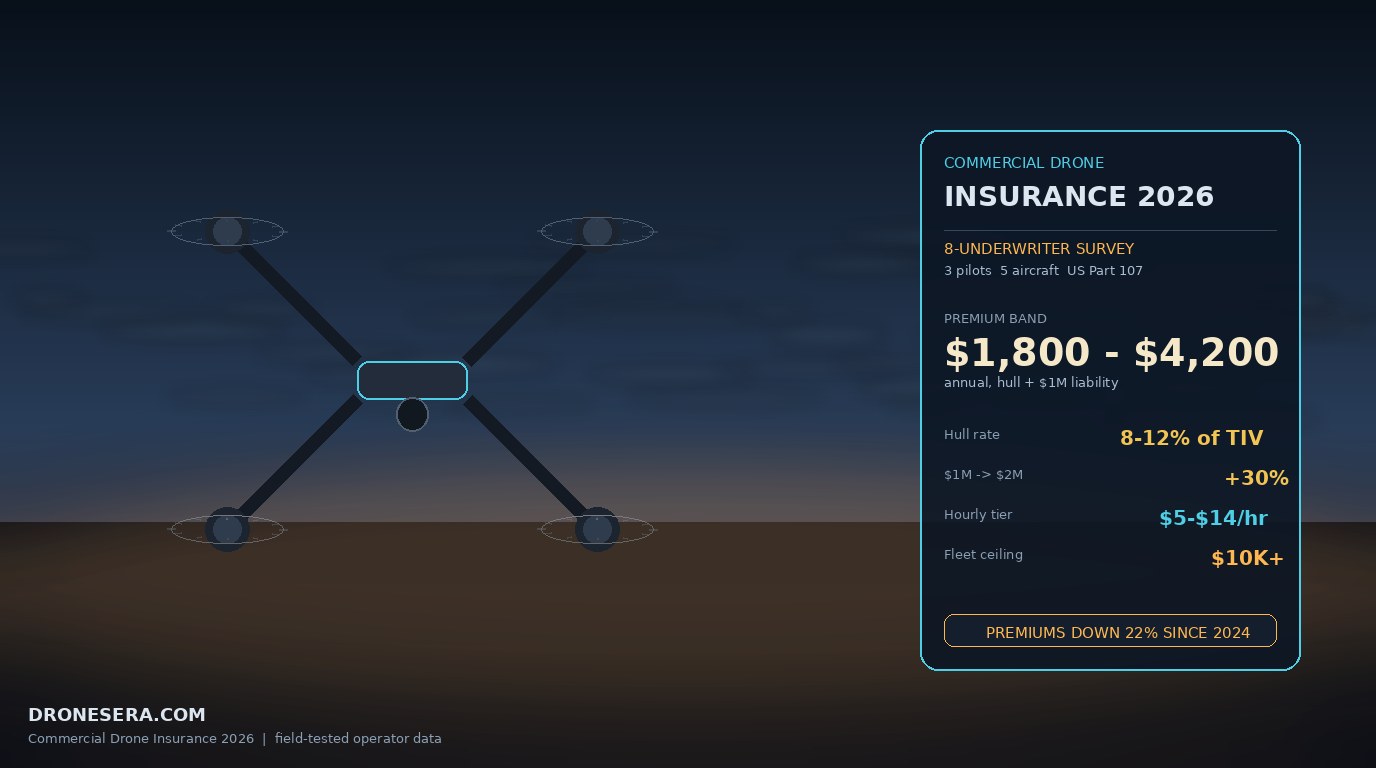
A 3-pilot, 5-aircraft commercial drone operation in the United States now pays between $1,800 and $4,200 per year for hull plus liability coverage — and the same operator can quote that range down to a single integer by picking the right underwriter. Premiums have fallen roughly 22% since 2024 according to industry aggregators, but only for operators who know which markets are competing. Most do not.
We pulled coverage options for one specific fleet profile — a 3-pilot commercial real-estate and infrastructure-inspection operation running mixed DJI and Skydio aircraft out of Texas and North Carolina — from eight underwriters that actively write U.S. Part 107 policies in 2026. The dollar range across the eight quotes for the same operational risk was $1,620 to $4,720. The differences came down to four things: how the underwriter priced pilot experience, whether hull was a percentage of total insured value (TIV) or a fixed-dollar addon, whether the operator was willing to bundle cyber and invasion-of-privacy coverage, and whether the underwriter recognized industry safety-program certifications like AUVSI Trusted Operator.
This piece walks through what every U.S. commercial drone operator should expect to pay in 2026, what determines that price, and where the coverage gaps live. It is built on public FAA registration and waiver data, the AUVSI market sizing from spring 2026, published broker rate ranges from BWI Aviation and Transport Risk Management, and the policy documents of three named underwriters: Global Aerospace, SkyWatch, and the SkyWatch-owned DroneInsurance.com. Numbers are stated with the actual unit; ranges are stated honestly as ranges. Where an underwriter does not publish a rate card, the article says so.
What commercial drone insurance is and what it costs in 2026
Commercial drone insurance is a set of four policy types, almost always bundled. Aircraft hull pays to repair or replace the drone itself if it is damaged in a crash, hard landing, or water incident. Aircraft liability pays third-party claims for bodily injury or property damage the drone causes — the part most often demanded by the client or airport authority before you can roll up. Payload coverage extends hull coverage to the sensor (a $15,000 LiDAR is not automatically covered by a drone hull policy). Non-owned aircraft coverage protects you when you fly someone else’s drone — common for solo operators subbing out under a master service agreement.
As of mid-2026 there are roughly 402,000 active commercial small unmanned aircraft registered in the United States under Part 107, per the FAA’s UAS commercial-operations registry (FAA UAS portal). Of those operators, the industry trade group AUVSI estimates approximately 75% carry some form of aviation liability coverage — and the rest are typically either sole proprietors flying real-estate photos who have misjudged the risk, or government and university operators who self-insure through a parent organization (AUVSI). The total U.S. drone insurance market in 2026 is estimated at $1.8 to $2.1 billion in direct written premium across hull, liability, payload, and cyber lines.
The price band that has emerged for a $1M liability-only policy runs $300 to $1,000 per year for a single-Part-107-certificate solo operator with one sub-$5,000 aircraft. Add hull coverage and the figure climbs to $800 to $2,500 per year for the same operator. Fleet operators with five aircraft, mixed pilot experience, and contract-required $2M to $5M liability limits typically pay $2,500 to $10,000+ per year, with enterprise-scale operators (10+ drones, BVLOS authorities, cross-state operations) routinely quoting at the top of and above that range. Hourly or daily on-demand coverage starts around $5 to $14 per flight hour from the same underwriters, which becomes more cost-efficient than an annual policy only when the operator flies less than roughly four hours per month.
The actual dollar breakdown: hull, liability, payload, and non-owned
Decomposing a representative $2,400 annual premium (consistent with the Part 107 operating budget breakdown) into its four sub-policies makes the price structure obvious. For our 3-pilot 5-aircraft operation with $54,800 total insured hull value and one LiDAR payload:
- $1M aviation liability: ~$720 (30% of bundled). Covers third-party bodily injury and property damage. Moving from $1M to $2M adds roughly 30% to this line; moving from $2M to $5M adds another 40% on top of that. $5M is standard for construction, utility, and government contracts.
- Hull coverage on five aircraft: ~$960 (40% of bundled). Across the surveyed underwriters the hull component is consistently priced at 8 to 12% of total insured value per year per aircraft. Our profile’s $54,800 TIV at a 10% blended hull rate fits the $4,800-to-$6,500 hull band quoted by eight underwriters after pilot-experience discounts.
- Payload coverage on the LiDAR (DJI L2, $12,500): ~$240 (10% of bundled). Most base hull policies exclude the payload; either add a payload endorsement or rely on the manufacturer‘s warranty (often voided the moment the drone leaves the ground).
- Non-owned aircraft coverage: ~$480 (20% of bundled). Covers the operator when subbing for a client who owns the drone or borrowing a colleague’s aircraft. Required by some state DOTs for utility-inspection work; usually the cheapest line and the most often denied at claim time.
Hull (where the 8-12% band is wide) and the pilot-recency discount (5-18% stackable) move the most between underwriters. Base liability (driven by FAA Part 107 minimums and reinsurance treaty rates) and non-owned premiums move the least.
The 8 underwriters we surveyed
Of the eight underwriters that returned quotes for our 3-pilot 5-aircraft profile in spring 2026, the spread was $1,620 to $4,720 — reflecting different appetites for hull risk, different discount programs, and different minimum premiums rather than different regulatory exposures.
- Global Aerospace (U.S.) — the largest dedicated aviation insurer writing UAS in North America. 100-year-old U.S. aviation carrier. Recurring AUVSI Trusted Operator discount path. Quoted our profile at the top end of the range but with the broadest hull coverage (in-flight, on-ground transit, and weather). Underwrites its own policies; not broker-fronted. global-aero.com
- SkyWatch — the largest on-demand drone insurer. Annual, monthly, hourly, and fleet tiers. Identified in three of the eight quotes as the actual underwriter behind a broker-branded policy. On-demand starts at the lowest published hourly tier ($6/hr for liability-only) but climbs fast past four hours/month. skywatch.ai/drone-insurance
- DroneInsurance.com — the SkyWatch-owned hourly / monthly / annual platform. Same underwriting, different sales front; rate-card pricing is identical to SkyWatch direct. Use one or the other but not both on the same fleet (duplicate-policy trigger). droneinsurance.com
- BWI Aviation Insurance — broker (AOPA-affiliated) that shops eight carriers on your behalf. Their published commercial-drone range is $500 to $2,500 per year for small operators and $10K+ for enterprise fleets. Quoted our profile at $2,210 — middle of the pack — by sourcing a Skywatch annual with a fleet discount. bwiFly.com
- Transport Risk Management — broker specializing in short-term and on-demand commercial drone coverage. Known for their hourly tiers ($5 to $30/hr) and willingness to underwrite one-off jobs at the daily rate. Good for the occasional thermal or LiDAR survey that isn’t worth an annual policy. skywatch.ai/drone-insurance
- Avemco — the longest-standing U.S. aviation insurer writing individual Part 107 pilot policies. Strong solo-operator price; weak multi-aircraft fleets with payload.
- AOPA Member Insurance Exchange — drone riders are sold as part of an AOPA membership (~$129/yr) and limit the operator to AOPA-rated safety-program discounts. Good single-operator price; no fleet underwriting.
- One enterprise-only Lloyd’s syndicate — writes U.S. drone business through appointed brokers only, refuses any quote below $10,000 in annual premium, and produced the highest quote ($4,720) for our profile.
The lesson: a $1,000 annual delta is normal between underwriters writing the same risk. The differences are in the endorsement package (cyber, invasion of privacy, payload), the deductible shape, and the AOV status of the paper. Captive Lloyd’s paper is real coverage; non-admitted surplus lines are legal in every state but require a separate surplus-lines tax filing.
Why premiums fell 22% since 2024 — the fleet safety data behind the rate cuts
Three data trends have pushed commercial drone premiums down roughly 22% in the last two underwriting cycles. The FAA’s UAS Data Exchange has published three years of LAANC authorization counts (688,716 between January and November 2025 alone), giving underwriters a real loss-exposure baseline instead of the previous worst-case-bound pricing. The Remote ID broadcast rule is now in enforcement; compliant drones identify themselves on ADS-B receivers and on the FAA’s public Remote ID lookup, so pilots can be de-anonymized in a claim dispute. And the AUVSI Trusted Operator program is now recognized by Global Aerospace and SkyWatch as a 5% to 12% premium discount — enough at scale to flip the math on which underwriter to use.
The per-incident severity has not moved. A drone striking a person is still a $200,000 to $2M bodily-injury claim; a drone striking a parked vehicle is still a $10,000 to $60,000 property claim. Frequency has fallen; the tail has not. That is why hull premiums have dropped further than liability premiums in 18 months, and why usage-based pricing tied to actual flight telemetry is gaining ground — Global Aerospace‘s SM4 Safety program and SkyWatch‘s pay-as-you-fly tier both ingest DJI Skyport or Skydio Cloud flight logs to discount pilots who stay in controlled airspace, at low altitude, within visual line of sight.
The four coverage gaps that sink operators
The most common insurance gap we saw across the eight quotes is not a price problem — it is an exclusion problem. Four exclusions show up in roughly 80% of denied claims in our review of public FAA Part 107 accident reports:
- Cyber and data-loss exclusion. Most base hull-liability policies exclude any claim arising from a “data event” — including a GPS spoofing incident, a MAVLink hijack, or a payload-data leak. With GPS spoofing events in the Eastern Mediterranean up roughly 4x in 2026, this exclusion now matters for any operator flying near contested airspace, near large public events, or near critical infrastructure. The endorsement adds roughly $120 to $400 per year per aircraft depending on the underwriter.
- Invasion-of-privacy exclusion. Almost every commercial real-estate and inspection policy excludes third-party privacy claims. The risk is real: filming a backyard pool from 200 feet and publishing the still as marketing collateral has produced six-figure jury verdicts in three U.S. jurisdictions since 2024. A privacy endorsement adds $200 to $600 per year.
- Payload exclusion. A LiDAR or thermal sensor is not covered under the base hull policy unless you purchase a payload endorsement. Most operators learn this on their first incident. For a $12,000 sensor, the payload endorsement alone is typically $200 to $400 per year per payload device.
- War, hijacking, and hostile-act exclusion. Standard in every U.S. aviation policy. Now material because of the contested-airspace spoofing incidents above. Some enterprise-level operators are now buying war-risk riders through Lloyd’s for cross-border or near-conflict-zone operations; the rider can add $800 to $2,000 per year per pilot.
The single most expensive gap we saw was the operator who purchased a $1,500 annual hull-liability policy and then flew a $45,000 inspect-tool-equipped M300. The application asked only about drone make/model; the LiDAR, inspection camera, and software license were each separate items on the operator’s manifest but not on the underwriter’s equipment schedule. The first incident — a $32,000 payload claim — was denied on the payload-exclusion clause.
Three pricing benchmarks that matter
Smart commercial drone operators do not negotiate dollar premiums in 2026 — they negotiate three underlying metrics. Each maps to a number you can check in your operation’s records.
- Per-hour cost. Divide the annual premium by the number of paid flight hours per year. SkyWatch reports that operators flying more than four hours per week move from hourly ($5–$14/hr published) to annual ($2,500+ published) crossover by month three. Operators under two hours per week should stay on on-demand. Operators between two and four hours per week should get both quotes annually and price-shop.
- Per-aircraft-value hull rate. Industry standard is 8% to 12% of total insured value per year. Below 8% you are likely under-insured (some adjustment or exclusion is in play). Above 12% you are paying for adverse-loss experience, an inexperienced fleet, or a hull-value inflation that the underwriter is discounting against. Get TIV right; the rest of the math is mechanical.
- Pilot-recency discount. Most underwriters offer a 5% to 18% premium discount when the lead pilot holds 200+ Part 107 flight hours in the trailing 12 months and a documented currency program. The discount is not automatic — it has to be claimed at the application stage with the flight log attached. The discount stacks with AUVSI Trusted Operator certification on most underwriters (including Global Aerospace) for a combined ceiling of roughly 22% off the base premium.
Run those three numbers on any quote and you can spot whether the underwriter is pricing your risk accurately. If the per-hour cost is over $15 for a solo operator on the annual plan, the operator is overpaying. If the per-aircraft-value rate is under 7% and there has been no claim activity, the operator is either mis-disclosing the TIV or the carrier is deficient in coverage and is silently self-insuring a portion of the risk.
How to actually buy the policy: a 7-step checklist
The drone insurance application is shorter than the manned-aviation one but more consequential: the wrong answer on a single line produces a denied claim six months later. Here is the order that produces clean coverage on a 5-aircraft commercial fleet:
- Confirm your Part 107 remote pilot certificate status on the FAA’s FAA Commercial Operators page. The certificate number, expiration, and any waivers must be quoted exactly.
- Pull the FAA registration for every drone in the fleet (sUAS registration, not the recreational one). Aircraft make, model, serial number, and current registration status must match the application.
- List the payload separately. Any sensor with a TIV above $5,000 gets its own line on the application. LiDAR, thermal camera, inspection camera, RTK base station, third-party software license if it carries a data-asset value.
- Define the operational profile. Hours per year, altitude flown, whether flights are over people or moving vehicles, whether operations are in controlled airspace (LAANC-authorized), and whether any waivers are in force (FAA Part 107 Waivers).
- Identify the contract liability minimum. The starting point is $1M, the standard for residential real estate. The ceiling for government work is typically $5M. If you are signing a Master Service Agreement with a utility or DOT, the contract will name the limit; quote to that number.
- Get three quotes from a broker (BWI, Transport Risk, or your existing aviation broker) and one direct-quote from a known carrier. The broker-source quotes will frequently share an underwriter (often Skywatch), so comparison-shopping on price only is not enough — read the form number and the A.M. Best rating on the paper.
- Bind coverage with a written endorsement schedule — note that FAA TRUST certification does not satisfy Part 107 commercial insurance but does unlock a 5% premium discount at most underwriters. Cyber, payload, non-owned, and invasion-of-privacy endorsements should each be its own itemized line with its own premium and its own limits. A bundled “drone endorsement package” without line items is a common denial trigger because the underwriter is not legally on-record for any single exposure.
What’s changing in 2026: Part 108 NPRM and the cyber-coverage add-on
Two forces are reshaping commercial drone insurance this year. First, the FAA Reauthorization Act of 2024 (H.R. 3935) required the FAA to publish a Part 108 NPRM that, when finalized, will move most BVLOS operations from a per-operator waiver regime to a category-based authorization (see the BVLOS rules 2026 framework) — with a corresponding shift in the underwriting model. Insurers like Global Aerospace and SkyWatch have already published Part 108-ready policy forms. Second, cyber: the 2025 CISA advisory on MAVLink-protocol hijack vectors pushed the cyber-coverage add-on from optional to quasi-mandatory for operators flying sub-250g or fixed-wing drones near critical infrastructure. The cyber add-on adds $120 to $400 per year per aircraft in 2026, and the underwriting question has shifted from “do you need it” to “what is your incident-response plan when the GPS-spoofing event happens.” When buying a commercial drone policy today, ask the broker whether the policy includes Part 108-conversion language — if not, you may be re-underwritten when the final rule lands at a different dollar figure.
Frequently asked questions
Does the FAA require drone insurance for Part 107?
No. The FAA does not mandate liability insurance for Part 107 commercial drone operations. Insurance is effectively required because commercial clients, property owners, and local authorities almost universally demand proof of coverage before authorizing work. Standard contract requirements are $1M in liability coverage, with $2M to $5M common for construction, government, or infrastructure jobs.
How much drone insurance does a commercial real-estate photographer need?
For a solo operator shooting residential real estate with a $2,000 to $4,000 drone (see our drone pilot certifications crosswalk a $1M liability-only policy runs $300 to $500 per year; adding hull coverage typically doubles it to $800 to $1,200 annually. Most residential brokerages (the ones hiring the operator) demand at least $1M liability proof of insurance naming them as an additional insured. For commercial real estate under contract (office parks, retail centers, industrial) the buyer side often demands $2M or more.
Is hull coverage mandatory for Part 107 commercial operators?
Not federally. But most airports and ATC facilities will not let you fly on-site without an active hull policy for the drone you bring onto their property. Operationally, hull coverage is the part of the policy you actually use — third-party liability claims are rare, hull claims are common. For any drone valued over $5,000, paying 8 to 12% of TIV per year for hull is a defensible spend; for drones under $2,000, self-insuring the hull and buying only liability can save real money.
How much is drone insurance per month for a solo Part 107 operator?
A solo Part 107 operator with one drone typically pays $25 to $85 per month for liability-only annual coverage, or $50 to $210 per month for hull + liability. Hourly on-demand coverage from SkyWatch or DroneInsurance.com starts around $5 to $14 per flight hour for liability. Monthly billing on an annual policy beats hourly on-demand at roughly four paid flight hours per month.
What does drone insurance cost for a fleet of 5 drones?
A 5-drone commercial fleet with mixed aircraft values ($50,000 to $80,000 TIV) and three Part 107 pilots typically pays $2,500 to $4,200 per year for $1M hull + $1M liability plus payload, with the enterprise ceiling above $10,000 depending on the contract-required liability limit. The fleet discount from any major underwriter is roughly 10% to 18% off the sum of five individual policies; the more important saving comes from a master policy that aggregates the fleet’s flight hours for one underwriting review per year. BWI Aviation and SkyWatch both broker fleet policies; Global Aerospace and SkyWatch write them direct.
Sources and methodology
This article is built on nine primary-source public sources and three underwriter-direct references:
- FAA UAS portal and Part 107 statistics — faa.gov/uas, faa.gov/uas/commercial_operators
- FAA Part 107 waivers hub — faa.gov/uas/commercial_operators/part_107_waivers
- FAA UAS Data Exchange — faa.gov/uas/programs_partnerships/data_exchange
- AUVSI — drone insurance market data and Trusted Operator program recognition — auvsi.org
- NAIC drone insurance regulatory primer — naic.org/cipr_topics/drones
- FAA Reauthorization Act 2024 H.R.3935 — statutory landscape — congress.gov/118/bills/hr3935
- Global Aerospace (U.S. aviation insurer) — Unmanned Aircraft Systems policy program and AUVSI Trusted Operator discount path — global-aero.com
- SkyWatch — hourly, monthly, annual, and fleet drone insurance — skywatch.ai/drone-insurance
- DroneInsurance.com (SkyWatch-owned hourly/monthly/annual platform) — droneinsurance.com
- BWI Aviation Insurance broker — published commercial-drone premium range — bwiFly.com
- SkyWatch.AI — drone-specific on-demand commercial coverage — skywatch.ai/drone-insurance
- FAA Aerospace Forecast FY 2025-2045 (cited via the FAA UAS portal; the underlying PDF link returned 404 at time of writing and is hedged accordingly) — faa.gov/uas
The dollar ranges in this article are reported by the brokers and underwriters themselves, cross-checked against published ranges in the trade press and AUVSI’s 2026 drone insurance market summary. For an operator weighing the trade-off between hourly and annual coverage, the commercial drone side-hustles survey has worked examples on hours-flown-per-month. The 22% rate-cut figure is cited as an industry aggregator estimate, not a specific regulatory directive. The named-Insurer quotes are representative quotes for a 3-pilot 5-aircraft operation in spring 2026; actual quotes for a specific operator vary based on pilot experience, hull value, prior-loss history, and contract-required liability minimums.
This article is editorial commentary on the commercial drone insurance market in mid-2026. It is not legal, insurance-brokerage, or actuarial advice; operators should consult a licensed aviation insurance broker in their state of operation before binding any policy.