
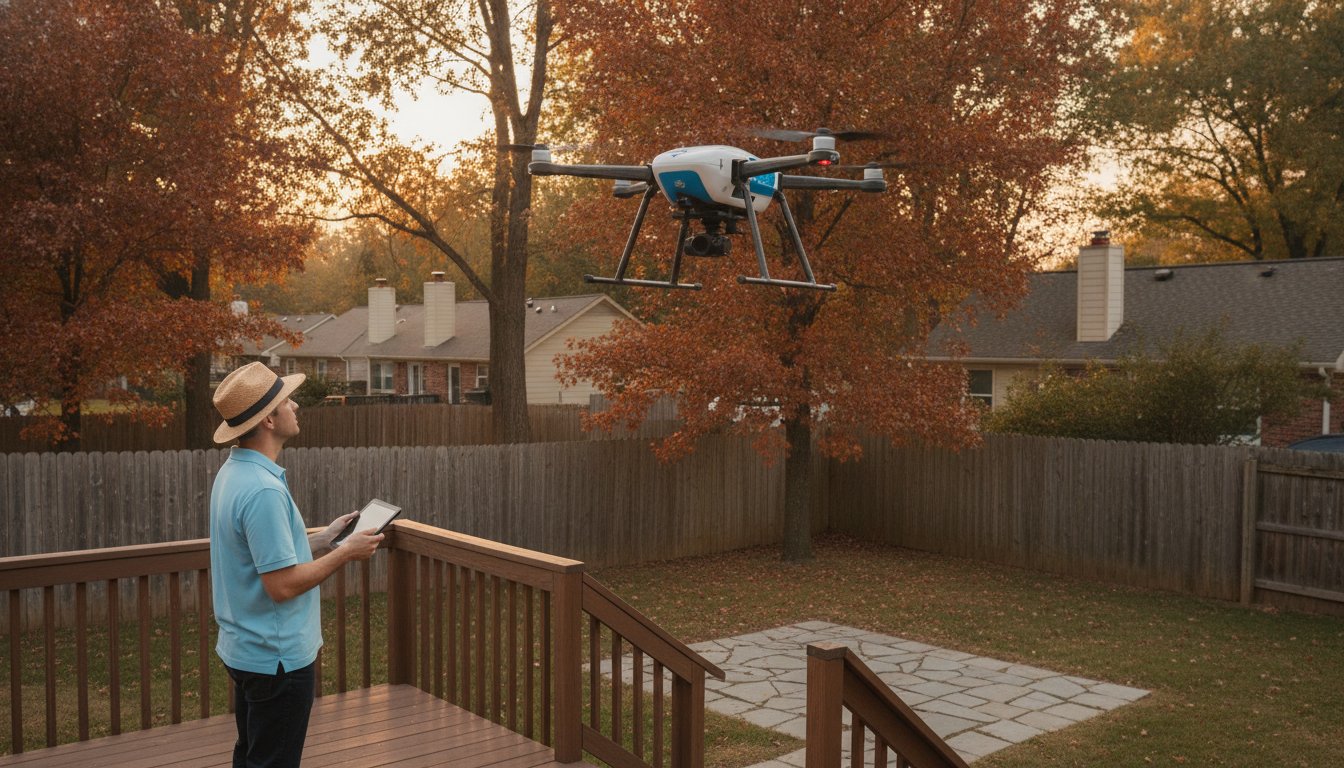
If you hear a high-pitched buzz over your house every morning at 7:15 a.m. and the local Amazon facility says the lease isn’t being renewed, the FAA says the city can’t regulate drone noise, and the operator says it raised altitude to 225 feet — you are not alone, and you are not powerless. This is what the new geography of drone noise complaints community regulations actually looks like in 2026, and what residents, HOAs, and municipal attorneys have learned about pushing back.
The complaint volume is real. The FAA’s Aviation Noise Complaint and Inquiry Response portal (ANCIR) is logging thousands of drone-related submissions per year, and the two highest-profile US delivery drone corridors — College Station and Richardson, Texas — both produced operational concessions inside 18 months without a single lawsuit. The playbook isn’t litigation; it’s organized complaint data plus FAA-published measurements plus operator goodwill. This article walks through the numbers, the legal framework, the case studies, and the exact workflow for filing a complaint that actually counts.
What does a delivery drone actually sound like — and how loud is loud?
The first thing to know about drone noise is that the FAA only published comparable across-operator numbers in August 2026. Before then, residents were arguing with operators who claimed each system was quieter than the next, with no shared reference.
| Drone | Measured SPL @ 50 ft | Source |
|---|---|---|
| Amazon MK30 | 88 dB | FAA Aug 2026 noise test |
| Wing (Alphabet) | 84 dB | FAA Aug 2026 noise test |
| Zipline | 79 dB | FAA Aug 2026 noise test |
| Matternet M2 | 67.8 dBA (operational @ 100 m AGL) | Matternet spec sheet |
For reference, the EPA’s daytime residential guideline is 55 dB. At 50 ft above ground level, all three major US delivery drones exceed that threshold by 24 to 33 dB — perceived as roughly 4× to 16× louder in raw loudness terms. The Matternet M2, by contrast, operates at 100 m AGL (about 328 ft) and stays under the residential guideline. The difference is altitude, not just airframe.
Consumer drones are quieter at the source, but they fly lower. The DJI Mavic Pro Platinum is the canonical example: DJI’s 8331 propellers combined with field-oriented-control ESCs deliver a 4 dB reduction versus the original Mavic Pro, which DJI equates to a 60% drop in noise power. More importantly, the redesign shifts the dominant pitch from a high-frequency, attention-grabbing buzz down to a lower-frequency tone most adults perceive as less intrusive. The DJI Mavic 3 Enterprise adds C2-certified Low-Noise propellers as a separately sold accessory, targeting commercial operators in urban and noise-sensitive environments. There is still no industry-standard measurement methodology for consumer drones — DJI does not publish an official dB spec for the Mavic 3 Enterprise.
The FAA’s noise framework: NEPA, DNL 65, and the 600-foot setback rule
The FAA does have a noise framework. It just doesn’t look like what residents expect when they pick up the phone to complain. The agency uses the Day-Night Average Sound Level (DNL) metric, the same metric it uses for manned aviation noise analysis. DNL 65 dB is the FAA’s threshold for significant residential noise exposure, and a DNL increase of 1.5 dB or more from a proposed action triggers a significant impact determination under the National Environmental Policy Act (NEPA). Below 65 dB DNL, residential land use is “compatible” under FAA guidance; above it, properties may be eligible for FAA-funded sound insulation.
For drone delivery operations specifically, the FAA has codified a 600-foot minimum setback from noise-sensitive land uses (residences, schools, parks, hospitals) for operators running up to 1,150 average annual daily deliveries. At that setback, hub noise stays below DNL 59.7 dB. The setback is committed in the operator’s FAA-issued Operations Specifications (OpSpecs), not in any local zoning code. Operators exceeding the 1,150-delivery threshold must conduct a more detailed site-specific noise analysis.
The practical consequence: residents are right that there is a federal noise standard. They are wrong that it triggers on any single overflight. DNL is a 24-hour average, weighted +10 dB between 10 p.m. and 7 a.m. A single loud drone pass at 7:15 a.m. won’t move the DNL needle. A pattern of two or three daily passes at 84-88 dB over a residential block, sustained for weeks, can — and that cumulative data is what the ANCIR portal is designed to capture.
Federal preemption: why your city council can’t ban drone noise
This is the part of the conversation where most municipal advocacy efforts hit a wall. The Noise Control Act of 1972 did not explicitly preempt local noise regulation. But the Supreme Court’s 1973 decision in City of Burbank v. Lockheed Air Terminal held that federal regulation of aircraft noise is so pervasive that it leaves no room for local police-power ordinances — including drone curfews, noise-ordinance amendments targeting UAS, or municipal bans on commercial delivery flights over residential zones.
There is one explicit exception: airport proprietors (the entities that own and operate airports) can impose non-discriminatory noise and access restrictions as property owners, not as regulators. A city that owns its municipal airport can write access rules for that airport. A city that does not own a drone delivery hub cannot.
On top of the federal layer, a growing number of states have passed their own drone preemption statutes. Florida, Georgia, and Arizona are the clearest examples — they explicitly prohibit local governments from enacting ordinances that regulate drone operations, including noise. Other states permit narrow local authority over takeoff and landing on public property and over general nuisance enforcement. The National Conference of State Legislatures tracks these statutes; the practical advice for residents is to check the specific state preemption law before launching a local campaign, because in many jurisdictions the path is closed at the state level before the FAA preemption argument even applies.
The implication: organizing for a “just ban it locally” ordinance is, in most US jurisdictions, wasted political capital. The work that moves the needle is organized complaint data plus operator engagement, not legislation.
What works: College Station, Richardson, and the operational concessions playbook
Two Texas cases from 2024-2026 show the playbook that does work.
College Station, Texas
Amazon Prime Air’s College Station facility drew sustained noise complaints from adjacent neighborhoods throughout 2024 and 2025. Residents described the MK27 drones as sounding like “a giant hive of bees” and “a flying chainsaw,” with multiple daily overflights from a hub sited near residential streets. According to KBTX News, Amazon scaled back operations, switched the fleet to the quieter MK30 airframe, and ultimately announced in September 2025 that the company would not renew the College Station lease, which expired September 30, 2025. No lawsuit was filed. The shift was a combination of community pressure, FAA-published noise data accumulating against the older MK27 platform, and operator preference for newer, quieter hardware.
Richardson, Texas
The Richardson case followed a different arc. Residents in neighborhoods under the Amazon flight path logged multiple weekly overflights at roughly 100 feet AGL — low enough to be audible indoors with televisions on. Per The Dallas Morning News in February 2026, Amazon responded by raising the minimum outbound flight altitude to about 225 feet and adjusting flight paths to reduce concentration over the most affected blocks. The city of Richardson explicitly declined to pursue rezoning of the delivery corridor, citing legal exposure under FAA preemption. The result was an operational concession — altitude, routing — achieved entirely through operator-community engagement and FAA complaint data, with the city in a supporting rather than leading role.
The pattern that emerges: organized complaint volume, especially ANCIR submissions that produce measurable data, gets operators’ attention because the FAA’s noise framework treats cumulative community exposure as the relevant metric. Operators do not want a NEPA significant-impact finding on their OpSpecs because that triggers re-certification work. Community advocates who understand this can negotiate from a position of structural strength without ever filing a lawsuit.
How to file a real noise complaint that gets counted
The workflow that produces results is the FAA ANCIR portal — the same data-driven FAA compliance pathway that other Part 107 operators use. The URL is https://ancir.faa.gov/ancir, and it is the FAA’s preferred channel for aviation noise feedback. Phone backup is (202) 267-3521. Email and third-party app submissions — including B4UFLY — are not accepted for noise complaints.
What the ANCIR portal actually asks for:
- Location — address or lat/lon of the overflight. Specificity matters; “my neighborhood” is not enough.
- Time and date — local time, including whether the event fell inside the FAA’s 10 p.m.–7 a.m. night-weighted window (which adds 10 dB to the DNL calculation).
- Nature of the noise — drone type if identifiable (MK30, Wing, etc.), altitude estimate, flight direction, duration.
- Optional attachments — photos, audio recordings, video. Even smartphone audio helps. The FAA has confirmed that video evidence of drone markings and flight direction is the most useful category.
The single most common reason ANCIR submissions get closed without action is incomplete follow-up. If the FAA reaches out for clarification and the complainant does not respond within seven days, the submission is closed. Treat the portal as an ongoing workflow, not a one-time form.
What residents should NOT expect: a per-complaint enforcement action. ANCIR data feeds the FAA’s cumulative noise exposure analysis. The agency’s response to sustained complaint volume is a NEPA review of the operator’s hub, not a phone call to Amazon. The leverage is structural, not transactional.
Mitigation: what operators and prop designers are doing about the noise
The industry is not ignoring the noise problem. The technology response splits into three layers.
Propeller and airframe design. The physics of drone noise center on blade tip speed — higher RPM means higher blade-tip Mach number, which drives tonal and broadband noise. The mitigation is lower RPM via larger chord (more lift per revolution), tip geometry changes (swept, oval, or loop tips to alter vortex structures), and trailing-edge serrations or Gurney flaps to manage boundary-layer transition. The DJI Mavic Pro Platinum’s 4 dB improvement came from exactly this combination: 8331 propellers plus field-oriented-control ESCs that allow lower-RPM, higher-torque operation. Not all innovations work — recent 2026 measurements show some off-the-shelf toroidal propeller designs actually produce higher SPL than conventional blades, contradicting earlier marketing claims.
Acoustic detection and ID. On the defensive side, counter-drone vendors have moved aggressively into acoustic detection because acoustic sensors require no line of sight, operate passively, and work in RF-dark environments where radar and RF detection fail. Dedrone (now part of Axon) fuses third-party acoustic inputs with RF, radar, and video into a software-defined detection platform. DroneShield takes a vertically integrated approach with proprietary hardware acoustic dish sensors managed through the DroneSentry command-and-control interface. Airservices Australia’s Sydney Airport drone-detection trial, which began in 2022, selected Thales as the prime contractor using a multi-sensor architecture that included acoustic. The deployment at airports is now routine; community-scale deployment is the next frontier, with some HOAs and gated communities deploying acoustic sensors to identify offending operators and timestamp complaints.
Acoustic neutralization. The CSIO acoustic anti-drone system, demonstrated in 2025, goes beyond detection into active neutralization. The system uses high-intensity focused sound waves to disrupt a drone’s internal balance sensors (IMU), causing the aircraft to lose stability and land. The technology is still experimental and raises obvious questions about collateral impact on wildlife and other aircraft, but it signals that acoustic countermeasures are now on the same trajectory radar and RF jamming followed a decade ago.
The international picture: EASA, ICAO, and the emerging-technology aircraft gap
The United States is not alone in working through this. The international picture is patchy, and the patchiness is itself the story.
The EASA UAS noise measurement guidelines, published June 12, 2023, are the most rigorous voluntary standard in the world. They apply to unmanned aircraft with maximum takeoff mass of 600 kg or less in the specific category. The methodology requires a minimum of six runs each for level-flight and hover procedures. Level-flight captures must be made with the UA stabilized between 17 m and 150 m above the measurement point at constant ground speed, with spatial positioning and speed logged at ≥2 Hz. Hover captures require 30 seconds of stable position at 12 m to 50 m AGL, logged at ≥1 Hz. The point of the standard is repeatability across jurisdictions — a noise measurement done in Stuttgart should be comparable to one done in Toulouse.
The ICAO Annex 16 framework, which governs manned aircraft noise certification globally, has no equivalent chapter for UAS. ICAO classifies UAS as Emerging Technology Aircraft (ETA), and ETA do not fit cleanly into the existing Annex 16 Volume I categories (which were designed around subsonic jets, propeller aircraft, and helicopters). National regulators are working around this gap by issuing Rules of Particular Applicability for specific type-certified models, and ICAO has signaled interim noise measurement guidelines for smaller ETA expected in 2025-2026. The bottom line: international harmonization is on the way but is not yet operational.
The UK Civil Aviation Authority takes a different approach. The CAA acknowledges that detailed noise data for UAS and advanced air mobility remains limited and has not adopted mandatory noise certification for general drone operations. Operators and manufacturers are pointed toward EASA’s voluntary 2023 guidelines and the CAA’s own research reports CAP3076 and CAP2962 for assessment methodology. In practice, the UK noise framework for drones is best described as voluntary measurement against an emerging European standard, not a regulatory floor.
Putting the three together: the US has a noise framework (DNL 65 + the 600-ft setback rule), the EU has a measurement standard (EASA 2023), the UK has voluntary guidance backed by research, and the international harmonization layer is still being built. The complaint volume in any single country today feeds both national regulation and the international standards process. A resident who files an ANCIR submission is not just lobbying the FAA — they are contributing to the data set that will, in two or three years, drive ICAO’s emerging-technology aircraft noise standards.
Frequently asked questions
Can my city ban delivery drones on noise grounds?
Generally, no. Federal preemption under City of Burbank v. Lockheed Air Terminal (1973) blocks most local police-power ordinances aimed at aircraft noise. States like Florida, Georgia, and Arizona explicitly preempt local drone ordinances including noise. Your city can regulate takeoff and landing on public property and enforce general nuisance laws, but a curfew or noise ordinance specifically targeting drones will not survive FAA review.
What is the FAA noise threshold for residential areas?
DNL 65 dB. The FAA treats noise as significant under NEPA when a residential area is exposed to DNL ≥65 dB AND the proposed action increases the DNL by at least 1.5 dB. Below 65 dB DNL, residential land use is “compatible” under FAA land-use guidance. Properties above the threshold may be eligible for FAA-funded sound insulation.
How loud are delivery drones in practice?
The FAA’s August 2026 measurements at 50 ft: Amazon MK30 88 dB, Wing 84 dB, Zipline 79 dB. The Matternet M2 hospital delivery drone operates at 67.8 dBA, well under its 78 dB type-cert ceiling at 250 ft. At 50 ft AGL, all three major delivery drones exceed the EPA 55 dB residential daytime guideline.
What is the setback for a drone delivery hub?
Operators running up to 1,150 average annual daily deliveries must site their hub at least 600 feet from noise-sensitive land uses (residences, schools, parks, hospitals). The setback is committed in the FAA-issued Operations Specifications (OpSpecs) and keeps hub noise below DNL 59.7 dB. Operators exceeding the 1,150-delivery threshold must conduct a more detailed site-specific noise analysis.
Where do I file a drone noise complaint?
The FAA ANCIR portal at https://ancir.faa.gov/ancir. Required fields: location, time, nature of noise. Incomplete submissions are closed if not followed up within seven days. Phone backup: (202) 267-3521. B4UFLY and other third-party apps do not accept noise complaints.
What residents, operators, and the FAA are learning together
Drone noise complaints in 2026 are working — but not in the way most residents expect when they first hear the buzz. Federal preemption rules out the clean “ban it locally” path in most jurisdictions. What works is organized ANCIR complaint volume combined with operator goodwill and the FAA’s published measurements. The College Station and Richardson cases both produced operational changes — a lease non-renewal, an altitude bump from 100 ft to 225 ft, a flight-path rerouting — without a single lawsuit.
The next eighteen months will tell whether the FAA’s existing noise framework — DNL 65 plus the 600-foot setback rule — gets formalized into Part 107 as an enforceable noise standard, or whether delivery drone noise becomes the first ambient city sound Americans learn to live with. The data set that answer will be made from is being written today, one ANCIR submission at a time. If you have been hearing the same drone at the same hour every week, your complaint is one of the data points the FAA will count. The portal is at ancir.faa.gov. The follow-up window is seven days. The cumulative impact is real.
For related coverage of commercial drone insurance 2026“>drone noise laws by state and the broader FAA drone remote ID enforcement reality guide“>2026 drone regulatory landscape, see the rest of our regulatory pillar.