
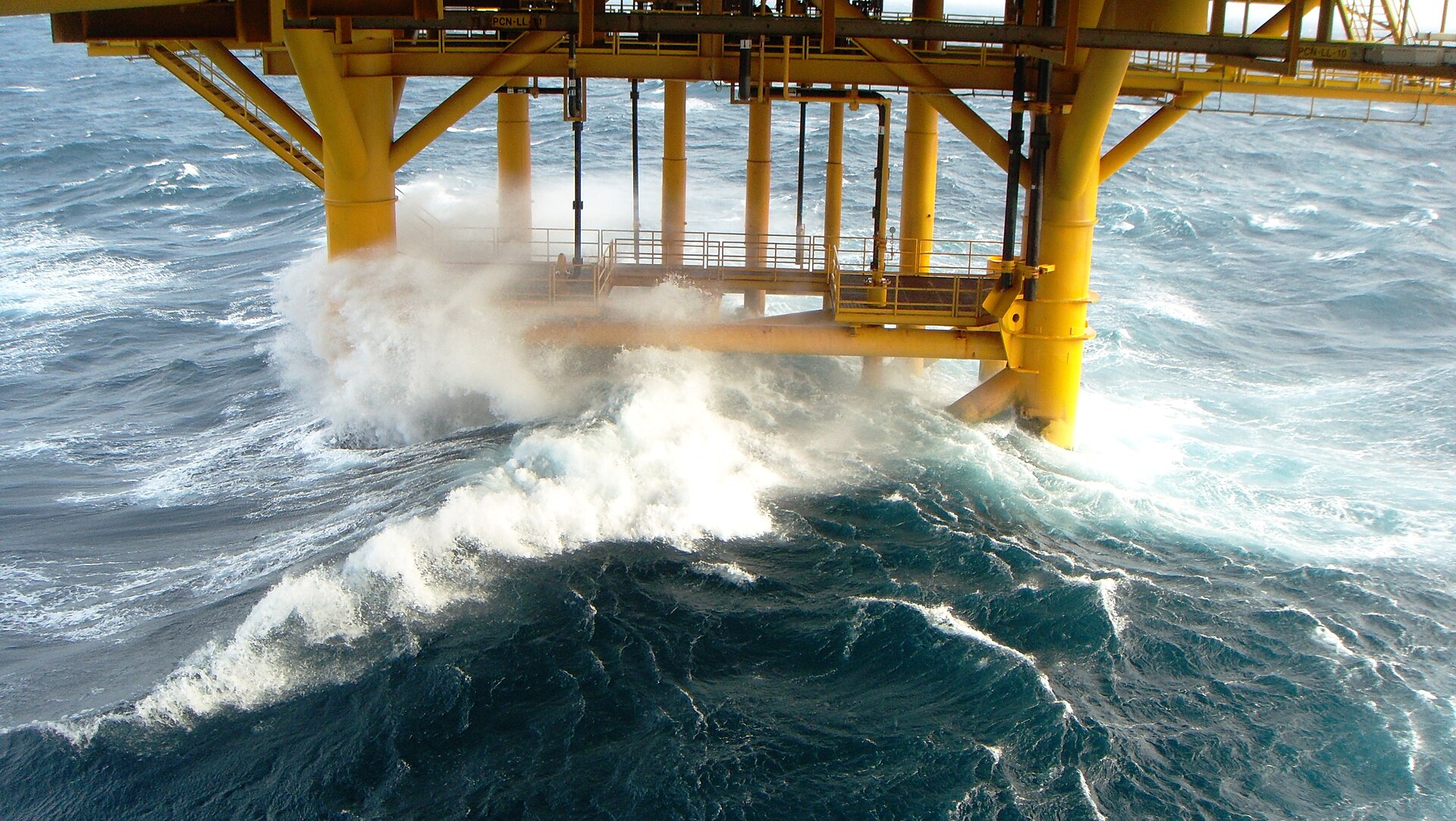
A jacket does not get a corrosion inspection because someone flew a camera past it. It gets one when a surveyor can say, from a defined location, what the coating is doing and what steel is left. Scaffolding and rope access have been the way to put a person and a probe on that steel. They are access systems. They are not a measurement.
A drone oil rig corrosion inspection replaces the access system only for the measurement the aircraft can actually take. Close visual of coating, pitting, and dropped-object hazards is one product. Contact ultrasonic thickness, with couplant and an A-scan, is another. Pulsed eddy current through insulation is a third, and it is a screen, not a remaining-wall certificate. Class does not treat the flight as the survey. The American Bureau of Shipping’s December 2022 guidance on remote inspection technologies, written against IACS Recommendation 42, says these tools assist the attending surveyor. That sentence is the job.
The same split shows up onshore. A thermal pass over a module field is not a torque check, which is why the workflow piece on drone solar farm inspection still separates the camera from the work order. Offshore, the stakes are a seaway, a hydrocarbon inventory, and a class file. If the quote you are holding does not say which product you are buying, it is not yet a corrosion inspection.
Drone oil rig corrosion inspection starts by unbundling the scaffold
When an operator prices scaffolding on a jacket or an FPSO tank, the invoice is buying three things that stay bundled until someone tries to delete the scaffold.
First, a person at the steel. Close visual inspection, the close-up a class surveyor means when they say CVI, is a distance and an angle, not a brand of aircraft. If the camera cannot hold that distance on the weld, the bracket, and the coating edge, you still need the rope. General visual from a fly-by is a different survey. Do not let a wide shot satisfy a close-up line on the survey programme.
Second, a probe that couples. Ultrasonic thickness needs contact, couplant, and a surface the sound can enter. Flyability’s Elios 3 UT payload, built with Cygnus Instruments, exists because a photograph of rust is not a thickness. The payload carries a remotely operated couplant dispenser, a cleaning module for deposits, and a probe arm that mounts above, in front of, or below the aircraft and folds so the cage can still pass a manhole. A laser pointer on the probe is there so the pilot hits the point, not the paint next to it. Without that contact, the flight is a visual, however close it looks on the screen.
Third, a signature. ABS, Bureau Veritas, and Tasneef all describe remote inspection techniques, drones included, as an aid to the attending surveyor. Tasneef’s guide, which reprints IACS Recommendation 42, puts acceptance of the outcome at that surveyor’s discretion. You can delete the scaffold and still fail the survey if the surveyor does not accept the record.
Price the three lines separately. The scaffold quote that survives is the one attached to a measurement the drone cannot take, or to a surveyor who has not agreed the method. The quote that should die is the one that existed only to put eyeballs on steel a cage and a tether can already reach.
Close visual and contact thickness are different jobs
Treat visual and thickness as different work orders, even when the same crew flies both on the same day.
A close visual, general or close-up, is what a caged aircraft already does well inside a tank, under a deck, and along a pipe rack in a GPS-denied volume. The Elios 3 is built for that: a collision-tolerant cage, thermal as well as visual, and LiDAR so the pilot can fly without satellite lock. Flyability’s oil-and-gas page is explicit that the offshore use, paired with the tether power unit, is tanks, overhead piping, and underdeck. Shell USA, quoted in the CAN-USA case study and published on Shell’s own From Ropes to Drones page in March 2026, said rope-access inspections that could take an entire day were being done in minutes once the same technicians flew the aircraft. That is an access saving. It is not a wall-thickness result. Write it that way in the close-out, or the next campaign will be sold on a minute-count that integrity cannot trend.
Contact UT is the second product. The Elios 3 UT probe set is four heads, and the choice is a procedure item, not a preference. The 7.5 MHz twin crystal is for small-diameter pipe and thin, corroded plate. The 5 MHz twin crystal is for heavily pitted walls. The 2 MHz twin crystal is for thick walls and dirty or highly attenuating surfaces. The 2.25 MHz single crystal is for general surfaces and thick coatings. Flyability states that the single-crystal multi-echo probe complies with IACS special-equipment requirements for thickness measurements on ships and mobile offshore units. That is the head you bring to a class survey, not the head that happened to be on the arm from the last pipe-rack job. Measurements can be tagged to the LiDAR model while the A-scan is live, and the echo can be re-gated in post-processing. Flyability states that, with the tether, the same payload can collect up to 250 thickness readings an hour in cluttered pipe-rack and offshore volumes. Treat that rate as a vendor ceiling. Coupling, cleaning, and the surveyor’s hold points will cut it. A plan that assumes 250 from the first minute is a plan that will miss the points that matter.
The third product is a screen. On 27 May 2026, Applus+ flew UT and dry-film thickness on tank shell and roof areas and on an insulated line in Saudi Arabia, then compared those readings with hands-on checks at the same points. After calibration alignment, Applus+ reported the verified readings within acceptable tolerance and the defined measurement uncertainty. The note does not publish the tolerance. What it does publish is the control: Level 3 supervision, and pulsed eddy current through insulation and coatings without stripping them, used to decide where a follow-up reading belongs. PEC finds candidate wall loss. It does not retire the UT, and it does not retire the person who interprets it.
If the work order says “corrosion inspection” and does not say which of the three products, the quote is not comparable to scaffolding. It is a camera flight with a corrosion word on it. Ask for the product before you ask for the day rate.
Cage, tether, and open-air contact are not interchangeable
Three airframes cover almost every honest offshore corrosion job. They do not substitute for each other, and a fleet that owns one of them does not own the campaign.
The caged, GPS-denied aircraft is for internals and underdeck. Cargo tanks, ballast tanks, vessels, and the steel under a cellar deck. The cage is the point. A jacket leg in a seaway is a collision hazard, and an open-frame quad that kisses a bracket becomes a dropped object, which is the hazard the inspection was supposed to find. CAN-USA’s Richard Turner, whose rope-access technicians were retrained to fly rather than replaced by a visiting pilot, said the tether opened areas they would not have been comfortable flying untethered, including over open water, and removed the pause for battery swaps. Flyability recommends the same tether offshore as a safety leash. Read that as a recovery plan. The piece on which airframes hold a 25 mph gust is the onshore cousin of this problem. A jacket in a seaway is a worse version of it, because the recovery is the sea, not a field.
The tethered, unlimited-endurance aircraft is for a tank that is a building. On the FPSO Turritella, operated by Shell in the Gulf of Mexico, ScoutDI’s Scout 137 flew the cargo-oil-tank portion of a special survey with no one in the tank. The aircraft is tethered, so flight time is not a battery budget. That is a different machine from a 25-minute free-flight quad, and it should be bid as one. Unlimited endurance is what lets the surveyor argue about an echo without watching a battery icon. If your procedure needs that argument, do not bid a free-flight aircraft and hope the tank is small.
The open-air contact platform is for external thickness where you need the probe on the steel and you are not inside a tank. Air Control Entech and Thornetix took a wireless UT payload, ARTIO, through DNV certification in Scotland in May 2023. The file was procedures, accuracy against certified test blocks, and a live demonstration on corroded samples under observation. DNV’s approval is what lets that combination be offered for official corrosion monitoring and thickness on offshore infrastructure, including oil rigs, LNG storage, and offshore wind structures. It is not a license to skip the surveyor, and it is not the aircraft you send into a cargo tank. External contact and internal cage work are different risk cases: one is over water with a recovery problem, the other is inside steel with a confined-space problem.
Splash zone and underwater are a fourth category, and they are mostly not a free-flying quad. ABS’s guidance notes separate the tools. A UAV is the fit for high structure such as a flare tower. An ROV is the fit for underwater inspection in lieu of dry-docking. The underwater ROV piece on this site is the subsea half of the same integrity campaign. Do not let a topside visual quote swallow the UWILD, and do not let a UT drone quote swallow marine growth you have not removed.
Class acceptance assists the surveyor
Read the class documents before you read the drone brochure. They are shorter, and they are the contract.
ABS Guidance Notes on the Use of Remote Inspection Technologies, effective 1 December 2022, define a remote inspection vehicle as a remotely controlled vehicle in the air, underwater, or on the structure. UAVs, ROVs, and crawlers are the examples. The notes were written against IACS Recommendation 42 on remote inspection techniques, IACS UR Z7 section 1.6, and UR Z17 on service suppliers. The operating sentence is plain. Remote inspection techniques may assist the attending surveyor with class surveys and, when the flag state agrees, with statutory work where a visual examination is required. They are an alternative means for close-up survey in line with UR Z17. They are not a substitute for the surveyor standing the survey. Data may include photos, video, LiDAR, and other NDE. The vehicle does not grade itself.
Bureau Veritas Guidance Note 693-NI, May 2025, uses the same frame. A UAV is a small rotary aircraft with no pilot on board, flown from a station or on a pre-mapped path built from an earlier campaign’s hot spots. Payloads explicitly include imaging, illumination, LiDAR, sonar, and an ultrasonic thickness probe. The note points at IACS Recommendation 42, Recommendation 72 on confined spaces, and Recommendation 90 on the ship structure access manual, plus BV’s own rules for steel ships (NR467), offshore units (NR445), and service-supplier approval (NR533). If your procedure does not name the service-supplier approval, you are asking the surveyor to invent one on the day.
The commercial collaboration sits downstream of that text. Bureau Veritas Marine & Offshore and Flyability have been qualifying the Elios 3 single-crystal UT probe against BV’s data-collection requirements: accuracy, repeatability, trials in representative vessel spaces, and comparison with conventional methods. Alexander Gregg-Smith, president of BV Marine & Offshore, called UT drones a promising evolution of remote inspection techniques, not a replacement of them. Redouane Assad, fleet management director, was more specific about the operational gain: high-quality digital data, and less exposure for surveyors and crews, while inspection standards stay in place. When the procedure is the approved one, BV says the Elios 3 UT data can meet its guidelines for class-approved activities. “Can meet” is the phrase. It is conditional on the procedure, the probe, and the way the job is flown.
So the bid language that fails is “class approved drone.” The bid language that survives is: RIT per IACS Recommendation 42, service supplier under UR Z17, procedure accepted by the attending surveyor of ABS, BV, or DNV, probe head matching the society’s thickness-equipment requirement. DNV’s May 2023 certification of the ARTIO and Air Control Entech combination is an example of the payload gate. It is not a blanket offshore approval for every quad with a camera, and it does not travel with the pilot to a different aircraft.
What the recent jobs actually measured
Four public jobs are enough to see the pattern. None of them is “we cancelled scaffolding and called it a corrosion programme.”
On Shell-operated platforms, CAN-USA kept the rope-access technicians and handed them the Elios 3 UT. The case study pictures the Olympus platform, 130 miles south of New Orleans, and describes tank, crane, piping, and dropped-object work. Shell USA’s line, reproduced in that case study, is the time claim worth keeping: a rope-access inspection that could take a day, done in minutes. Turner is careful about what the tether added. Longer flight time was expected. The unexpected part was operational permission to work areas the team would not have flown untethered, including over water, without hauling lithium batteries into the hazardous area. Rope access stayed for the steel that still needed a person. That hybrid is the result, not a drone-only replacement. If a vendor shows you this job and then deletes the rope-access line from your bid, they have edited the result.
On Turritella, the claim is sharper, and it is a class claim. ScoutDI and the CWL companies describe the cargo-oil-tank special survey as the first fully robotic COT special survey with no human entry, signed off by ABS, done at sea in the Gulf of Mexico, with no diving, no work at height, and no confined-space entry. Four tanks were accredited on the first offshore deployment. The drone piece was 35 to 40 flights and more than 40 hours, tethered, beyond visual line of sight inside the tank, with the surveyor on the top deck watching the same screen as the pilot. On-screen A-scan let the team accept or reject a reading before the aircraft moved. Steven Trevino, Shell’s deepwater robotics program manager, said the onshore structural integrity team used Scout Portal to check each day’s data while the crew was still on the asset, because the FPSO had a fiber link. The 2024 Craig Black Innovation and Technology Award went to the iCOT approach, which is the package: drone, crawler, ROV, and UTM, not a single airframe. If your procedure cannot put the surveyor on the live A-scan, you do not have this job. You have a video.
In Saudi Arabia, Applus+ ran the comparison that integrity engineers actually ask for. Drone UT and dry-film thickness against hands-on readings at the same locations, after calibration alignment, within the tolerance they had defined. They did not publish the number. They did publish the control: Level 3 oversight, and PEC as a screen through insulation so the contact readings go where the screen says the wall may be thin. The drone was the access. The NDT method, the calibration, and the Level 3 were the inspection. Copy the comparison even when you cannot copy the client. A campaign with no hands-on cross-check on the first deployment is a campaign asking the society to trust a new chain on reputation.
The DNV file from May 2023 is the external-UT cousin. Thornetix and Air Control Entech did not publish a day-rate saving in the certification note. They published a path: procedures, calibration against certified blocks, and a witnessed scan on corroded samples. After that, the combination could be offered for official thickness and corrosion monitoring offshore. Certification is market access. It is not a measured saving. Any “days of setup to hours” line on a vendor page should be read as the vendor’s claim, not as a figure from that audit. This piece does not use it.
What still needs a person on the steel
Cancel the scaffold for the lines the aircraft and the surveyor have both accepted. Keep the rope, the crawler, or the ROV for the rest. The list is shorter than the brochure and longer than a pilot wants.
The surveyor does not get cancelled. ABS, BV, and Tasneef are aligned on that. A flag-state statutory survey is a further gate. ABS allows remote inspection techniques to assist statutory visual work when the flag agrees. Do not assume class acceptance covers the flag, the coastal state, or the operator’s own aviation manual. Those are separate documents, and the one you forgot is the one that stops the job at the helideck.
The surface does not prepare itself. The Elios 3 UT cleaning module is for deposits, and the couplant dispenser is there because ultrasound does not cross a dry gap or a thick marine-growth mat. Splash-zone steel, with growth and a coating system built for constant wetting, is still a preparation job. A visual pass can map where the coating has failed. It cannot report remaining wall until something couples. If the cleaning module cannot get to bare or near-bare steel, the reading does not go in the file. Mark the point as visual-only and send a prepared follow-up. Guessing a thickness through scale is how bad numbers enter a trend.
The recovery case does not disappear because the brochure says offshore. Turner’s tether comment is the honest version. Over open water, an untethered loss is a search, not a landing. The reliability work on what millions of real flights actually show is the reason you do not send an unproven airframe on that recovery case. And the aircraft you do send still has props, motors, and a battery or a tether to maintain. The maintenance piece on which parts fail first applies to an inspection drone the same way it applies to a mapping drone. A UT probe also has a calibration interval. Miss it and the A-scan is a picture of a number you cannot defend.
Internal flight beyond the pilot’s direct view, inside a cargo tank, is not a Part 107 BVLOS waiver. Turritella’s crew flew that way under a class survey procedure, with LiDAR on a shared screen and no one in the tank. If the campaign is in US civil airspace and the pilot cannot see the aircraft in open air, that is the waiver problem covered in the Part 107 BVLOS piece, and Part 108 is the rule text to read before you promise a beyond-visual jacket circuit. Do not cite Turritella as evidence that the waiver is unnecessary. Different steel, different rules, different signature.
The file an integrity engineer will sign
Integrity does not want a highlight reel. It wants a point that can be found again next campaign, by someone who was not on the aircraft.
Location-tagged thickness is the minimum for a contact job. Flyability’s UT payload is designed to fly with the LiDAR so each reading sits on the model during capture, not as a guess in the report. Scout 137 does the same: the portal shows the UT point, the value, and the A-scan. The LiDAR explainer on this site is the sensor half of that sentence. A thickness with no position is a number you cannot trend, and a trend is the only reason to fly the point twice. If the LiDAR and the probe are not on the aircraft together, say so in the procedure and accept that the location will be a manual callout, with the error that implies.
The A-scan ships with the number. Both the Elios 3 cockpit and the Scout screen show it live so the surveyor can reject a bad echo before the aircraft moves. Post-processing that lets you re-select the echo is useful, and Flyability’s Inspector software is built for that review, including a criticality tag on the point. A single millimetre in a spreadsheet, with no waveform, is not a class record. If the file you deliver cannot reproduce the echo, you delivered a claim.
Match the probe to the wall before you fly, and write the head into the procedure. The 7.5 MHz head is the wrong tool on a thick, coated jacket member. The 2.25 MHz single crystal is the head Flyability points at class work and thick coatings. A campaign that swaps heads without saying so cannot be trended against last year. Same locations, same head family, or a written reason for the change.
Calibration is a witnessed step, not a checkbox in the pilot’s app. Applus+ compared drone and hands-on readings at the same points after alignment. Thornetix validated against certified blocks under DNV observation. Copy that, even when the society is not standing on the deck for every point. A Level 3, or the society’s equivalent competent person, reviews the file. The pilot does not grade their own thickness. Then the comparison: prior campaign, same locations, criticality on the points that moved. That is the maintenance plan. The flight is how you got there.
Frequently asked questions
Can a drone replace scaffolding on an oil rig corrosion inspection?
For the access, sometimes. For the measurement, only if the aircraft can put a probe on prepared steel, or the work order is visual only. For the signature, no. ABS’s December 2022 guidance treats the drone as an aid to the attending surveyor. Cancel the scaffold on the lines both the aircraft and the surveyor have accepted. Keep it where the probe cannot couple or the surveyor has not agreed the method.
Will class accept drone ultrasonic thickness on an FPSO or a jacket?
Yes, as a remote inspection technique, when the service supplier, the procedure, and the probe meet the society’s rules and the attending surveyor accepts the outcome. ABS signed the Turritella cargo-tank special survey with no human entry. Bureau Veritas has validated the Elios 3 single-crystal probe against its data requirements. DNV certified the ARTIO and Air Control Entech combination in May 2023 for offshore thickness and corrosion monitoring. None of those is a blanket approval for an unlisted aircraft or an unapproved service supplier.
What is the difference between a visual inspection drone and a UT drone offshore?
A visual aircraft records coating, pitting, geometry, and dropped-object hazards. A UT aircraft adds contact thickness, couplant, an A-scan, and a position. Flyability’s own split is the clean one: the Elios 3 for visual and thermal in GPS-denied volumes, the UT payload for thickness, up to the vendor’s stated 250 readings an hour when the tether and the surface cooperate. Pulsed eddy current, as Applus+ used it in May 2026, is a screen through insulation, not a substitute for the contact reading.
Does an internal tank flight count as Part 107 BVLOS?
Not by itself. A cargo-tank flight beyond the pilot’s direct view, as on Turritella, is an internal remote inspection under the class procedure and the owner’s confined-space rules. A flight in US civil airspace where the pilot cannot see the aircraft is a Part 107 waiver question, and Part 108 is the text to read before you sell an open-air beyond-visual circuit. Class UT acceptance does not issue the waiver.
What should the integrity file contain after the flight?
Position, thickness, A-scan, probe frequency, calibration reference, the name of the person who accepted the echo, and the prior reading at that point if one exists. A video link is supporting evidence. It is not the file. If any of those fields is missing, the point is a visual finding until someone goes back.
Bottom line
Write the campaign as two line items before you cancel the scaffold. Line one is close visual: where the camera can hold class close-up distance, what the coating and the dropped-object survey need, and who reviews the frames. Line two is contact thickness: probe head, couplant and cleaning, calibration block, Level 3 or the surveyor on the A-scan, and the locations that will be trended. Anything in the splash zone, underwater, or behind growth you cannot remove stays on rope, crawler, or ROV.
If the work runs in US civil airspace outside civil twilight, the night-waiver piece is the gate. A class file does not cover it. The next step is a one-page procedure that names the society, IACS Recommendation 42, the service-supplier approval, and the surveyor who will stand the job. Price the scaffold you still need after that page exists, not before.