
Detroit, not Houston. May 11 to 14, not May 4 to 7. The dates and city kept moving in the press cycle because AUVSI’s own organizers ran the communications through Detroit’s local media first, and the trade press picked up variations. The substance was more stable. XPONENTIAL 2026 was where the commercial drone industry stopped debating “if autonomous” and started shipping the procurement and policy stack that runs it. The four trade-press takeaways frameworks — Commercial UAV News, Inside Unmanned Systems, Lidar News, and Rapido Space — all converge on the same thesis: experimental innovation is over; industrial-scale integration is the work.
For a Part 107-cert holder or a working commercial operator, the practical question is what changes in your operations this year. Not the marketing deck. Not the keynote soundbites. The four moves that actually shifted in Detroit, the FAA rule that didn’t land on schedule, the procurement framework that just got teeth, and the workforce and AI shifts that the show treated as infrastructure, not spectacle.
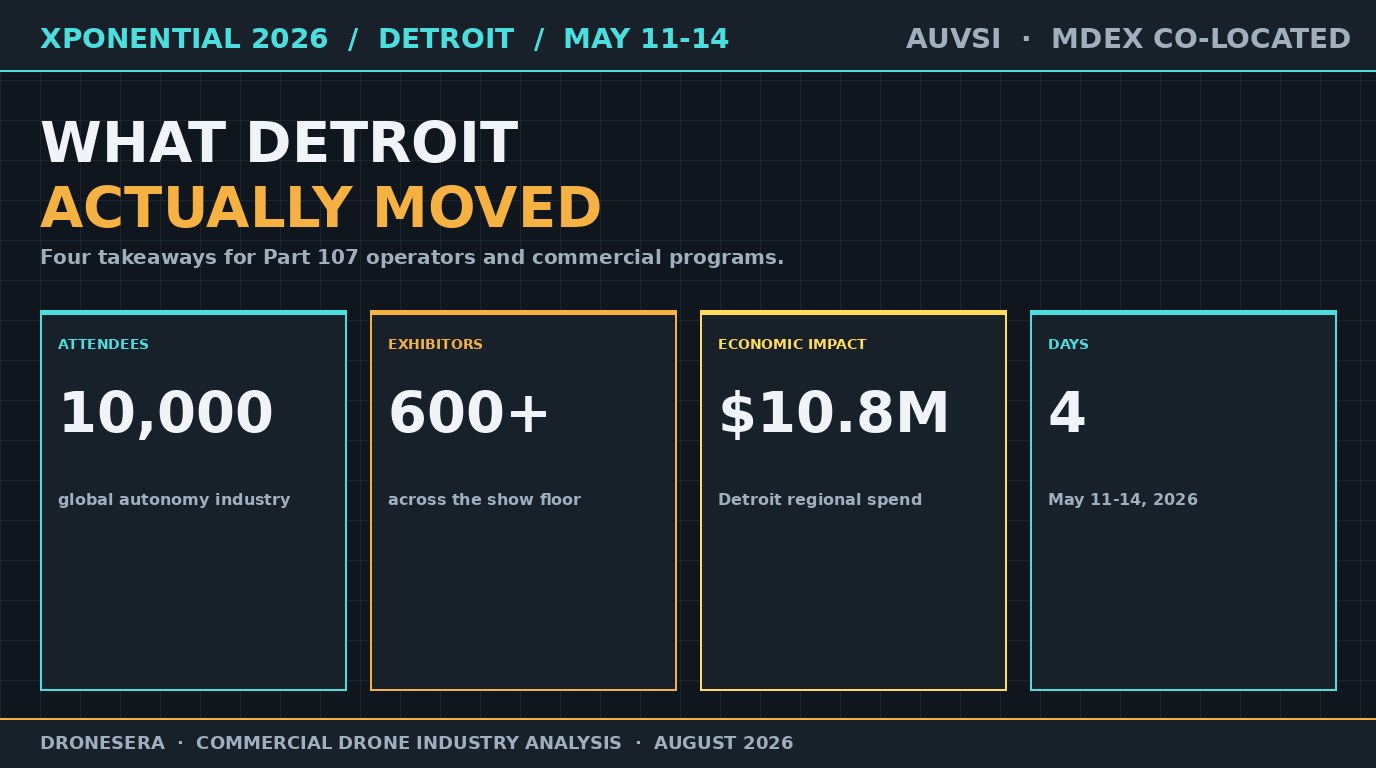
By the numbers: 10,000 attendees, 600+ exhibitors, $10.8M Detroit impact
Per AUVSI’s official economic impact report (May 21, 2026), XPONENTIAL 2026 drew roughly 10,000 attendees and more than 600 exhibitors to Detroit’s Huntington Place from May 11 to 14. Trade Show News Network’s independent coverage confirms the 10,000 figure. The show generated approximately $10.8 million in economic impact for the Detroit region — a number that matters less for the dollar figure than for what it signals: Detroit has effectively won the multi-year competition with Houston and other candidate cities to be the permanent-ish host for the largest commercial-drone trade show in North America.
The Michigan Defense Expo (MDEX) co-location was the structural signal. NDIA’s MDEX, previously a standalone defense-only procurement event, sat alongside AUVSI’s commercial show for the first time. That co-location is the explicit acknowledgement that the dual-use civil/military drone market is now the center of gravity, not a side track. Per AUVSI’s coverage of the opening keynote, Governor Gretchen Whitmer opened the show with the framing that Detroit is now the “global robotics and autonomy hub” — a state-level claim that comes with the actual industrial base: Michigan hosts Anduril’s Michigan expansion, several PDW contractors, and the Army’s Tank Automotive Command (TACOM), all of which buy drones or drone components.
What Detroit actually moved: the four announcements that change ops this year
Stripping the show floor down to operational impact, four announcements actually shift what a commercial drone program does in 2026:
1. FAA Part 108 NPRM is real, and the rule is now expected late 2026 to 2027. The agency’s Air Traffic COO Franklin McIntosh gave the most-cited keynote of the show, framing drones as aircraft and operators as pilots — operationally, not legally. The unification language matters because it telegraphs that Part 108 will not invent a parallel drone-airspace; it will plug BVLOS into the existing National Airspace System as a certified operation. The slip from the July 2026 Unified Agenda target is the operational story. DroneXL’s June 18 coverage traced the cause to two unresolved disputes: presumptive right-of-way for cooperative aircraft, and the electronic conspicuity standard that would let crewed aircraft see drones. Both are technical questions with huge safety implications, and the FAA is not going to ship a rule that leaves either ambiguous.
2. Drone Dominance Program — Phase 2 (Gauntlet II) is live. The DoD’s small-drone procurement program, run through the Defense Innovation Unit, used XPONENTIAL 2026 to roll out the Phase 2 framework. Per Inside Unmanned Systems’ July 14 coverage, Phase 2 adds sustained purchase orders and grades vendors on demonstrated manufacturing capacity, not prototype performance alone. The supply-chain rules are the binding constraint: component-level traceability, exclusion of parts from China, Russia, North Korea, and Iran. The Pentagon tightened these rules again in late July per Inside Defense. For commercial vendors, Drone Dominance is now a procurement signal that affects what gets funded and what gets deprioritized.
3. Skydio’s multi-drone operations moved from waiver to program of record. The 1:4 PIC (one pilot, four aircraft) waiver that Skydio secured from the FAA in March 2026, and which the company detailed on its engineering blog, was framed at XPONENTIAL as a working operational pattern rather than a one-off waiver. Twelve police departments had deployed the multi-drone model by show time. For commercial mapping and inspection operators, this is the proof point that BVLOS-at-scale is operationally tractable today, even before Part 108 lands.
4. Anduril’s Collaborative Combat Aircraft (CCA) win. On June 17, 2026, the U.S. Air Force selected Anduril’s Lattice for Mission Autonomy software for the CCA program, alongside General Atomics for the airframe. Per Anduril’s own release, this is the autonomy-stack half of the CCA program. The XPONENTIAL relevance: Anduril is a commercial-drone adjacency vendor, and CCA shows the dual-use trajectory of mission-autonomy software — the same Lattice stack runs the company’s Ghost / Roadrunner tactical products. For operators tracking where defense money is going, CCA is the single largest dollar signal of 2026.
FAA Part 108: the BVLOS rule is real, it’s late, and here’s the operator prep
The operational consequence of the slip is that operators now have more time to prepare, and less excuse not to. Commercial UAV News’s Part 108 preparation guide lays out the four things operators should be doing now regardless of the final rule’s exact publication date:
- Digital flight logging. Part 108 will require machine-readable flight records. Operators still running paper logbooks or spreadsheet exports will be non-compliant on day one. Adoption now is cheap; the migration later is not.
- Safety Management System (SMS). Voluntary today, expected mandatory under Part 108. The FAA’s existing SMS framework is the template — operators with a Part 135 or Part 121 charter certificate are already familiar with the structure.
- Fleet audit against proposed technical requirements. The NPRM specifies detect-and-avoid capability, C2 link redundancy, and a published reliability threshold. Operators should be auditing their fleet against these proposed requirements and budgeting the upgrade cycle now, not after the final rule.
- Personnel for security threat assessments. Part 108 will require vetted personnel for certain BVLOS operations. Operators should identify which roles will be in scope and start the security clearance process in advance — the wait times for classified-eligibility determinations are not short.
Per FedScoop’s July 31 coverage, DOT pushed back on industry calls to accelerate the rule. The agency’s position is that stakeholder input on right-of-way and conspicuity is more important than deadline adherence, and that a 6 to 12 month implementation window after the final rule’s publication is the right cadence. The operator-side framing makes the same point makes the same point from the operator side: the BVLOS operational reality is arriving, and the rule is the formal marker, not the inflection.
For a working commercial operator, the practical path is the same as it’s been: continue Part 107 waiver-driven operations where the economics justify it (long-linear inspection, large-acre mapping, public safety), audit your fleet and personnel against Part 108’s expected requirements, and budget the SMS + logging + training investments across the next two budget cycles. Our BVLOS operations guide covers the waiver-side strategy; Part 108 is the eventual formalization of that work.
Drone Dominance: where the Pentagon’s supply-chain rules meet the floor
The Drone Dominance Program’s signal at XPONENTIAL was not the existence of the program — that was announced in July 2025 in the DoD’s “Unleashing U.S. Military Drone Dominance” memo. The signal was the Phase 2 framework: live competitive “Gauntlet” events, sustained purchase orders, manufacturing capacity scoring, and a hard supply-chain provenance requirement.
Per DRONELIFE’s May 13 XPONENTIAL coverage, the supply-chain framework is the binding constraint. Component-level traceability is required — every motor, every ESC, every flight controller, every battery cell must trace to a documented source. Vendors using Chinese-sourced components are excluded by default; vendors sourcing from covered countries (China, Russia, North Korea, Iran) at any point in the bill of materials are out. The July 2026 tightening from Inside Defense added the explicit prohibition on redesign-around patterns (e.g., relabeling parts to obscure origin).
For commercial operators not in the defense market, this matters less directly but not zero. The same supply-chain pressure is reshaping what gets manufactured at scale. Motor vendors, battery vendors, and flight-controller vendors that pivoted to domestic or allied sourcing to qualify for Drone Dominance are now offering the same provenance to commercial buyers. The pricing reflects the supply-chain cost, but the availability is up. Operators buying fleet-scale should be asking vendors for the same traceability documentation DoD requires, even on commercial purchase orders — the documentation cost is fixed, and the resale/trade-in value of a documented-provenance airframe is structurally higher than one with murky sourcing.
The dual-use framework also means operators can pivot to defense-adjacent work (USDA wildlife surveys, BLM rangeland management, state DOT bridge inspection under federal funding) with the same airframes that qualify under Drone Dominance. Our commercial drone pilot salary guide tracks which sectors are paying for dual-use-eligible operations; the dual-use pivot is now a meaningful share of full-time commercial pilot income.
Workforce pipeline and grounded AI: the two soft-power shifts
Two XPONENTIAL 2026 threads were framed as infrastructure, not product announcements. Both matter more than the keynote slides gave them credit for.
Workforce pipeline. The recurring panel theme across all four days was the talent gap. Per Rapido Space’s XPONENTIAL takeaways, industry leaders identified soft skills and professional readiness as the binding gap — technical education is catching up, but the gap between “can fly a drone” and “can run a commercial drone program” is widening. The implication for operators is that hiring a Part 107-cert holder is not the same as hiring a commercial drone program manager. The latter requires project management, client communication, regulatory navigation, and data-pipeline fluency. Drone flight school programs are starting to add these modules, but the structural gap will take 2-3 years to close.
Grounded AI. The AI conversation at XPONENTIAL 2026 was notably less hype-driven than at the 2024 and 2025 shows. The dominant framing was utility, public safety, and infrastructure inspection — data-driven decision-making rather than generative AI spectacle. Specific applications getting operational traction: automated defect detection on power-line and pipeline inspection imagery, change-detection on repeat-mapping surveys, and traffic monitoring for BVLOS corridor planning. The shift from “AI can do X” to “AI is doing X in production at Y customer” is the maturation marker. Drone fleet management software vendors are now embedding these capabilities as standard features rather than premium add-ons.
What this is not: the three things XPONENTIAL 2026 didn’t actually change
Three things that didn’t move, despite the volume of conversation:
1. The hobbyist / recreational side. XPONENTIAL is a commercial / defense show. The recreational and sub-250g category got almost no floor time. FAA Remote ID enforcement remains the binding regulatory development for that segment, and it’s tracked through the regulatory channels, not the trade show floor.
2. New airframe platforms. As Inside Unmanned Systems noted, the show was about industrialization, not product launches. The notable hardware news in the 2026 window — DJI Mavic 4 Pro, Skydio X10 updates, Anduril’s CCA work — happened at company events or through dedicated launches, not at XPONENTIAL. If you’re evaluating a new commercial platform in 2026, XPONENTIAL was the wrong venue.
3. The Part 108 timeline. As covered above, the rule slipped past the July 2026 target. Operators waiting for the final rule before scaling BVLOS operations are waiting on something that won’t arrive on the original schedule. The waiver-driven path remains the correct near-term strategy, and the Part 108 preparations should be parallel workstreams, not blockers.
Frequently asked questions
When and where was XPONENTIAL 2026?
Huntington Place in Detroit, Michigan, May 11 to 14, 2026. Hosted by AUVSI (Association for Uncrewed Vehicle Systems International). Co-located with the Michigan Defense Expo (MDEX).
How many people attended XPONENTIAL 2026?
AUVSI’s official economic impact report (May 21, 2026) cites roughly 10,000 attendees and more than 600 exhibitors. Trade Show News Network’s independent coverage confirms the 10,000 figure.
What is the FAA Part 108 BVLOS rule and when does it land?
Part 108 is the FAA’s notice of proposed rulemaking to normalize routine beyond-visual-line-of-sight (BVLOS) drone operations. The original Unified Agenda target was July 2026; per DroneXL and FedScoop coverage in June and July 2026, the FAA has slipped the final rule to late 2026 or 2027, with right-of-way and electronic conspicuity the open disputes. Expect a 6 to 12 month implementation window after publication.
What is the Drone Dominance Program?
A Department of Defense initiative run through the Defense Innovation Unit (DIU) that uses “Gauntlet” live competitive events to field small, low-cost, one-way attack drones at scale. Phase 2 (Gauntlet II) emphasizes demonstrated manufacturing capacity and a strict supply-chain framework that mandates component-level traceability and excludes parts from covered countries (China, Russia, North Korea, Iran).
Did any major manufacturer launch a new drone at XPONENTIAL 2026?
No. Per Inside Unmanned Systems and Commercial UAV News coverage, XPONENTIAL 2026 was about industrialization and policy, not consumer/commercial product launches. The notable manufacturer-side news was Anduril’s June 17, 2026 USAF selection for the Collaborative Combat Aircraft (CCA) mission-autonomy software program.
Detroit was the work. The show floor was the procurement and policy stack the industry needed to converge on. Part 108 will land when it lands. Drone Dominance Phase 2 is already running. Skydio’s multi-drone waiver is a working program, not a demo. Anduril’s CCA win is the largest dual-use signal of the year. The operators who move on this stack now will be the ones who don’t have to rebuild workflows in 2027.