
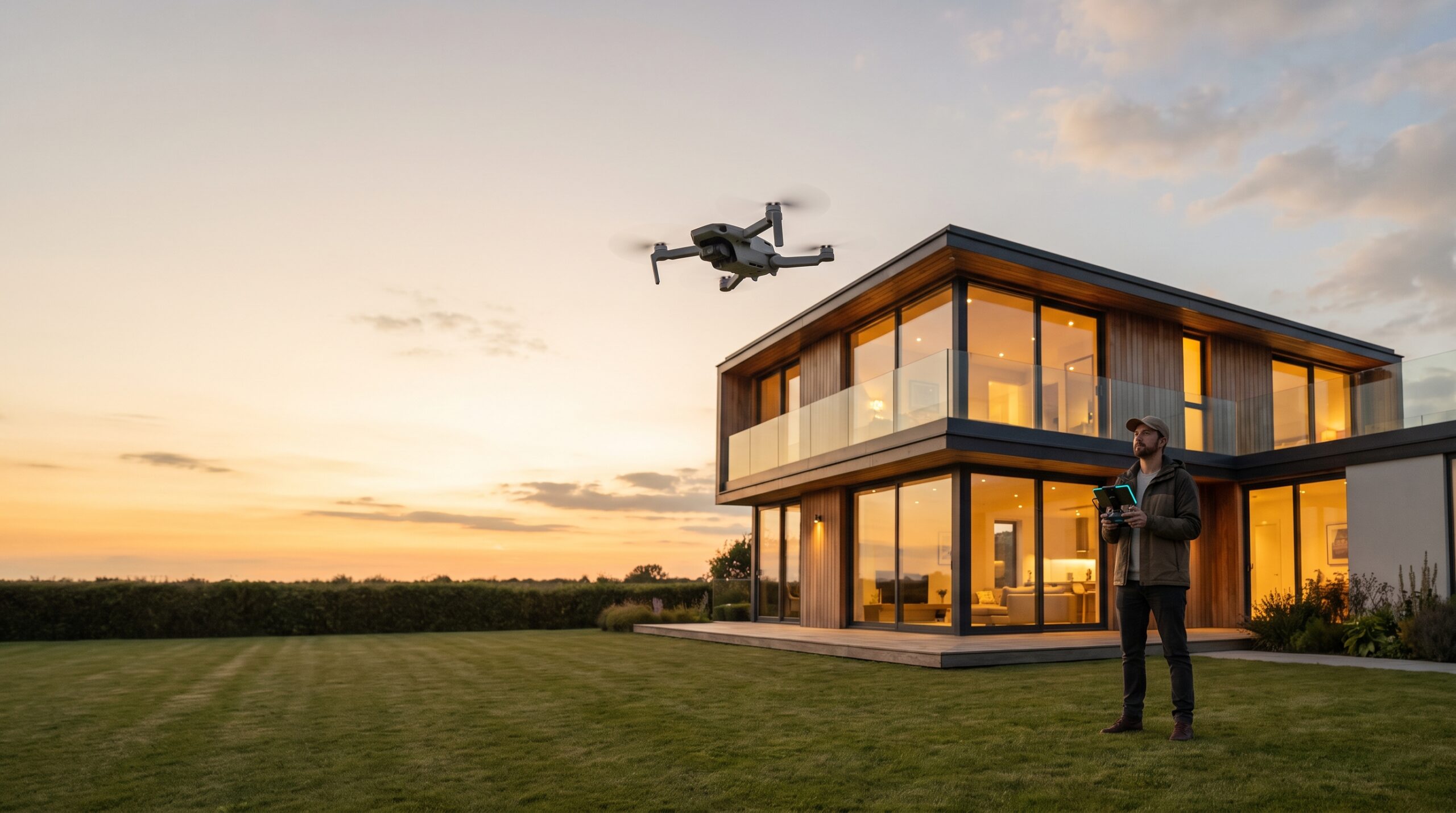
The best drone under $500 for real estate work is the aircraft that preserves shadow detail, holds position near structures, and gets through a 20-property week without turning post-production into damage control. For most operators, that means a discounted or refurbished DJI Mini 4 Pro. When that configuration is genuinely above the cap, the DJI Mini 3 is the rational fallback—not an off-brand specification gamble.
This comparison treats $500 as an aircraft-and-controller budget, not a complete business budget. Batteries, ND filters, insurance, storage, certification, and editing still sit outside that number. It also separates manufacturer laboratory ratings from field performance. A 34-minute specification does not equal a 34-minute property sortie.
The under-$500 answer in one line
Buy a DJI Mini 4 Pro if a legitimate sale or refurbished package puts it below $500. Its omnidirectional obstacle sensing, 10-bit D-Log M recording, 48 MP RAW stills, and true vertical capture reduce risk and expand deliverables. Buy a DJI Mini 3 if the Mini 4 Pro is over budget and your work is primarily exterior stills plus short daylight video clips.
The Mini 3 uses the same broad sensor class—a 1/1.3-inch CMOS—and records RAW photographs, but it gives up the Mini 4 Pro’s all-direction obstacle sensing and advanced tracking. That trade is acceptable on open suburban lots with a disciplined orbit plan. It is less acceptable around trees, wires, chimneys, narrow courtyards, and luxury properties where one interrupted shot can cost more than the price difference.
If your assignment requires dusk interiors through windows, heavy highlight recovery, paid broadcast delivery, or consistent work in wind, stop optimizing around the $500 number. A larger platform such as the Mavic-class aircraft buys more than resolution: it buys exposure latitude, stability, and repeatability.
What real-estate work demands from a sub-$500 drone
Real-estate imagery is deceptively demanding. Houses are grids of vertical and horizontal lines. A horizon error of two degrees is visible immediately. White siding clips early, dark roofs block up, and late-afternoon windows produce reflections that are hard to repair. The useful buying criteria are therefore not headline range or automated flight count. They are the following:
- RAW still capture: JPEG-only output leaves too little room for highlight recovery and white-balance correction.
- Exposure bracketing: AEB frames make high-contrast facades and bright skies manageable without synthetic-looking HDR.
- Stable three-axis gimbal: Property lines reveal roll drift and abrupt yaw corrections.
- Predictable wind behavior: The aircraft must hold framing long enough to finish a bracket or slow reveal.
- Obstacle awareness: It is a risk-control tool, not permission to fly close to wires or trees.
- Efficient vertical delivery: Agents increasingly request 9:16 reels alongside MLS stills and 16:9 video.
The pilot’s workflow matters as much as the camera. A Mini-series aircraft can produce clean listing imagery when flown at low ISO, with controlled shutter speed, a level gimbal, and an exposure bracket. The same aircraft produces brittle files when the pilot underexposes a backlit facade and expects a preset to recover it. Before buying, review our drone photography settings guide and ND-filter field guide.
DJI Mini 4 Pro: best operational tool when the price fits
DJI’s Mini 4 Pro specification sheet lists a takeoff weight below 249 g with the standard battery, a 1/1.3-inch CMOS sensor, 48 MP stills, 4K/60 fps HDR video, and a 34-minute maximum flight-time rating. DJI’s Mini 4 Pro product page also documents omnidirectional obstacle sensing and true vertical shooting. Those features map directly to property work.
The camera is not a substitute for a Micro Four Thirds or 4/3-class payload, but it is competent when exposed correctly. The 24 mm-equivalent field of view is wide enough for most residential exteriors without the exaggerated edge stretch of an ultra-wide lens. DNG files support practical recovery in Lightroom or Capture One, and the fixed f/1.7 aperture helps at dusk. The limitation is that exposure control relies on shutter speed, ISO, and filters because aperture is fixed.
The Mini 4 Pro’s strongest advantage is operational, not pixel-level. Omnidirectional sensing gives the pilot more information when backing away from a facade or making a lateral reveal. It does not reliably detect every wire, leafless branch, or low-contrast surface, but it reduces the number of blind-vector mistakes. ActiveTrack can support a reveal or vehicle-follow shot, although manual inputs remain preferable around buildings.
For color work, D-Log M provides more grading flexibility than a baked standard profile. Keep the pipeline restrained: normalize, correct exposure and white balance, then match clips. Avoid forcing a heavy cinema LUT onto listing footage. Our drone LUT and color-grading guide explains why technical transforms and creative looks should be separate steps.
DJI Mini 3: the value pick for still-focused work
The DJI Mini 3 specification sheet lists a 248 g takeoff weight, the same 1/1.3-inch sensor format, 48 MP output, a 38-minute maximum flight-time rating with the standard battery, and 10.7 m/s wind resistance. DJI’s Mini 3 product page documents the platform’s vertical capture and imaging feature set. It records RAW stills and rotates the gimbal for native vertical framing. For agents who need 10-15 exterior photographs and several short social clips, that is a capable core.
What you give up is sensing coverage and a more robust video toolset. The Mini 3 relies on downward vision positioning rather than the Mini 4 Pro’s omnidirectional system. The pilot must build larger buffers around rooflines and vegetation and avoid backward or lateral moves without a visual check. That is manageable on an open lot; it slows down dense properties.
The Mini 3 is therefore the better value only when the savings fund the rest of the working kit: two additional batteries, a charging hub, high-speed cards, propellers, an ND set, and liability coverage. A $399 aircraft with one battery is less useful than a $499 aircraft package that can complete three properties before returning to mains power. Use our accessories-under-$100 guide to prioritize spares rather than decorative add-ons.
Used and refurbished alternatives: inspect before buying
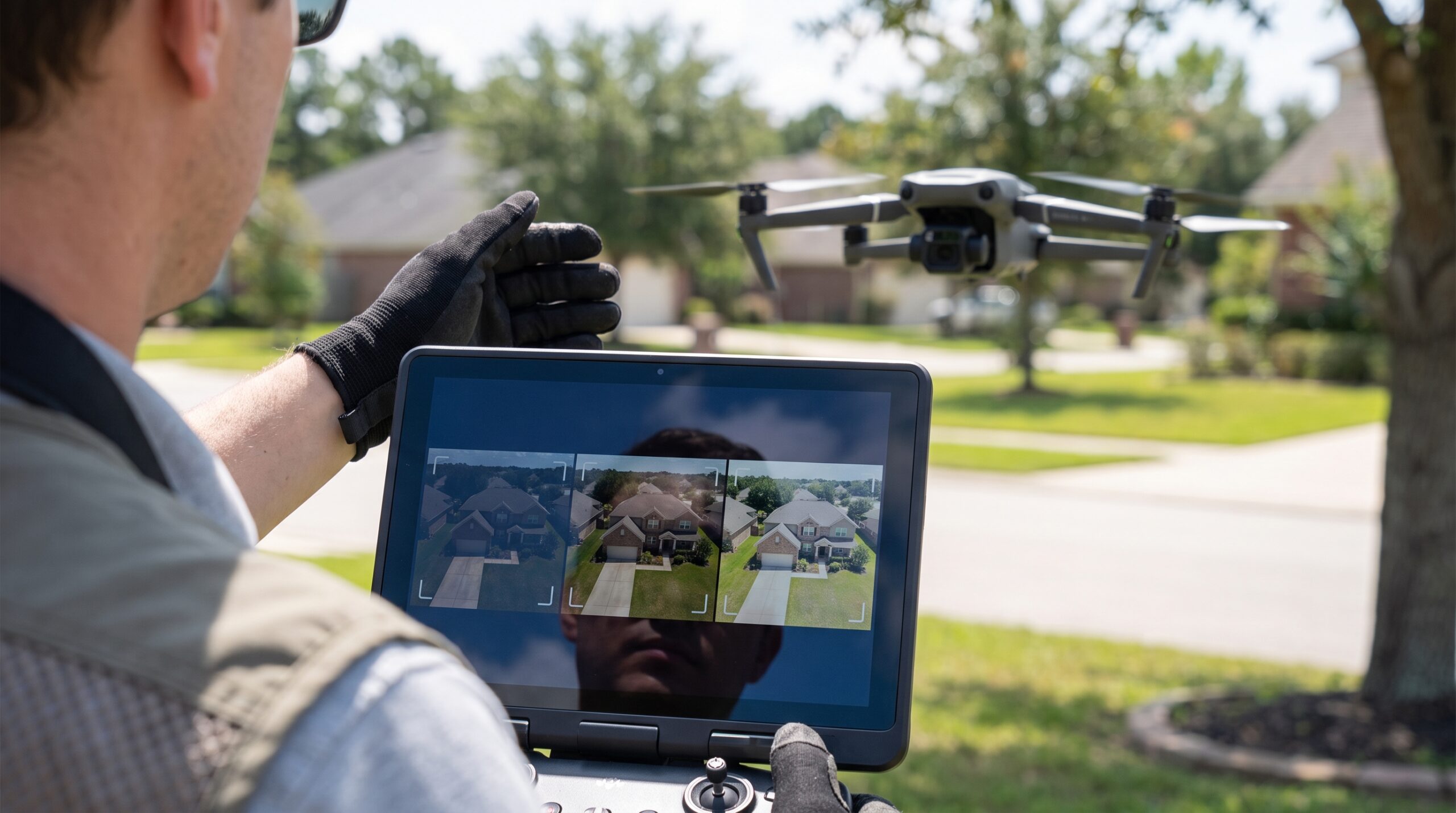
A used Mini 3 Pro, Mini 4 Pro, or older Air-series aircraft can outperform a new entry-level package at the same price, but only if battery and gimbal condition are known. Ask for battery cycle counts, flight logs, a cold-start gimbal video, and unedited DNG files. Check that the aircraft holds a level horizon during a slow 360-degree yaw and that the camera does not twitch after braking.
Avoid buying on a controller screenshot alone. Verify that the account binding is removed, firmware updates complete, Remote ID behavior is normal, and every battery charges to a consistent cell voltage. Inspect the front arms and motor mounts under side light for repaired cracks. A bargain aircraft with one swollen battery and a drifting gimbal is not a $500 tool; it is an interruption waiting for a client appointment.
Older Air models can offer larger sensors or variable apertures, but weight and support condition change the equation. A heavier aircraft may hold better in wind, yet it consumes more space, requires a more deliberate launch area, and can be less convenient for quick suburban listings. Compare the actual payload and workflow against our DJI buying guide, not against a launch-year marketing sheet.
Camera comparison: sensor, codec and delivery
| Criterion | Mini 4 Pro | Mini 3 | Real-estate impact |
|---|---|---|---|
| Sensor | 1/1.3-inch CMOS | 1/1.3-inch CMOS | Similar baseline still-image potential at matched exposure |
| RAW stills | Yes | Yes | Both support professional color and highlight correction |
| Video | Up to 4K/60 HDR; D-Log M/HLG options | Up to 4K/30 HDR | Mini 4 Pro is better for movement and grading |
| Obstacle sensing | Omnidirectional | Downward positioning sensors | Mini 4 Pro provides more protection during lateral and reverse moves |
| Standard-battery rating | 34 minutes | 38 minutes | Plan materially less after reserves, wind and repeated climbs |
| Vertical capture | True vertical shooting | True vertical shooting | Both support native social deliverables without cropping |
Do not over-read the 48 MP number. In good light, high-resolution mode can preserve roof and landscaping detail. In moving air or low light, a standard-resolution bracket often produces a cleaner result. The correct mode is the one that keeps exposure stable and avoids motion between bracketed frames.
For MLS delivery, export a full-resolution archive and a platform-sized set. Keep verticals corrected conservatively; aggressive perspective transforms can make the house look wider than it is. For video, capture a stable establishing shot, one controlled orbit, one approach or reveal, and a vertical sequence. More clips increase edit time without necessarily improving the listing.
A repeatable property-shoot workflow
1. Scout before launch. Walk the perimeter. Mark wires, trees, neighboring privacy areas, people, pets, and reflective surfaces. Confirm the property boundary and identify a recovery area. Use a weather source and the process in our weather guide for drone pilots.
2. Establish legal authority. Paid listing work falls under the FAA’s commercial framework. The FAA commercial-operator guidance is the starting point, and aircraft registration rules are described on the FAA registration page. Most registered aircraft must also meet the requirements outlined in the FAA Remote ID guidance. A sub-250 g aircraft does not exempt a paid operation from Part 107. Review airspace, authorization, operations over people, night requirements, and Remote ID before accepting the job.
3. Capture stills first. Fly the must-have angles while batteries, light, and client attention are fresh. Use RAW, low ISO, histogram and zebra warnings, then capture a bracket where the sky-to-facade contrast demands it. Check one DNG at 100% on the controller or tablet before leaving the angle.
4. Capture restrained motion. Set smooth gimbal and yaw response. Finish each movement with several stationary frames so the editor has handles. A slow shot with a clean endpoint is more useful than an automated orbit that changes radius around a roof corner. The smooth-footage guide covers control tuning.
5. Protect the data. Copy cards before formatting, maintain a property-address folder structure, and retain original DNG and video files until the client signs off. Deliver edited assets separately from originals. If the job involves a repeat client, save camera, color, export, and naming presets so the next listing matches.
When to skip the $500 class
Move to a Mavic 3 Classic or comparable larger-sensor aircraft when the job routinely includes twilight exteriors, commercial property, complex color matching, strong wind, or premium video deliverables. The larger camera and variable aperture reduce dependence on filters and improve exposure control. The platform also carries more mass, which can produce steadier movement in moderate wind.
The upgrade is not automatic. A larger drone increases replacement cost and can be less discreet around occupied properties. Run the decision against revenue. If the Mini 4 Pro completes 80% of assignments and the remaining 20% can be scheduled for favorable light, keep the smaller aircraft and rent for edge cases. If clients regularly reject noise, clipped windows, or wind-limited sessions, the larger platform is a business requirement.
Budget for operations rather than the box. Our Part 107 business-cost guide covers recurring expenses, while the drone-insurance guide explains the coverage questions that matter when flying around client property.
Frequently asked questions
What is the best drone under $500 for real estate photography?
A discounted or manufacturer-refurbished DJI Mini 4 Pro is the strongest choice when it falls below $500 because it combines RAW stills, a 1/1.3-inch sensor, 10-bit video options, true vertical capture, and omnidirectional obstacle sensing. If it does not fit the cap, choose the DJI Mini 3 and spend the balance on batteries and filters.
Is the DJI Mini 3 good enough for real estate photography?
Yes, for daylight residential exteriors. It records DNG files, uses a 1/1.3-inch sensor, and supports vertical capture. Its main limitation is reduced obstacle sensing, so it demands larger buffers and more conservative lateral or reverse movements near buildings and vegetation.
Do I need Part 107 for paid work with a sub-250 g drone?
Yes. In the United States, the purpose of the flight determines whether Part 107 applies. Paid real-estate imagery is a commercial operation. The recreational registration exception for some sub-250 g aircraft does not convert paid work into recreational flying.
Should I shoot real-estate photos in RAW?
Yes. DNG files retain more exposure and white-balance flexibility than JPEGs, which matters when a bright sky, reflective windows, white siding, and shaded landscaping appear in the same frame. A bracketed RAW sequence is preferable when the scene exceeds a single exposure.
When is a Mavic 3 Classic worth the extra money?
Upgrade when twilight work, strong wind, premium video, or demanding highlight recovery is routine rather than occasional. The larger sensor and variable aperture improve exposure control and file latitude. For daylight residential listings, the Mini 4 Pro usually remains the more efficient tool.
Bottom line
For an affordable real estate drone, buy capability in this order: RAW capture, stable gimbal, predictable wind handling, batteries, and obstacle awareness. A Mini 4 Pro below $500 is the best-balanced field tool. A Mini 3 is the disciplined value choice. Ignore anonymous “8K” alternatives that cannot provide verifiable DNG files, repair support, flight logs, and reliable batteries.
Before the first client shoot, build one repeatable checklist: legal review, perimeter walk, exposure bracket, four required angles, video sequence, card backup, and delivery export. The aircraft gets you airborne. The checklist is what makes the work billable.