

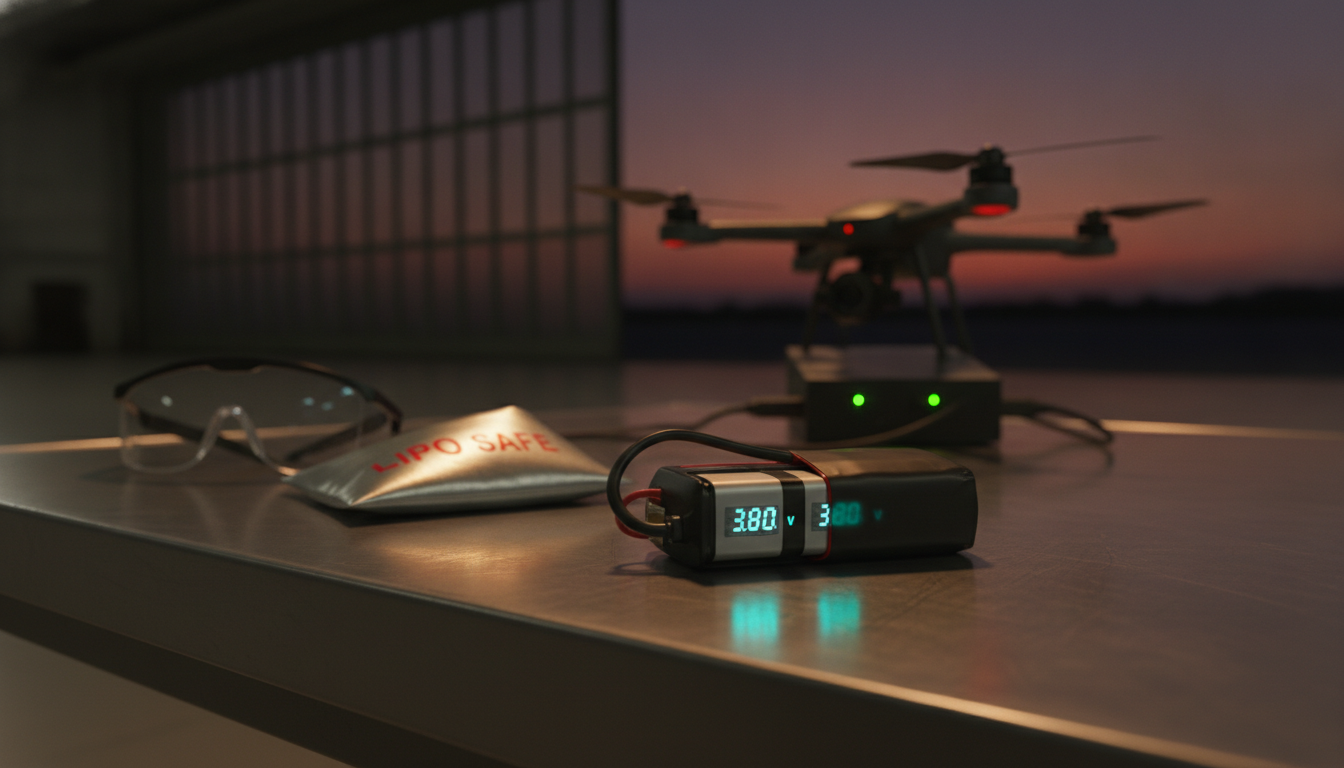
A Matrice 350 TB65 is rated to roughly 400 cycles. A 6S 5000 mAh LiPo in a custom-built quad is rated for 200-300 if you treat it carefully and under 100 if you don’t (DJI spec sheet; Heliguy TB60 guide). The delta is not chemistry – it is storage voltage, storage temperature, and depth-of-discharge between missions.
The good news: lipo battery care for drone operators is a schedule, not a talent. A handful of mechanical habits – storage voltage, storage temperature, balance-charge cadence, puff detection – any Part 107 pilot can adopt in a week. The cost of the schedule is fifteen minutes per pack per month. The cost of skipping it is a swollen pack at the bottom of a LiPo safe bag, or a thermal event on your tailgate.
This guide covers what the manufacturer PDFs say (DJI BS60 Station manual, Tattu 3.0 manual), what the lithium-ion research community has published since 2022 (MDPI Batteries: Swelling Mechanisms; Frontiers in Chem Eng pouch-cell gas), and where field consensus diverges from spec sheets. The schedule applies whether your fleet is one Mavic 4 Pro for real-estate shoots or ten Matrice 350 TB65 batteries for commercial surveys.
What a LiPo cell voltage curve actually means for storage
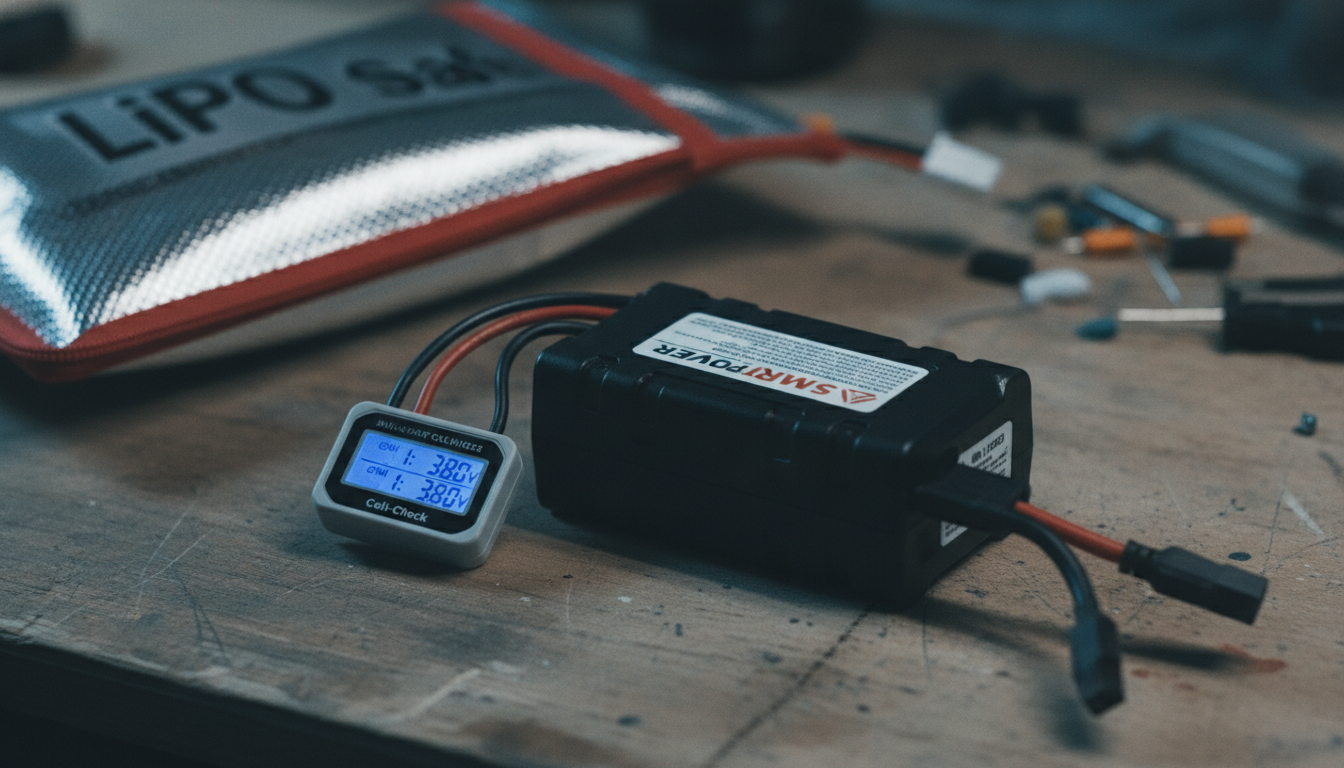
Lithium polymer cells used in drones follow a per-cell voltage ladder that the manufacturers all converge on:
| State | Per-cell voltage | Pack state (6S) | |—|—|—| | Fully charged | 4.20 V | 25.2 V | | Nominal | 3.70 V | 22.2 V | | Storage (recommended) | 3.80 V | 22.8 V | | Discharged cutoff | 3.00 V | 18.0 V | | Damage threshold | below 2.50 V | below 15.0 V |
The numbers above are consistent across Battery University’s LiPo longevity reference, Battery University / Isidor Buchmann (the Cadex Electronics reference set), and the Grepow manufacturer reference (Grepow Lithium Polymer storage guide). The single number you commit to memory is 3.80 V per cell. That is the storage target — about 40–50% state of charge — where the calendar-aging curve of the cell is at its lowest slope and the electrolyte degradation reactions are slowest.
The why: a cell at 4.20 V/cell sits at peak cathode-oxidation potential; a cell at 3.00 V sits above the copper-current-collector dissolution threshold. The cell is happiest somewhere in the middle. Per Hanery’s research summary on LiPo swelling, a cell stored fully charged will swell in weeks at room temperature and in days at 40 °C.
The 2026 LiPo care schedule pilots can run on autopilot
This is the actual workflow. It is calibrated to keep cells in the 3.80 V / 15–25 °C / 40–60% SoH window for as many cycles as the manufacturer budget allows.
1. Charge the pack the day you fly, balance it the day before
Balance-charge every flight pack to 100% within 24 hours of the mission. Then bring it back to storage voltage (3.80 V per cell / “storage mode” / “discharge” depending on your charger’s vocabulary) before you put it on the shelf. The Tattu 3.0 product manual treats this as a single workflow: charge to 4.20 V/cell the day-of, return to 3.80 V/cell the day-after (Tattu 3.0 PDF). Doing both in one session is what the cycle-life curve in Battery University’s charging chapter assumes.
For DJI smart batteries, the firmware does this for you. The Matrice 300 RTK’s TB60 auto-discharges to roughly 50% when the pack sits idle for ten days at room temperature, per the BS60 Station User Guide. For hobby LiPos charged with a Hobby-grade balance charger (ISDT, ToolkitRC, SkyRC, etc.), you either run a “storage” charge cycle or top-balance to 4.20 V/cell, then manually discharge each cell to 3.80 V/cell using the charger’s storage program. Both workflows land the cell in the same place.
2. Storage temperature beats storage voltage for cold-weather operations
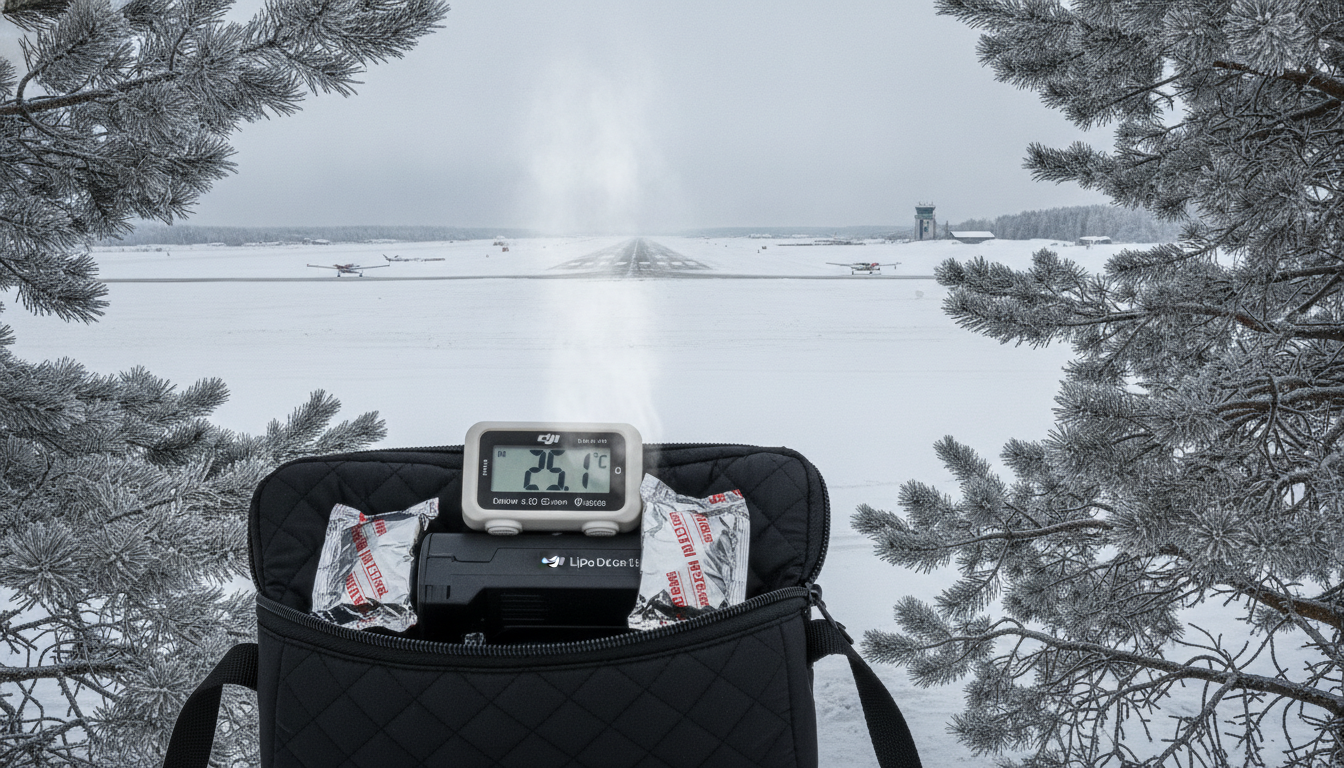
This is where most winter-flying pilots lose money. Cold does two things to a LiPo:
- Internal resistance rises sharply below 10 °C. A pack that delivers 220 Wh/kg at 25 °C may deliver only 130 Wh/kg at 0 °C, and the available capacity at the same discharge curve drops by 20 to 40% (Renogy Lithium in Cold Weather).
- Charging a sub-0 °C cell plates metallic lithium on the anode, which is irreversible. The Em3ev lithium-freeze guide is the cleanest version of this warning: “Do not charge below freezing (32°F / 0°C).”
The number that matters: if your pack internal temperature is below 5 °C, do not plug it into a charger. The DJI BS60 manual codifies a charging window of 5 °C to 40 °C (BS60 PDF). Below 5 °C is the danger zone for plating.
Field protocol:
- Pre-warm to ≥15 °C in an insulated bag with hand warmers (rice-bag-in-microwave works at small scale).
- Keep packs in a heated vehicle until takeoff. Treat them like ammunition — cool is fine, frozen is not.
- Never charge a cold-soaked flight pack until it equilibrates to ≥15 °C. The DJI Pilot app will warn you if firmware disagrees; if it doesn’t, the chemistry still will.
A pack that flew at -10 °C and landed at 35% capacity does not regain full capacity on warming — some loss is permanent for that cycle. Treat the cold-day landing as a storage event: leave at partial SoC, bring indoors, equilibrate to 20 °C, then run a slow balance-charge.
3. Depth of discharge: the 80% rule vs the 100% rule
Two competing rules:
- 80% depth-of-discharge – Battery University’s cycle-life chart shows 100% DoD vs. 80% cuts cycle life by ~a third.
- Fly to 20% remaining – what most pilots do.
The honest read: DoD matters more for cells that spend most of their life in storage. 2025 pouch-cell research (MDPI: C-Rate, Float Charging, Temperature) shows sustained float-charging at high voltage accelerates swelling more than DoD in 60-100% range. Rule: don’t store a pack at 100% SoC for a week, don’t routinely land at 100% DoD.
4. Puff detection: when a LiPo is dead
A puffed LiPo has produced gas from electrolyte decomposition – hydrogen, methane, CO2 (Frontiers in Chem Eng: Gas in Pouch Cells, 2022). The gas does not come back out. Retire.
Visual test:
- Place on a flat, level surface, label-up.
- Label should be flat – any convex bow (even a few mm) is a puff.
- Compare to a known-flat reference pack.
The resistance test that catches puffs earlier than the eye:
- Charge the pack to storage voltage (3.80 V/cell).
- Measure the resting voltage of each cell 24 hours later.
- A healthy pack will hold within ±0.01 V across all cells. A pack with one cell at 3.78 V and another at 3.81 V is showing internal resistance asymmetry and is on the way out.
Disposition: Move to a LiPo safe bag, discharge to zero via a low-wattage resistor or salt-water bath (outdoor, controlled), recycle at a drop-off. Never household trash – decomposition products include hydrogen fluoride precursors (NFPA: Li-ion Battery Fires & Post-Incident Considerations, 2024).
5. Cycle counting and rotation
A spreadsheet with three columns – pack ID, cycle count, last balance-charge date – pays for itself in months. The Heliguy guide recommends a full charge/discharge every 50 cycles; count each balance-charge as one cycle for non-smart LiPos.
Rotate the fleet – don’t always fly Pack A – so all packs reach end-of-life together.
6. After-action sequence for every flight
Daily version of the schedule:
- Post-flight: cool to ambient before the next step (cool if >40 degrees C).
- Within 30 min: inspect for puff, tab damage, wire-nick abrasion.
- Same day: bring to 3.80 V/cell via storage mode.
- Within 7 days: full balance-charge, no cell drifting greater than 0.01 V.
Pair this with the monthly maintenance checklist.
Storage layout and LiPo safe practice
Three rules converge across the manufacturer references:
- 15–25 °C is the comfort band. Grepow sets 21 °C; NIST TN 2365 recommends a thermal-runaway-vented LiPo cabinet for stationary storage.
- Charge separately from storage. A single failed pack on a charging shelf can take the whole row.
Air transport: the regulatory frame you cannot ignore
If you fly cross-state for work, you will eventually have to put a LiPo on a commercial flight. The U.S. framework is:
- FAA Lithium Battery Resources (faa.gov/hazmat/resources/lithium_batteries) — the operator quick reference.
- FAA Interactive Guide to Shipping Lithium Batteries (faa.gov/hazmat/safecargo) — the walkthrough.
- 14 CFR Part 107.36 (Govinfo) — the carriage of hazardous material rule for sUAS operations.
Domestic passenger-airline rules: ≤100 Wh carry-on, 100–160 Wh with airline approval (≤2 spares), >160 Wh only via FAA exemption. For Part 107 cargo ops, the PHMSA advisory guidance governs packaging, marking, and labeling.
The decision that catches operators: a fully-charged Matrice 300 TB60 is 274 Wh. That is over the 160 Wh carry-on ceiling. The legal move is to discharge it to storage voltage (around 130 Wh remaining) before the flight, and ship it ground (or carry it on a charter aircraft under Part 107.41 cargo rules). The wrong move is to wrap it in a LiPo bag and pretend it is small.
Cost-of-bad-storage math for a small fleet
A five-pack fleet of 6S 5000 mAh LiPos at $150 per pack is a $750 replacement event. Stored at 100% SoC in a hot garage, cycle life can drop below 80 — at two flights per week per pack, that’s $4,500/year in replacements. Stored at 3.80 V/cell / 21 °C, cycle life is 200–250 and the fleet lasts about a year for $750/year. The difference is the schedule, and it is real.
What lithium-polymer care cannot do
The schedule extends cycle-life. It does not:
- Reverse a puff. Mechanical damage is permanent.
- Recover a deep-discharged cell. A pack at 0 V for weeks has copper dissolution; unsafe to charge.
- Fix a crash-damaged cell. Breached enclosure = end-of-life.
When any of those happens, the pack goes to a recycle drop-off.
Field-tested checklist for 2026
Operator-grade version of the schedule — same structure used by both commercial survey fleets and custom-built FPV quads.
Before flight:
- Pack internal temperature ≥ 15 °C.
- Pack voltage 3.80 V/cell minimum at takeoff (for full-flight planning).
- No puff. Label flat.
- Visual: tabs, wires, balance lead, no nicks or wear.
- Date last balance-charge within 7 days.
Post-flight:
- Cool to ambient before any charger.
- Visual puff check.
- Storage-charge or full balance-charge based on next-flight horizon (24 h).
- Log: pack ID, cycle count, post-flight voltage, post-flight puff state.
Monthly:
- Capacity test: full charge → hover/load discharge to storage voltage → measure mAh returned. Anything > 80% of rated capacity is healthy. Below 70%, retire.
- Balance test: full balance-charge → 24 h rest → measure per-cell voltage. All cells within ±0.01 V = healthy.
- Puff recheck.
Annual:
- Cycle-count review. Replace any pack approaching 80% of rated cycles.
- Charger firmware update.
- LiPo safe bag condition inspection.
This is the same structure used by the BVLOS corridor-survey pilots flying 100+ cycles per quarter on Matrice 350s, adapted for the hobby LiPo form factor. It is not aspirational — it is what already runs in the field.
Conclusion: schedule beats chemistry
The biggest open secret of lipo battery care for drones is that the chemistry is forgiving if the operator is not. Cycle life lives or dies on storage voltage and storage temperature – both mechanical choices, 15 minutes per pack per month. The research literature consistently shows calendar aging at high SoC and high temperature is a steeper loss curve than cycle aging (MDPI: Swelling Mechanisms, 2025; Hanery LiPo Swelling Science).
Next concrete move: spend an hour writing your pack roster into a spreadsheet and run the field-test protocol for one cycle. A digital cell-check voltmeter (Cellmeter 8 or ToolkitRC M8, under $30) reads per-cell voltage to two decimal places – the resolution you need to catch the resistance-asymmetry drift that visual inspection misses.
For the airframe side, see the complete drone-maintenance schedule.
FAQ
Should I store my LiPo fully charged if I am flying again tomorrow? Yes. For 24-hour turnaround, leaving the pack at storage voltage costs you cycle life and time; leave it at full SoC until you are within 24 h of the next flight, then bring it to storage. Anything longer than a week sitting at full SoC accelerates calendar aging measurably (Battery University storage voltage notes).
Can I charge my LiPo at -5 °C if it is in the car with the heater on? No. Internal cell temperature lags the surface temperature by tens of minutes. By the time the surface hits 10 °C, the interior is still below 0 °C. The DJI BS60 user guide recommends the pack reach 5 °C internally before charging; surface temperature is not a reliable proxy (BS60 PDF).
My LiPo puffed slightly after a crash. Is it safe to fly? No. A puffed cell has produced decomposition gas from the electrolyte. The puff is permanent and gets worse on the next cycle, not better. Move the pack to a LiPo safe bag, discharge to zero volts through a low-wattage resistor, and recycle.
How do I know when a LiPo is at end-of-life? Three signals: puff, capacity below 70% of rated, or per-cell voltage spread > 0.05 V after a full balance-charge and 24 h rest. Any one of those and the pack is at end-of-life.
Does the DJI smart-battery auto-discharge cycle count toward the cycle rating? The cycle rating in the DJI spec (Heliguy TB60) counts full charge/discharge cycles, not storage mode cycles. Storage mode is part of the routine; it does not consume your budget.
Can I use a LiPo that has been stored at 0 V for a week? No. Copper current-collector dissolution starts below 2.5 V per cell and is irreversible. The pack is unsafe to charge regardless of how the surface looks.
What is the difference between storage voltage and the “storage mode” on my charger? Storage mode is the charger’s program that drives each cell to 3.80 V. If you set storage mode on a fully-charged pack, the charger will discharge each cell to 3.80 V. If you set it on a half-charged pack, the charger will charge each cell to 3.80 V. The target voltage is identical.
Sources
- DJI Store — DJI TB51 Intelligent Battery
- DJI BS60 Intelligent Battery Station User Guide (PDF)
- Heliguy Knowledge Base — How do I maintain the TB60 Intelligent Flight Battery?
- Tattu 3.0 Series Product Manual (PDF)
- Grepow — Everything about Storing Lithium Polymer (LiPo) Batteries
- Battery University — How to Prolong Lithium-based Batteries
- Battery University (mirror) — Charging Lithium-Ion Batteries
- Em3ev — Can Lithium Batteries Freeze? Cold Weather Guide & Storage
- Renogy — Lithium Batteries in Cold Weather: Performance, Challenges, Solutions
- Hanery — The Science Behind LiPo Battery Swelling (Puffing)
- Hanery — Li-Po Battery Sub-Zero Performance: 21 Key Questions
- Frontiers in Chemical Engineering — How Gas Generates in Pouch Cells and Affects Consumer Products
- MDPI Batteries — Swelling Mechanisms, Diagnostic Applications, and Mitigation Strategies in Lithium-Ion Batteries (2025)
- NIST TN 2365 — Understanding the Risk of Lithium-Ion Battery Fires: Multi-Source Data Analysis
- NFPA — Research Update: Li-ion Battery Fires & Post-Incident Considerations (2024 PDF)
- FAA — Lithium Battery Resources (U.S. DOT hazmat)
- FAA — Interactive Guide to Shipping Lithium Batteries
- FAA Advisory Circular AC 107-2A (PDF)
- 14 CFR Part 107 — Small Unmanned Aircraft Systems (Govinfo PDF)