
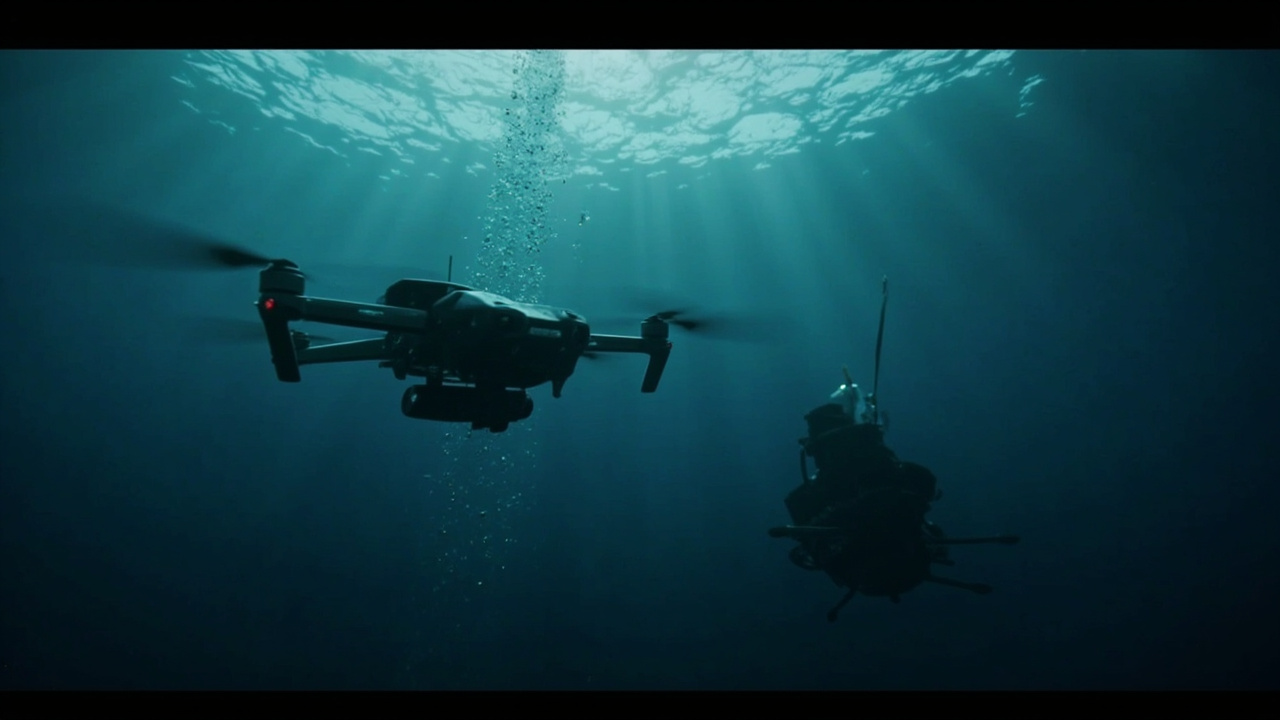
In the past 12 months, three independent recoveries — a missing boater in 100m Norwegian fjord water, a submerged car from Falls Lake in North Carolina, a piece of forensic evidence from a Colorado reservoir — all credited the same tool class: the tethered underwater ROV. Search-and-recovery teams bought more underwater ROVs in 2025 than in any prior year, and the platform choice that worked in 2024 is no longer the one that works in 2026.
This article is for the people who actually have to choose one: water rescue teams, dive squad commanders, evidence-recovery officers, and the procurement officers who write their checks. We cover the 2026 SAR ROV market by the numbers, the operational capability matrix that separates a $25,000 observation ROV from a $150,000 tactical SAR package, and the five platforms that should be on every shortlist. We also dig into the unsexy decisions — tether strength, controller layout, current station-keeping — that determine whether an ROV buys you time on the search clock or wastes it.
The 2026 SAR ROV market by the numbers
The first-responder ROV segment is no longer a niche line item in a public-safety budget. The market was valued at $85.0 million in 2025 and is forecast to reach $171.7 million by 2033 at a 9.2% CAGR, with the “Others” slice (which includes SAR, evidence recovery, and underwater mapping) growing 12.1% CAGR — the fastest segment in the breakdown (Archive Market Research, 2026). The broader underwater drone market — which includes defense, offshore energy, and commercial inspection — is sized at $6.4 billion in 2026, growing to $12.2 billion by 2032 at a 12.4% CAGR (Market.us, 2026). Mordor Intelligence’s full ROV market sits at $3.72B in 2026 heading to $6.05B by 2031, with the shallow-water segment (under 300m) advancing at a 13.1% CAGR — the exact slice that matters for inland water rescue, harbor security, and near-shore recovery (Mordor Intelligence, 2026).
The demand signal behind those numbers is the operational reality of public-safety diving. National incident databases in several coastal economies show a 52% increase in flood and water rescue callouts between 2019 and 2024 (Archive Market Research, 2026). In the United States alone, the CDC reports an annual age-adjusted drowning death rate of 1.31 per 100,000 during 2018-2021 (CDC drowning data), and the American Red Cross estimates ~4,000 unintentional drowning deaths per year, roughly 11 per day (American Red Cross). Globally, the WHO counts ~236,000 drowning deaths per year, with the global age-adjusted rate having fallen 38% since 2000 (from 6.1 to 3.8 per 100,000) but still unacceptably high (WHO drowning fact sheet).
The economics of putting an ROV in the water alongside (or instead of) a diver are increasingly in the ROV’s favor. The Archive Market Research report puts the cost gap bluntly: $450 per diver-hour versus under $150 per ROV-hour. A typical SAR callout might burn 4-12 diver-hours before recovery; the same task with an ROV is 1-3 hours topside. On a single drowning recovery in a public lake, that is the difference between a $4,500-$5,400 operation and a $450 operation. Multiply by callout volume and procurement officers stop asking “do we need one?” and start asking “how many do we need?”
Why imaging sonar, not camera, decides mission success
The single most common procurement mistake in 2024-2025 was buying an ROV with a great 4K camera and no sonar. In clear water (Caribbean reef, tropical cenote, alpine lake in July) the camera does most of the work. In everything else — and SAR work is rarely in clear water — sonar is the primary sensor. Deep Trekker’s 2026 ROV buying guide is direct about this: “Target search and recovery missions are far more effective with an imaging sonar, particularly when the sonar can be angled to optimize the field of view” (Deep Trekker, 2026 ROV buying guide).
Three imaging sonar models matter for the SAR use case in 2026:
- Oculus M750d (Blueprint Subsea, multi-beam): the default pairing for Blueye X3/X3 Ultra. Northern Wake Fire Department in North Carolina uses an X3 with the M750d multibeam sonar across the 175 miles of Falls Lake shoreline the department is responsible for (Blueye Robotics).
- Deep Trekker M1200: high-quality imagery at ranges up to 30m (98 ft), the right tradeoff for identification clarity at SAR-relevant depths. The M1200 trades range for clarity compared to the M750 and M370 — the right tradeoff when the task is identifying a target rather than scanning wide area (Deep Trekker).
- Deep Trekker M3000: higher-power sonar used on PIVOT Expert for civil-infrastructure inspections; overkill for most SAR teams unless you’re routinely working in high-flow rivers.
The 2026 trend worth flagging is 3D sonar SLAM (simultaneous localization and mapping). Deep Trekker’s SPECTRA integrates real-time 3D sonar SLAM, which generates live 3D point clouds of the search area — improving coverage, repeatability, and spatial awareness in low-visibility water where a 2D sonar sweep has to be re-stitched mentally by the operator (Deep Trekker). For high-value missions — evidence recovery, drowning scene documentation — the 3D record is also admissible in court in a way that operator-imagined mapping is not. If your agency handles evidence recovery as well as SAR, put 3D sonar SLAM on the shortlist.
Depth rating: how deep is deep enough for SAR
Depth rating is the spec most often over-specified by procurement and under-appreciated by operators. The honest depth-budget breakdown for SAR work in 2026:
- 0-50m: covers nearly all inland lake, river, reservoir, and quarry recoveries. Most US public-safety dive teams operate in this band.
- 50-150m: required for coastal port and harbor work, some quarries, deep reservoirs (Lake Tahoe, Crater Lake, Lake Chelan).
- 150-300m: covers the bulk of coastal search-and-recovery outside harbor walls (fjord work, near-shore plane/craft recovery).
- 300m+: offshore, subsea infrastructure, plane crashes. Outside the SAR envelope unless your agency is a coast guard with offshore jurisdiction.
The 300m band is the sweet spot for tactical SAR packages. VideoRay’s Mission Specialist Pro 5 — the platform the U.S. Coast Guard deploys “at all units equipped with underwater technology” — is rated to 305m (1,000 ft), weighs 10 kg dry, and has a three-thruster vectored configuration with forward thrust of 20.3 kg (44.7 lb) and a forward speed over 4.4 knots (VideoRay, AeroVironment spec sheet). Pro 5’s tether uses Kevlar rated at 450 kg (1,000 lb), with connectors rated at 80 kg (175 lb) — meaningful for any recovery operation that puts real load on the line (VideoRay tether documentation).
Procurement over-spec is real: an agency that buys a 1000m-rated work-class system to recover a car from a 12m lake is paying for hardware they will never use, and the operational penalty is the system weight and topside footprint that prevent single-vessel deployment. Buy to the depth you can prove on paper from your last five years of incident reports, plus a 50% safety factor for the cases you have not yet had. For a deeper dive on operational procurement discipline, see our drone maintenance cost playbook and autonomous infrastructure investment framework.
Current performance and station-keeping under load
Station-keeping is the SAR-relevant spec that almost no procurement RFQ asks for. “Can the ROV hold position in 2 knots of current while the operator reads the sonar?” is the question that decides whether a recovery takes 20 minutes or 2 hours. The Deep Trekker REVOLUTION and PIVOT Expert both offer DVL (Doppler velocity log) automatic station-keeping out of the box; the SPECTRA platform pushes the envelope with station-holding in currents up to 2.3 knots and forward speeds up to 3.5 knots, using seven vectored thrusters (Deep Trekker).
VideoRay Pro 5 with its three-thruster vectored configuration sits in the same operational band — the forward thrust of 20.3 kg is enough to push against most lake and harbor currents while maintaining a hover. Blueye’s X3/X3 Ultra — designed for one-person deployment and lighter payload — is honest about its limits: hold station in calm water or weak flow, work with the current rather than against it in anything over 2 knots.
The Blueye field record is instructive. The Norwegian Coast Guard recovered a deceased person from 100m depth in the Romsdalsfjord near Molde using a Blueye X3 — the recovery required working with the tether under load, not fighting current, and the boat’s positioning did most of the station-keeping (Blueye Robotics, May 2024). For coastal SAR in fjord and harbor conditions, that pattern — ROV for search and verification, surface vessel for station-keeping — is the modern operational default.
Manipulator and recovery hardware
An ROV that finds the target but cannot recover it converts a 30-minute task into a 3-hour task. The standard 2026 manipulator options break into three categories, and the choice depends on what you are recovering:
- Grabber claw: the workhorse. Deep Trekker’s REVOLUTION SAR Package ships with a 260-degree rotating grabber head (Deep Trekker). Good for objects, evidence, and most recoveries. Less ideal for sensitive items — the teeth can damage.
- Interlocking jaws (small / large): Deep Trekker add-ons specifically designed for delicate retrievals; better suited for sensitive items than the grabber teeth (Deep Trekker). For evidence recovery (firearms, electronics, cultural items), this is the right tool.
- Carabiner with line: the operator latches the ROV to a target, then attaches a surface line that divers follow down for the actual extraction. The ROV becomes the guide, not the gripper. This is the modern pattern for body recovery in deep water.
VideoRay Pro 5 ships with a manipulator payload rating of 3.1 lbs (1.4 kg) — enough for evidence, not enough for larger objects (AeroVironment). If your agency routinely recovers heavier items (vehicle parts, larger weapons, contraband), factor that into the manipulator spec. The Pro 5’s modular architecture accepts a heavier manipulator if needed; the lighter observation-class ROVs (Chasing M2 Pro, Blueye X3) cannot.
The five-platform shortlist
After talking to operators and reading 2026 buyer guides, the shortlist for a US public-safety agency buying its first or second SAR ROV in 2026 looks like this:
- VideoRay Mission Specialist Pro 5 — $90K-$140K with sonar. 305m, 10 kg, modular. The default for federal and large-municipal teams. USCG standard. (VideoRay, AeroVironment)
- Deep Trekker REVOLUTION SAR Package — $95K-$160K with M1200 sonar, rotating grabber, Mission Planner software. The premium tactical SAR option. (Deep Trekker)
- Deep Trekker PIVOT SAR Package — $85K-$140K. Tilting grabber arm, DVL station-keeping, 97-degree rotating grabber. Slightly less capable than REVOLUTION, much easier to deploy from a single boat. (Deep Trekker)
- Blueye X3 / X3 Ultra — $25K-$45K with Oculus M750d multibeam sonar. The default for one-person-deploy teams and volunteer water rescue. Norwegian Coast Guard field record. (Blueye Robotics)
- Chasing M2 Pro / M2 Pro Max — $4K-$9K. The observation-only option. No manipulator, no work-class sonar. Useful for “eyes in the water” missions and training, not for evidence recovery. Note: Chasing markets to consumers and prosumers; treat the marketing claims with the same skepticism you would apply to a new drone brand.
For comparison, our existing consumer underwater ROV guide covers the lower-cost Chasing and FIFISH platforms in depth — those are the right picks for hull inspection, fishing, and content creation, not for SAR.
Tether, controller, and topside integration
The platform choice gets most of the procurement attention. The topside integration gets too little. Three things determine whether an ROV is actually usable on a real callout:
- Tether management. VideoRay’s Pro 5 tether uses Kevlar rated at 450 kg (1,000 lb) with 80 kg connectors (VideoRay tether docs). That is enough for body recovery with a follow-the-tether diver. Cheaper systems have weaker tethers that limit recovery options.
- Controller layout. Deep Trekker’s BRIDGE box integrates sonar, positioning, and video on one display with HDMI output to a larger topside monitor. Blueye’s surface unit is more portable but expects the operator to bring a laptop. VideoRay’s Mission Specialist Allegro topside is the gold standard for multi-feed SAR work — sonar + video + positioning on one ruggedized screen.
- Topside power. Tactical SAR packages need 1,500-3,000W topside. That is a Honda EU2200i inverter generator or a large battery bank, plus a power conditioner. Skimping on topside power is how teams end up with a $100K ROV that cannot run for a full day.
Operating cost: $450 per diver-hour vs. $150 per ROV-hour
The Archive Market Research report frames the operating-cost case in a way that procurement officers understand: ~$450 per diver-hour versus under $150 per ROV-hour, with the ROV also delivering real-time video to the incident commander (a capability divers cannot match) (Archive Market Research, 2026).
Where the math gets more interesting is when you factor in the search-clock benefit. A trained two-person ROV team can have eyes in the water in under 10 minutes from arrival. A public-safety dive team with full gear-up takes 30-45 minutes. In a drowning where the victim is still alive, that 20-35 minute delta is the difference between a recovery and a rescue. In an evidence-recovery case where the scene is degrading with current and time, the same delta is the difference between admissible evidence and a cold case.
Training and operator certification requirements
There is no US federal ROV-operator certification analogous to a Part 107 for aerial drones. Manufacturer-run training is the de facto standard. VideoRay runs a 3-day operator course at their facility; Deep Trekker runs both in-person and on-site training; Blueye offers online + on-site. For SAR teams, the training pathway that holds up operationally is:
- Manufacturer basic operator course (3 days) — covers piloting, sonar interpretation, tether management, basic maintenance.
- Agency-specific SAR exercise (1-2 days quarterly) — works the ROV into the agency’s existing dive-team protocols, tests deployment from the agency’s actual boats, integrates with the agency’s comms.
- Annual recertification with the manufacturer — covers firmware updates, new sonar modes, accessory changes.
The drone-pilot certification gap is worth noting for operators who also fly aerial drones. An ROV pilot who also holds a Part 107 has a meaningful advantage in cross-domain SAR operations (aerial drone does surface search, ROV does subsurface verification, both feed the same incident commander). See our Part 107 night waiver guide for the cross-domain context, and our LiDAR use-cases guide for how aerial drones map the search area before the ROV submerges.
Procurement checklist: what to ask the vendor
For a US agency writing a 2026 ROV RFQ, the questions that separate a serious vendor from a reseller are:
- What is the depth rating at the manipulator, not at the camera head? (Procurement-grade vs. observation-grade tethers differ here.)
- What is the maximum sustained current the ROV can hold station in, with a manipulator attached?
- Which imaging sonar models integrate natively, and which require custom integration? (Native = operator training works out of the box.)
- What is the topside power draw at full load (sonar + lights + manipulator)?
- What is the mean time to repair on the thrusters, camera head, and main electronics?
- Is the firmware/safety critical system updateable in the field, or does it require factory return?
- What is the warranty, what does it cover, and what does it exclude? (Tether wear, flooded cameras, dropped ROVs — all common.)
The vendors that answer these questions directly — VideoRay, Deep Trekker, Blueye — are the ones to shortlist. The ones that answer with marketing copy are not.
The bottom line
If you are buying an underwater ROV for SAR work in 2026, the operational spec order is: imaging sonar, depth rating, station-keeping in current, manipulator, tether strength, topside integration. Brand matters for support and warranty, but a Blueye X3 with an Oculus M750d is a more capable SAR platform than a VideoRay Pro 5 without sonar. Buy to the mission, not to the marketing.
For a $25,000-$45,000 budget, a Blueye X3/X3 Ultra with a multibeam sonar and a single-operator topside is the right answer for most volunteer water rescue teams and small-municipal SAR. For a $90,000-$160,000 budget, a VideoRay Pro 5 or Deep Trekker REVOLUTION/PIVOT SAR Package is the right answer for federal, state, and large-municipal teams with a dedicated dive squad. For evidence-recovery agencies with a court-admissibility requirement, the 3D sonar SLAM capability on the SPECTRA platform is the operational edge worth the premium.
Whatever platform you buy, the ROV is a tool that improves your existing operation, not a replacement for a dive team. The 2026 operational pattern is: ROV locates and documents, divers follow the tether for extraction, both feed the same incident commander. Agencies that adopt this pattern are buying time on the search clock and reducing diver risk. Agencies that buy an ROV and leave the divers on the bench are not. For the same discipline applied to aerial SAR drones, see our Pentagon autonomous drone procurement analysis and the LiPo battery maintenance schedule for keeping both platforms mission-ready.
Frequently asked questions
What depth rating does a police/fire water rescue team actually need in 2026?
For lake, reservoir, and river SAR in the US, 200m covers more than 95% of incidents. For coastal port security, 300m is the minimum practical floor. Anything beyond 1000m is offshore inspection, not SAR — the operational sweet spot for tactical SAR packages is 300m, which is exactly where VideoRay Pro 5 and Deep Trekker REVOLUTION/PIVOT/SPECTRA sit.
Do you still need divers if you have an ROV?
Yes, for the recovery phase. The modern modern operational pattern the target, then divers follow the tether down for the physical extraction. ROVs reduce but do not eliminate diver risk. The Norwegian Coast Guard, the US Coast Guard, and most large-municipal SAR teams run this hybrid pattern as standard in 2026.
How much does a SAR-grade ROV system cost in 2026?
$25,000-$45,000 for an observation-class system with sonar (Blueye X3 with Oculus M750d, Chasing M2 Pro Max with sonar). $85,000-$150,000 for a tactical SAR package (VideoRay Pro 5, Deep Trekker REVOLUTION/PIVOT SAR). Work-class systems with 3D sonar SLAM start at $250,000+. The Archive Market Research operating-cost analysis puts the per-hour cost gap at $150/ROV-hour vs. $450/diver-hour, which is the procurement math that justifies the higher upfront cost on callout volume alone.
Can a tethered ROV work in current?
Yes, with limits. Top tactical ROVs hold station in 2-3 knots of current using vectored thrusters and DVL positioning (Deep Trekker REVOLUTION/PIVOT/SPECTRA, VideoRay Pro 5). Anything faster requires a work-class system with seven-vectored thrusters (SPECTRA-class), or launching from upstream of the search area. Lake and harbor SAR in the US is almost always inside the 2-knot envelope; coastal river work in flood conditions is where current becomes the limiting factor.
How fast can an ROV be deployed compared to a dive team?
A trained two-person ROV team can have eyes in the water in under 10 minutes from arrival. A public-safety dive team with full gear-up takes 30-45 minutes. The ROV buys 20-35 minutes on the search clock — the difference between a recovery and a rescue in a drowning case, and the difference between admissible evidence and a cold case in a forensic recovery.
{“@context”:”https://schema.org”,”@type”:”Article”,”headline”:”Underwater ROV Drones for Search and Recovery in 2026: What Operators Actually Need”,”description”:”A 2026 operator’s guide to tethered underwater ROVs for SAR teams: market sizing, imaging sonar vs camera, depth rating, current station-keeping, and the five-platform shortlist with verified pricing and field case studies.”,”author”:{“@type”:”Organization”,”name”:”dronesera.com”,”url”:”https://dronesera.com”},”publisher”:{“@type”:”Organization”,”name”:”dronesera.com”,”url”:”https://dronesera.com”,”logo”:{“@type”:”ImageObject”,”url”:”https://dronesera.com/wp-content/uploads/2025/01/dronesera-logo.png”}},”datePublished”:”2026-09-21″,”dateModified”:”2026-09-21″,”mainEntityOfPage”:{“@type”:”WebPage”,”@id”:”https://dronesera.com/underwater-rov-drone-search-recovery-2026/”},”image”:”https://dronesera.com/wp-content/uploads/2026/09/underwater-rov-search-recovery-hero.jpg”,”keywords”:”underwater ROV drone search recovery 2026, SAR ROV, tethered ROV, imaging sonar, search and recovery, water rescue”} {“@context”:”https://schema.org”,”@type”:”FAQPage”,”mainEntity”:[{“@type”:”Question”,”name”:”What depth rating does a police/fire water rescue team actually need in 2026?”,”acceptedAnswer”:{“@type”:”Answer”,”text”:”For lake, reservoir, and river SAR in the US, 200m covers more than 95% of incidents. For coastal port security, 300m is the minimum practical floor. Anything beyond 1000m is offshore inspection, not SAR — the operational sweet spot for tactical SAR packages is 300m, which is exactly where VideoRay Pro 5 and Deep Trekker REVOLUTION/PIVOT/SPECTRA sit.”}},{“@type”:”Question”,”name”:”Do you still need divers if you have an ROV?”,”acceptedAnswer”:{“@type”:”Answer”,”text”:”Yes, for the recovery phase. The modern operational pattern is the ROV locates and documents the target, then divers follow the tether down for the physical extraction. ROVs reduce but do not eliminate diver risk. The Norwegian Coast Guard, the US Coast Guard, and most large-municipal SAR teams run this hybrid pattern as standard in 2026.”}},{“@type”:”Question”,”name”:”How much does a SAR-grade ROV system cost in 2026?”,”acceptedAnswer”:{“@type”:”Answer”,”text”:”$25,000-$45,000 for an observation-class system with sonar (Blueye X3 with Oculus M750d, Chasing M2 Pro Max with sonar). $85,000-$150,000 for a tactical SAR package (VideoRay Pro 5, Deep Trekker REVOLUTION/PIVOT SAR). Work-class systems with 3D sonar SLAM start at $250,000+. The Archive Market Research operating-cost analysis puts the per-hour cost gap at $150/ROV-hour vs. $450/diver-hour, which is the procurement math that justifies the higher upfront cost on callout volume alone.”}},{“@type”:”Question”,”name”:”Can a tethered ROV work in current?”,”acceptedAnswer”:{“@type”:”Answer”,”text”:”Yes, with limits. Top tactical ROVs hold station in 2-3 knots of current using vectored thrusters and DVL positioning (Deep Trekker REVOLUTION/PIVOT/SPECTRA, VideoRay Pro 5). Anything faster requires a work-class system with seven-vectored thrusters (SPECTRA-class), or launching from upstream of the search area. Lake and harbor SAR in the US is almost always inside the 2-knot envelope; coastal river work in flood conditions is where current becomes the limiting factor.”}},{“@type”:”Question”,”name”:”How fast can an ROV be deployed compared to a dive team?”,”acceptedAnswer”:{“@type”:”Answer”,”text”:”A trained two-person ROV team can have eyes in the water in under 10 minutes from arrival. A public-safety dive team with full gear-up takes 30-45 minutes. The ROV buys 20-35 minutes on the search clock — the difference between a recovery and a rescue in a drowning case, and the difference between admissible evidence and a cold case in a forensic recovery.”}}]} {“@context”:”https://schema.org”,”@type”:”WebPage”,”name”:”Underwater ROV Drones for Search and Recovery in 2026: What Operators Actually Need”,”speakable”:{“@type”:”SpeakableSpecification”,”xpath”:[“/html/body//h1″,”/html/body//h2[1]”,”/html/body//p[1]”]},”url”:”https://dronesera.com/underwater-rov-drone-search-recovery-2026/”} {“@context”:”https://schema.org”,”@type”:”BreadcrumbList”,”itemListElement”:[{“@type”:”ListItem”,”position”:1,”name”:”Home”,”item”:”https://dronesera.com/”},{“@type”:”ListItem”,”position”:2,”name”:”Drone Guides”,”item”:”https://dronesera.com/category/drone-guides/”},{“@type”:”ListItem”,”position”:3,”name”:”Underwater ROV Drones for Search and Recovery in 2026″,”item”:”https://dronesera.com/underwater-rov-drone-search-recovery-2026/”}]}