
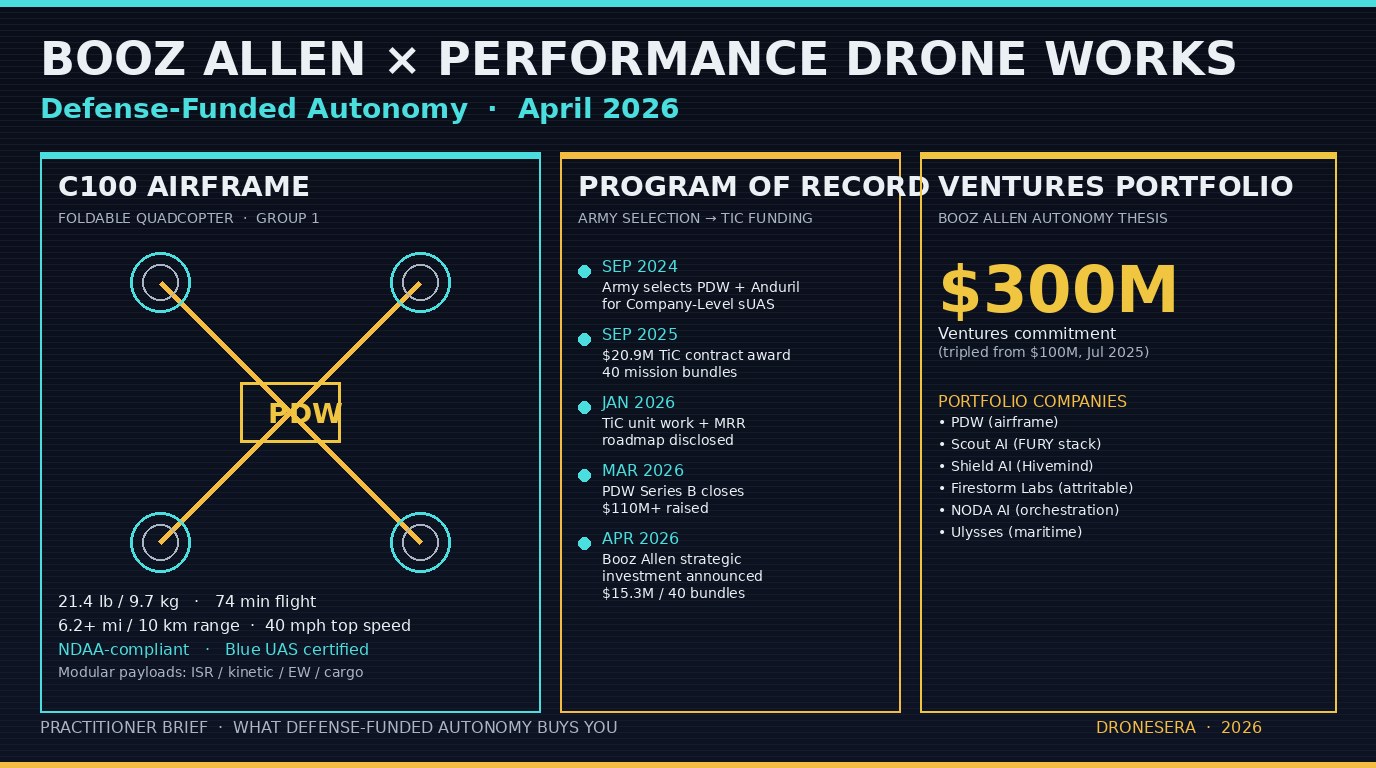
On April 30, 2026, Booz Allen Hamilton announced a strategic investment in Performance Drone Works, the Huntsville, Alabama maker of the C100 quadcopter that the U.S. Army selected for its Company-Level Small Uncrewed Aircraft System requirement in September 2024. Five weeks earlier, on March 25, PDW had closed a Series B financing round totaling more than $110 million, with Booz Allen participating alongside other investors. The deal is the clearest signal yet that the consulting giant’s $300 million Booz Allen Ventures commitment — tripled in July 2025 from an initial $100 million — is being deployed against a single strategic thesis: domestically produced autonomous drone systems, integrated end-to-end, are now the highest-leverage investment frontier in the U.S. defense market.
The investment matters beyond PDW’s balance sheet. Booz Allen’s federal contracting footprint, program-management bench, and customer relationships across the Department of War mean that an aligned autonomy vendor gets pulled into programs of record in ways a pure venture-backed startup cannot replicate. For practitioners — especially those evaluating tactical small UAS for federal, state, or DOD-adjacent work — this is the moment to pay attention to the C100 platform as a viable, in-pipeline competitor to Anduril Ghost-X, Skydio X10, and the Teal Drones Black Widow.
The 30-second version: what Booz Allen bought, and what it isn’t
Headline: Booz Allen made a strategic equity investment in PDW in late April 2026. The dollar figure is undisclosed. PDW separately raised $110M+ in Series B equity in March 2026, and Booz Allen was a participant. The C100 — PDW’s flagship airframe — has been fielded under the Army’s Company-Level Small UAS Directed Requirement since 2024 and is currently funded under the Transformation in Contact (TiC) initiative. (See: drone industry coverage.)
What this isn’t: this isn’t a Booz Allen acquisition. PDW remains an independent operating company. It isn’t a one-off check, either. PDW joins Scout AI, Shield AI, Firestorm Labs, NODA AI, and Ulysses on the Booz Allen Ventures autonomy portfolio — a deliberate cluster around the autonomy stack rather than individual airframes. The PDW investment is the airframe leg of a portfolio thesis that says the value migrates from aircraft hardware to the software-and-integration layer above it.
Why Booz Allen Ventures wrote the check: the strategic logic
Booz Allen Ventures announced its initial $100 million venture commitment in 2022, then tripled it to $300 million in July 2025, explicitly to back companies building dual-use defense and national-security technology. By Q4 fiscal 2026, management was framing the portfolio as a key growth driver for the FY27 national-security book of business. (See: commercial drone pilots actually earn.)
The strategic logic is straightforward: Booz Allen’s federal contracting revenue depends on winning prime contracts for the Department of War, intelligence community, and federal civilian agencies. When those contracts increasingly require an autonomous-systems integration layer, Booz Allen needs vendors that are already aligned with its capture and program-management processes. Pure venture-backed startups, no matter how good their autonomy stack, take 18-24 months to onboard into a DoD program of record. Portfolio companies with shared infrastructure can compress that to months.
The portfolio also forms a defensible moat: PDW makes the airframe; Scout AI builds the FURY mission-adaptive autonomy stack; Shield AI contributes the Hivemind enterprise platform for swarming operations; Firestorm Labs supplies 3D-printed attritable airframes; NODA AI provides multi-system orchestration. Together, Booz Allen can now bid on full-stack autonomous-systems programs as a systems integrator rather than as a services contractor subbing out the airframe work. That’s the deal — a portfolio that becomes a bid.
What PDW actually makes: the C100 platform, end to end
The PDW C100 is a foldable, man-packable quadcopter designed for the squad-and-company echelon. Per the manufacturer’s product page and the Army’s 2024 selection announcement, the published specifications are: (See: commercial drone insurance.)
- Weight: 21.4 lb (9.7 kg) airframe, man-packable in a standard ruck
- Flight time: up to 74 minutes
- Range: 6.2+ miles (10 km) line-of-sight
- Top speed: 40 mph
- Edge compute: on-board processing for autonomous navigation, obstacle avoidance, and target tracking
- Payload integration: modular — ISR, kinetic effects, electronic warfare, cargo transport
- Compliance: NDAA-compliant, Blue UAS-certified
Forbes’ David Hambling framed the C100 as “scout, bomber, carrier, logistics” — a multi-mission platform rather than a single-purpose ISR drone. The modular payload architecture is the load-bearing feature: a unit can swap an EO/IR sensor for a warhead, a radio relay, or a small-package delivery module without re-certifying the airframe. That modularity is what made it attractive to the Army’s Transformation in Contact (TiC) initiative, which is explicitly buying reconfigurable systems rather than single-mission fleets.
On price: PDW CEO Ryan Gury said in January 2024 that the core C100 vehicle costs less than $50,000 per unit. Treat that as the airframe-only line item. The Army’s $20.9 million TiC contract announced in September 2025 and the $15.3 million award in April 2026 for 40 mission bundles cover full mission bundles — airframes, ground stations, payloads, training, and sustainment — not bare airframes. At $382K per bundle for the 40-bundle deal, the per-mission cost is materially higher than the per-airframe price; the difference is integration, support, and fielding.
The Army’s path of record: from Company-Level sUAS to TiC
The C100 entered the U.S. Army’s pipeline in September 2024 when, alongside Anduril Ghost-X, it was selected for the Company-Level Small Uncrewed Aircraft System Directed Requirement — a program designed to push small UAS capability down to the brigade combat team and below. Defense One’s coverage called it out as the Army’s commercially available drone pivot, directly informed by Ukraine: small-unit autonomy at scale, attritable airframes, no bespoke procurement cycle. (See: FAA Part 107 framework.)
From selection to funding, the path was short. By September 2025, PDW had won $20.9 million for C100 deliveries under TiC — the Army’s iterative field-testing initiative that funds units to experiment with new commercial technology in operational settings. By January 2026, Defense Daily reported on PDW’s work with TiC units and the Army’s potential move into MRR (Medium-Range Reconnaissance) later in the year — a program that would extend the C100’s mission profile up-echelon.
By April 2026, the Army awarded another $15.3 million contract to PDW for 40 additional mission bundles for modular small UAS ISR systems. The pattern is clear: a 2024 selection, a 2025 funding, a 2026 expansion. That’s the canonical program-of-record ramp, and the Booz Allen investment lands cleanly inside it. The bet is that TiC → MRR transitions become full-rate production buys over 2026-2028, and PDW has the in-pipeline airframe to capture that spend.
Inside the Replicator → DAWG pipeline: where the C100 sits
Booz Allen’s PDW investment doesn’t happen in a vacuum. It happens inside the Replicator initiative’s successor organization, the Defense Autonomous Warfare Group (DAWG). Replicator, launched in 2024, set a goal of fielding thousands of low-cost, attritable autonomous systems by August 2025. In December 2025, Breaking Defense reported that Replicator lived on as DAWG, now looking at bigger UASs — broader scope, higher dollar value, less attritable framing. (See: BVLOS regulatory picture.)
By April 2026, DAWG was coordinating a $55 billion drone plan across the Pentagon, encompassing everything from Group 1 quadcopters to one-way attack drones. The C100 sits in the Group 1-2 layer — company-level reconnaissance, modular payloads, squad-organic autonomy. Its role in DAWG is the high-volume bottom of the portfolio: thousands of airframes, attritable-by-design, integrated with autonomy stacks above.
For Booz Allen, this is the leverage point. A prime contract under DAWG that requires airframe + autonomy + orchestration has three components. Booz Allen now has aligned vendors for all three: PDW (airframe), Scout AI and Shield AI (autonomy), NODA AI (orchestration). It can bid as a systems integrator. That’s a fundamentally different revenue profile than subbing out autonomy work to a non-portfolio vendor.
What defense-funded autonomy actually changes for procurement
The practitioner-side question: does Booz Allen’s investment in PDW change anything for an actual buyer of tactical small UAS? Yes, in three specific ways. (See: drone fleet management.)
First, procurement velocity. A Booz Allen-aligned PDW airframe is more likely to be pre-cleared on a multi-award IDIQ vehicle, an OASIS+ task order, or a DoD-specific procurement vehicle than an independent vendor’s product. For federal civilian agencies, state and local law enforcement, and prime contractors bidding on DoD work, the integration risk drops materially.
Second, autonomy stack compatibility. The C100’s edge compute is the integration point. With Scout AI’s FURY and Shield AI’s Hivemind in the Booz Allen portfolio, the C100 becomes a candidate airframe for autonomy stacks that would otherwise require a custom integration. For a buyer evaluating multi-vendor autonomy, the C100 is now a known-quantity option rather than a green-field integration project.
Third, sustainment and training. Booz Allen’s program-management bench means PDW can now offer tiered sustainment contracts — operator training, field-service representatives, depot-level maintenance — that a venture-backed vendor can’t resource on its own. That converts the C100 from an airframe purchase into a fielded capability, which is what most DoD buyers actually need.
What this isn’t: the limits of the Booz Allen–PDW bet
It’s worth being clear on what this deal does and doesn’t change. The C100 remains a Group 1 quadcopter. It doesn’t displace Group 2-3 fixed-wing platforms like the Insitu ScanEagle or the Quantix Recon. It doesn’t replace Group 4-5 tactical UAS like the MQ-1C Gray Eagle. It’s not a one-way attack drone in the Altius-600M class. (See: battery and endurance limits.)
The investment also doesn’t change the regulatory environment. The C100 still operates under the same Blue UAS certification, the same NDAA compliance posture, the same FAA Part 107 small UAS rules for domestic training and non-DoD operations. For state and local law enforcement buyers, the FAA waiver process for operations over people, BVLOS, and night remain the gating constraints — Booz Allen’s investment doesn’t move those.
And the dollar disclosure is genuinely thin. Booz Allen didn’t disclose the investment size. PDW’s Series B was over $110M but Booz Allen’s specific check size isn’t public. Treating this as a giant strategic acquisition would be overreach. It’s a meaningful alignment signal — a portfolio positioning move — not a transformational capital event for either party.
What it is, finally, is a vote of confidence from one of the most sophisticated federal-contracting primes in the U.S. that domestically produced autonomous drone systems are now a defensible, programmatic, portfolio-worthy investment thesis. For everyone else evaluating this market — vendors, primes, federal buyers — that’s the signal worth tracking.
FAQ
Is the PDW C100 a military drone or a commercial drone?
Both. The C100 is a domestically produced, NDAA-compliant, Blue UAS-certified quadcopter. It was selected for the Army’s Company-Level Small UAS Directed Requirement in September 2024 as a commercial-off-the-shelf platform, then funded under the Transformation in Contact initiative for operational testing. The same airframe sells commercially to federal, state, and law enforcement customers.
How much did Booz Allen actually invest in PDW?
Booz Allen announced a strategic investment in PDW on April 30, 2026. The dollar figure has not been publicly disclosed. PDW’s separate Series B financing round, which closed March 25, 2026, raised over $110 million total across all investors — Booz Allen was a participant. For the strategic-investment portion specifically, treat it as undisclosed but material enough to qualify as a balance-sheet commitment rather than a venture-portfolio token.
What is the Replicator initiative, and what is DAWG?
Replicator was a 2024 Pentagon program to field thousands of low-cost, attritable autonomous systems by August 2025. In December 2025 it was reorganized under the Defense Autonomous Warfare Group (DAWG), which now coordinates a broader drone portfolio including larger one-way attack UAS. The C100 sits inside this pipeline as a Company-Level reconnaissance and tactical-effects platform.
How much does a C100 cost?
PDW CEO Ryan Gury stated in January 2024 that the core C100 vehicle costs less than $50,000 per unit. The Army’s contract awards ($15.3M for 40 mission bundles in April 2026; $20.9M in September 2025) cover full mission bundles — airframes, ground stations, payloads, training, and sustainment — not just airframes. Treat the $50K figure as the lower bound on the airframe-only line item.
What does Booz Allen actually contribute — money, integration, or both?
Both. As a Booz Allen Ventures portfolio company, PDW gets access to Booz Allen’s federal contracting infrastructure, program-management depth, and customer relationships across the DoD. As an investor, Booz Allen gets financial exposure to PDW’s growth and a privileged integration channel for its autonomy stack (Scout AI FURY, Shield AI Hivemind) with a proven tactical UAS airframe. The deal converts PDW from a hardware vendor into a Booz Allen–aligned autonomous-systems integrator.
Sources
- PDW — Series B financing announcement (March 25, 2026)
- Booz Allen Hamilton — strategic investment announcement (April 30, 2026)
- Booz Allen Ventures — portfolio listing
- PDW — C100 Defense product page
- U.S. Army — Company-Level sUAS Directed Requirement selection (September 2024)
- Defense Daily — $20.9M TiC contract award (Matthew Beinart, September 2025)
- Military Aerospace — $15.3M contract for 40 mission bundles (Jamie Whitney, April 2026)
- Defense Daily — TiC work details and MRR roadmap (Matthew Beinart, January 2026)
- Breaking Defense — $55B drone plan under DAWG (Ashley Roque, April 2026)
- Breaking Defense — Replicator → DAWG transition (Sydney Freedberg, December 2025)
- Congressional Research Service — DOD Replicator Initiative background
- GovCon Wire — Booz Allen FY2026 financial analysis (Kristen Smith, May 2026)
- Booz Allen — Scout AI investment
- BusinessWire — Booz Allen triples Ventures commitment to $300M (July 2025)