
FAA Part 107 Night Drone Waiver: 2026 Operator’s Guide to §107.29, §44807, and DroneZone
If you fly Part 107 commercial work after sunset — thermal-imaging inspections, public-safety callouts, search-and-rescue, real-estate twilight shoots, infrastructure patrols — the 2021 §107.29 amendment changed the rules so that most night operations no longer need a waiver. You just need the right training and anti-collision lighting. But a non-trivial set of night-flying cases still does require an FAA waiver, and the paperwork goes through a portal most operators have never touched. This post walks through what §107.29 actually changed, when a Part 107 waiver is still required, the §44807 exemption pathway as an alternative, the DroneZone application mechanics, and the cost-and-timeline shape of the waiver process in 2026.
We have already covered the broad strokes of night-flying legality in our night drone operations guide and the practical equipment side in the practical guide to legal night operations. This post is the missing third rail: the waiver and exemption paperwork, when you need it, and how to actually file it. For the broader Part 107 framework — currency, remote pilot certification, the recurrent training requirement — the FAA TRUST Certificate 2026 walkthrough and the complete Part 107 guide for 2026 are the canonical primer.
What the 2021 §107.29 final rule actually changed
Before April 6, 2021, operating a small unmanned aircraft at night under Part 107 required an FAA waiver issued under §107.200. The process took months, the approval rate was uneven, and the resulting certificates of waiver typically limited operations to specific aircraft, dates, and lighting configurations. That regime ended with the Operations Over People (OOP) final rule published at 86 FR 4382 on January 15, 2021, with the night-operations provisions becoming effective April 6, 2021 for training and May 17, 2021 for the cutover of pre-existing waivers (14 CFR §107.29, Cornell LII mirror).
Under the current rule, a remote pilot in command may operate a small unmanned aircraft system at night without a waiver, provided two conditions are both met (14 CFR §107.29(a)):
- The remote pilot in command has completed an initial knowledge test or recurrent training under §107.65 after April 6, 2021. Pilots who took the Part 107 initial knowledge exam before that date need to complete the free online recurrent training before flying at night without a waiver.
- The aircraft has lighted anti-collision lighting visible for at least 3 statute miles, with a flash rate sufficient to avoid a collision. The remote PIC may reduce the intensity of the lighting when operating conditions warrant, but may not extinguish it.
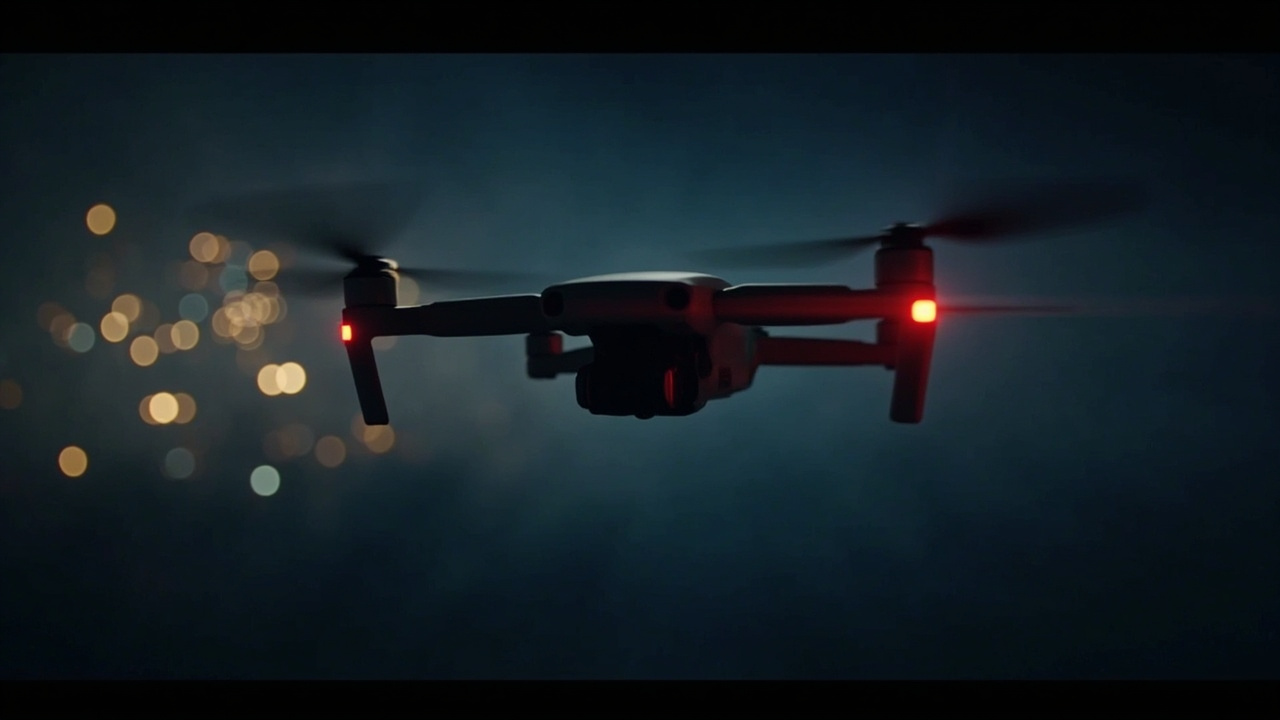
That 3-statute-mile visibility figure is the load-bearing technical number in the rule. It is also the part that catches most first-time night operators off guard, because it does not match the practical visible range of many built-in drone status lights. A DJI Mavic 3, for example, has downward and rear-facing status LEDs that are visible to the pilot within tens of feet, not 3 statute miles (5,280 yards). To meet §107.29(a)(2), you need a third-party strobe or LED anti-collision light rated for at least 3 sm of visibility, mounted on the aircraft, switched on for the duration of night flight. Manufacturers that publish 3 sm-compliant strobe specs include the Lume Cube Strobe (FAA-compliant per the manufacturer’s documentation), the Firehouse Technology ARC-1, and the FoxFury Rugo. Verify the manufacturer’s actual FAA-compliance claim against the rule text — not all “drone strobe” products meet the 3 sm threshold.
The second major change was the simultaneous sunset of all pre-April 21, 2021 night waivers. Under §107.29(d), certificates of waiver issued before April 21, 2021 that authorized deviation from §107.29 terminate on May 17, 2021 (14 CFR §107.29(d), FAR/AIM mirror). The FAA confirmed this in plain language on its Part 107 waivers landing page: “The FAA published a new rule on January 15, 2021 that amended part 107. The rule modifies part 107 to permit routine operations of small unmanned aircraft (UAS) at night. As a result, on May 17, 2021 all night waivers are cancelled in accordance with 14 CFR §107.29(d) and all night operations must comply with the updated regulation.” If you are still carrying a pre-2021 night waiver in your documentation, it is operationally void.
Civil twilight: the 30-minute window that trips up the most operators
Section 107.29(b) extends the same lighting requirement to “periods of civil twilight.” The FAA’s definition is technical and not what most people assume civil twilight means (14 CFR §107.29(c)):
- **Except for Alaska**, civil twilight begins 30 minutes before official sunrise and ends at official sunrise, OR begins at official sunset and ends 30 minutes after official sunset.
- **In Alaska**, civil twilight is defined per the Air Almanac, because the state’s high-latitude summer days produce 18+ hour civil twilight periods that the 30-minute rule does not capture.
The reference times for sunrise and sunset are the official NOAA-published tables for the operator’s location on the day of flight, not the local newspaper’s sunrise/sunset. The difference is usually small but matters on the boundary cases. Pilots operating near the official sunset / civil twilight boundary should use an almanac app that updates against the official NOAA tables — the popular ones for Part 107 work are Skyward, UAV Forecast, and B4UFLY. Our how to read drone weather forecasts practical guide walkthrough covers the broader weather-windowing side.
The civil twilight rule exists because the original Part 107 night waiver regime had a visible-by-the-pilot requirement that the FAA found operationally unworkable. The 2021 final rule traded that for the lighting-visible-for-3-statute-miles requirement across both full night and civil twilight, on the theory that manned aircraft pilots need to see your drone at all times when ambient light is below the threshold for unaided visual detection of small UAS.
When you still need a Part 107 operational waiver for night work
The waiver regime did not go away entirely. Section 107.205 lists the operating rules that can be waived, and §107.29(a)(2) and (b) are both on that list — meaning the anti-collision lighting requirement is itself waiverable under specific conditions (14 CFR §107.205, Cornell LII mirror). A waiver is required when the proposed operation cannot meet the baseline §107.29 conditions, even with the 2021 changes. The canonical cases:
- **Aircraft without built-in or attachable 3 sm lighting.** Older or custom-built UAS where the operator cannot equip the aircraft to meet the 3 sm visibility threshold. A waiver in this case typically requires a documented equivalent safety case — e.g., ground-based observers with high-intensity searchlights, or operations restricted to a confined area where manned aircraft are excluded.
- **Operations where the strobe light would create a hazard.** Some inspection work (e.g., near high-voltage energized equipment, in proximity to flammable gas clouds, or during sensitive wildlife surveys) creates conditions where a strobe could itself become a safety hazard. The FAA has granted waivers in these cases with documented mitigation.
- **Combined waivers for night + BVLOS + operations over people.** A single Part 107 waiver can cover multiple deviations. Many real-world operations — a long-line infrastructure patrol at night over a remote corridor, for example — combine night operations with beyond visual line of sight, operations over people (e.g., road workers), and operations in Class B/C/D airspace. Each individual deviation is on the §107.205 list, and they are commonly combined into a single waiver application. The intersection with our [BVLOS drone operations 2026 commercial future](/bvlos-drone-operations-2026-the-future-of-commercial-drones/) and [the Part 108 BVLOS rule](/bvlos-drone-regulations-2026-faa-part-108-waivers/) is where the modern combined-waiver conversation actually lives.
The FAA’s public list of issued Part 107 waivers confirms which sections are actively being waived as of 2026. A scan of recent issuances shows active waivers predominantly cite §107.51 (operating limitations, including altitude and visibility), §107.39 (operations over people), §107.31 (visual line of sight), §107.33 (visual observer), and §107.145 (operations over moving vehicles). §107.29-specific waivers are rare in the current dataset because the 2021 baseline regime covers most night operations — the waivers that do cite §107.29 are typically combined-waiver applications.
The §44807 exemption pathway: the alternative for delivery, BVLOS, and non-standard UAS
For night operations that fall outside Part 107 entirely — typically because the aircraft exceeds the 55-pound Part 107 weight limit, or because the operation involves large-scale BVLOS package delivery — the 49 USC §44807 exemption pathway is the alternative to a Part 107 waiver. Section 44807 authorizes the Secretary of Transportation to determine that certain UAS operations do not create a hazard to users of the national airspace system, and to issue exemptions from operating rules accordingly. Operationally, the FAA has used §44807 to enable package delivery BVLOS operations, extended visual line of sight, and shielded operations within 100 feet of the ground or a structure.
The §44807 pathway is heavier than a Part 107 waiver. It requires a formal petition, an airspace analysis, and a public comment period before the FAA grants an exemption. The recent §44807 grants of note include Amazon Prime Air, Wing (Alphabet), Zipline, and Matternet for medical logistics — all of which operate night and day under §44807 exemption rather than Part 107. For a delivery-side deep dive, see our drone delivery 2026 networks map and the drone delivery in healthcare ROI analysis. For most working Part 107 pilots, §44807 is the wrong tool for night-only operations; it is the right tool when you are operating an aircraft above the Part 107 weight threshold or conducting BVLOS at a scale that Part 107 waivers do not support.
For Part 107 pilots who occasionally need a non-standard night operation — a single project, a custom aircraft, a confined job — the Part 107 waiver remains the right route. For fleets building a recurring night operation at scale, the §44807 exemption is the right strategic destination.
The DroneZone waiver application: step-by-step
All Part 107 waivers are filed through the FAA DroneZone portal, not by paper mail and not via the older FAADroneZone login that some operators still have in their bookmarks. The portal is at the FAA DroneZone UAS portal (faadronezone.faa.gov); the FAA’s Part 107 waivers landing page is the entry point for new applications. The application flow:
- **Create a DroneZone account** or sign in to an existing one. The account must be tied to the operator’s Part 107 remote pilot certificate number.
- **Select “Part 107 Operational Waiver Application”** from the application menu. The form is FAA Form 8710-7 in the digital backend but the public-facing application is on the DroneZone portal.
- **Specify the section(s) of Part 107 you are requesting waiver from.** The application accepts multiple §107.205-listable sections in a single submission. Be precise: the FAA reviews each requested deviation independently and may grant part of the application while denying the rest.
- **Describe the proposed operation in operational terms.** The application requires the aircraft make/model, the operating area, the times of operation, the proposed mitigations for the waived rules, and the equivalent level of safety argument. This is the section where the application lives or dies — the FAA reviews for specific operational mitigations, not general assertions.
- **Attach supporting documentation.** For night waivers specifically, this typically includes the aircraft lighting configuration (with photos), the proposed operating volume, the airspace class and any LAANC authorization status, and the pilot qualifications (currency, recurrent training, night-flight hours).
- **Submit and pay the application fee.** The fee is set per the FAA’s Part 107 fee schedule and updated annually; the current fee is in the low three figures. The application is routed to the FAA UAS Integration Office for review.
The review timeline in 2026 runs roughly 60 to 120 days for a clean single-section application, longer for combined waivers or for operations in complex airspace. The FAA publishes issued waivers to the public list, which is searchable by company name, responsible person, or waivered regulation. If your waiver is approved, it will appear on that list within a few days of the approval date.
Combined waivers: night + BVLOS + OOP in 2026
The most operationally valuable waiver type in 2026 is the combined waiver — a single application covering the §107.205-listable sections that a complex night operation needs simultaneously. The canonical case is a long-line powerline or pipeline inspection at night, which may need waivers for §107.29 (custom lighting configuration), §107.31 (VLOS), §107.39 (operations over people, e.g., highway crews), and §107.145 (operations over moving vehicles, e.g., active road traffic). Each is individually waiverable; combined, they describe a single operational profile.
For combined waivers, the application requires an integrated equivalent level of safety argument — not four parallel arguments for four separate sections. The FAA wants to see how the proposed operation as a whole mitigates the deviations, including the interaction effects (e.g., night lighting that supports both §107.29 anti-collision visibility AND the BVLOS detect-and-avoid capability that supports §107.31). Combined waivers take longer to review (90 to 180 days common) but produce a single certificate that covers the operational envelope, which is easier to extend and amend than four parallel waivers. Operators building inspection or corridor-survey pipelines will also want to factor in drone fleet management software scaling — the BVLOS + night waiver is the regulatory half; the operational half is the dispatch, battery, and pilot-rotation system behind it.
For BVLOS at scale — the kind of operation that Part 108 will eventually cover — the §107.205 waiver pathway is being supplanted by Part 108 itself. The Part 108 NPRM, published separately, sets up a regularized BVLOS rule with operational categories rather than a per-application waiver. For 2026 operations, the practical reality is that Part 108 is not yet final, so the §107.205 waiver remains the only path for BVLOS at any operational scale, and a combined night+BVLOS waiver is the standard approach for corridor-survey and long-line inspection work.
Cost, timeline, and denial patterns
The application fee for a Part 107 waiver is published in the FAA’s fee schedule and runs in the low three figures. For operators planning their first waiver, the realistic 2026 budget should account for:
- **Application fee**: published FAA schedule, low three figures USD.
- **Operational preparation time**: 20 to 40 hours of internal work on the equivalent level of safety argument, lighting configuration documentation, and airspace analysis.
- **Review time**: 60 to 180 days depending on the complexity and the workload of the UAS Integration Office.
- **Re-submission cycles**: most first-time waiver applications are returned at least once with a request for additional information. Plan for two cycles.
The historical denial patterns from the pre-2021 waiver era — and from 2022-2024 combined-waiver applications — cluster around a few recurring issues:
- **Insufficient equivalent level of safety argument.** The most common denial reason. The FAA wants operationally specific mitigations, not generic assertions of pilot skill or equipment quality.
- **Inadequate airspace analysis.** Particularly for operations in or near Class B/C/D airspace, the application must demonstrate that the proposed operation does not interfere with manned aircraft traffic.
- **Aircraft or lighting configuration not documented to spec.** Photos, spec sheets, and FAA-compliance claims for anti-collision lights must be in the application package. A claim that “the aircraft has anti-collision lighting” without documentation is grounds for return.
- **Public interest concerns.** Operations over large gatherings, near critical infrastructure, or in environmentally sensitive areas may trigger a public comment period and additional FAA review. The cinematic side of night operations — large drone light shows, coordinated multi-aircraft film shoots — is one of the more common waiver-requiring cases; see our [drone light show vs fireworks 2026 cost analysis](/drone-show-vs-fireworks-2026/) and the [drone cinematography Emmy-winning techniques](/drone-cinematography-emmy-winning-techniques/) for the production side, both of which historically rely on §107.51 altitude waivers to operate close to manned traffic or in restricted airspace.
For operators willing to invest the preparation time, the published issued waivers list is the best calibration dataset — the issued waivers describe what the FAA has actually approved, and the format of the approval (sections waived, duration, mitigations) gives applicants a template for their own applications.
Field checklist for the operator going out tonight
For a Part 107 remote pilot planning a routine night operation in 2026, the pre-flight checklist:
- **Remote pilot currency**: confirm you completed the recurrent training under §107.65 after April 6, 2021 (and that your last recurrent training is within the 24-month window).
- **Aircraft lighting**: confirm the anti-collision light is rated for at least 3 statute miles visibility, mounted on the aircraft, powered on, and tested before takeoff. Carry a backup battery for the strobe.
- **Sunset / civil twilight timing**: look up the official sunrise/sunset times for the operating location on the day of flight. Note the civil twilight window — 30 minutes before sunrise and 30 minutes after sunset — and plan the operation around it.
- **Airspace authorization**: confirm any LAANC or other airspace authorization is current for the operating volume, and that the airspace class supports night operations (most do, but check).
- **Visual line of sight**: confirm the operating volume is visible from your ground station, with a clear sight line maintained throughout the operation.
- **Pre-2021 waiver check**: confirm you are not relying on a pre-April 21, 2021 night waiver. Any such waiver terminated May 17, 2021 per §107.29(d).
For non-routine operations — the cases that need an actual waiver — the checklist starts earlier, with the waiver application and the DroneZone submission, and the field operation follows only after the waiver is in hand.
FAQ
Do I need a Part 107 waiver to fly at night? Not for routine operations. Since April 6, 2021, a remote pilot in command with recurrent training after that date may operate a small unmanned aircraft at night under Part 107, provided the aircraft has anti-collision lighting visible for at least 3 statute miles per §107.29(a)(2). A waiver is required when the proposed operation cannot meet the baseline conditions — typically because of an unusual lighting configuration, a combined BVLOS + night operation, or an aircraft that cannot be equipped to meet the 3 sm threshold.
What is the difference between a Part 107 waiver and a §44807 exemption? A Part 107 waiver under §107.205 authorizes deviation from a specific Part 107 operating rule for a defined operation. A §44807 exemption is granted under 49 USC §44807 and authorizes broader UAS operations that the Secretary of Transportation has determined do not create a hazard to the national airspace — typically large-scale BVLOS, package delivery, or non-standard aircraft above the 55-pound Part 107 limit. For night-only Part 107 operations, a §107.205 waiver is the right route. For BVLOS package delivery or non-Part-107 aircraft, §44807 is the strategic destination.
Where do I file a Part 107 waiver? Through the FAA DroneZone UAS portal at faadronezone.faa.gov. The application is filed as a Part 107 Operational Waiver Application and routed to the FAA UAS Integration Office for review.
How long does a Part 107 waiver take to be approved? Clean single-section waivers typically take 60 to 120 days in 2026. Combined waivers (night + BVLOS + OOP, for example) commonly take 90 to 180 days. Most first-time applications are returned at least once with a request for additional information, which adds 30 to 60 days to the timeline.
What counts as anti-collision lighting visible for 3 statute miles? The rule (§107.29(a)(2)) requires lighted anti-collision lighting visible for at least 3 statute miles with a flash rate sufficient to avoid a collision. The FAA does not maintain a list of approved lights; operators are responsible for verifying that their chosen light meets the threshold per the manufacturer’s specifications. Built-in drone status LEDs typically do not meet the 3 sm threshold; a third-party strobe rated for the visibility distance is the standard solution.
Does my pre-2021 night waiver still apply? No. Per §107.29(d), all certificates of waiver issued before April 21, 2021 that authorized deviation from §107.29 terminate on May 17, 2021. Pre-2021 night waivers are operationally void.
Can I fly at night under Part 107 without a waiver if my drone doesn’t have built-in 3 sm lighting? Only if you attach a third-party anti-collision light that you have verified meets the 3 sm visibility threshold per the manufacturer’s spec sheet. The FAA does not pre-approve specific light products; the operator carries the documentation burden.
Is the FAA DroneZone the same as the FAADroneZone? Yes. The FAA DroneZone UAS portal is the current name for what was historically FAADroneZone. The URL is faadronezone.faa.gov and existing FAADroneZone accounts continue to work.
Conclusion
The 2021 §107.29 amendment closed the most common waiver pathway for night Part 107 operations: the routine post-sunset flight now happens under baseline Part 107 with training and a 3-statute-mile strobe, no FAA waiver required. What remains is the long tail of cases that need an actual certificate of waiver — combined BVLOS + night operations, custom lighting configurations, operations over people at night, and the rare non-standard aircraft — plus the strategic §44807 pathway for BVLOS at scale. For most operators, the practical next step is the DroneZone account setup and a survey of the issued waivers list to calibrate the equivalent level of safety argument before filing. For fleets operating BVLOS at scale, the long-term destination is Part 108, not the Part 107 waiver pipeline.
The field reality is that the paperwork path is well-trodden: the FAA UAS Integration Office has processed hundreds of Part 107 waivers and dozens of §44807 exemptions, and the issued-waivers list is the best public source of what an approvable application looks like. The cost is the application fee plus the preparation time, the timeline is months not weeks, and the most common failure mode is an insufficient equivalent level of safety argument. Build the operational case in operational language, attach the documentation, and file. For broader operating-budget context as you scale a night-and-BVLOS commercial practice, our Part 107 business costs 2026 operating budget breakdown covers the staffing, software, and insurance line items that pair with a waiver-driven operation.
Sources
- [14 CFR §107.29 — Operation at night (Cornell LII mirror of eCFR)](https://www.law.cornell.edu/cfr/text/14/107.29)
- [14 CFR §107.205 — list of Part 107 sections eligible for waiver (Cornell LII)](https://www.law.cornell.edu/cfr/text/14/107.205)
- [14 CFR §107.25 — Operation from a moving vehicle or aircraft (Cornell LII)](https://www.law.cornell.edu/cfr/text/14/107.25)
- [14 CFR §107.39 — Operation over human beings (Cornell LII)](https://www.law.cornell.edu/cfr/text/14/107.39)
- [14 CFR §107.29 — Operation at night (FAR/AIM mirror)](https://www.faraim.org/faa/far/cfr/title-14/part-107/section-107.29.html)
- [49 USC §44807 — Exception for limited recreational operations (Cornell LII)](https://www.law.cornell.edu/uscode/text/49/44807)
- [FAA Part 107 Waivers — official landing page](https://www.faa.gov/uas/commercial_operators/part_107_waivers)
- [FAA Part 107 Waivers Issued — searchable public database](https://www.faa.gov/uas/commercial_operators/part_107_waivers/waivers_issued)
- [FAA Remote Identification of Drones — official page](https://www.faa.gov/uas/getting_started/remote_id/)
- [FAA Advisory Circular AC 107-2A — Part 107 sUAS (PDF, 972 KB)](https://www.faa.gov/documentLibrary/media/Advisory_Circular/AC_107-2A_Editorial_Update.pdf)
- [Federal Register 86 FR 4382 — Operations Over People final rule (PDF)](https://www.govinfo.gov/content/pkg/FR-2021-01-15/pdf/2021-00831.pdf)
## Schema reference